
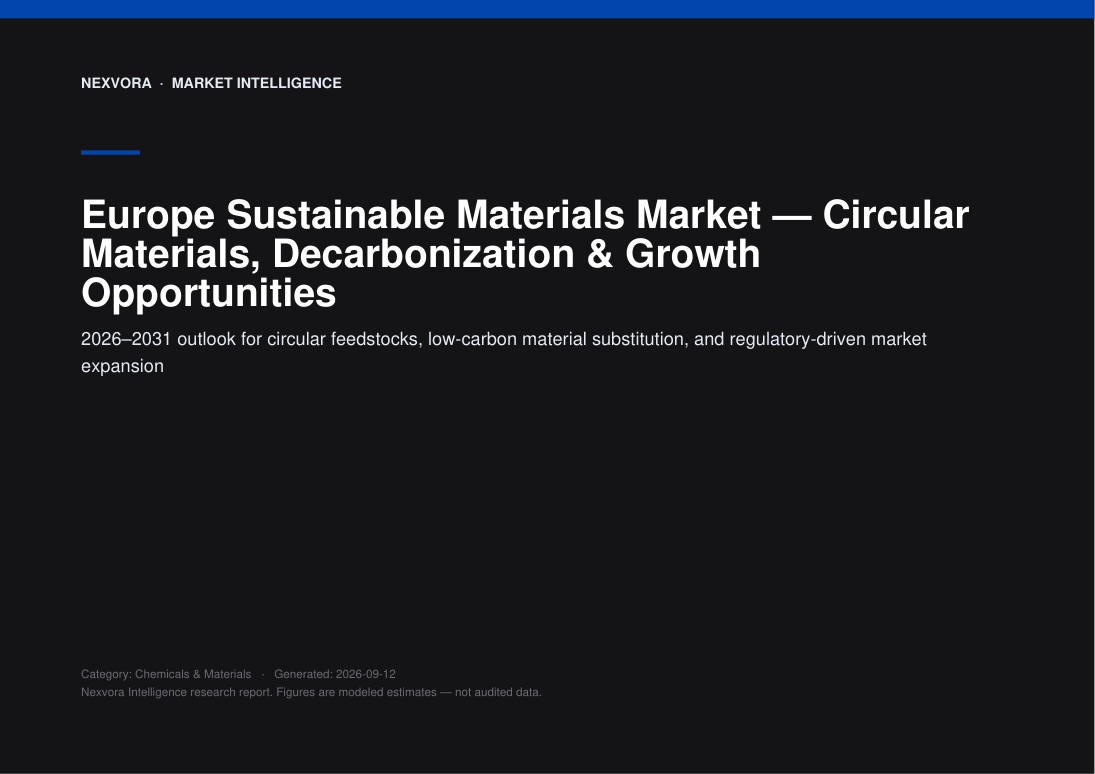
Europe Sustainable Materials Market — Circular Materials, Decarbonization & Growth Opportunities
2026–2031 outlook for circular feedstocks, low-carbon material substitution, and regulatory-driven market expansion
Nexvora Intelligence market report on Europe Sustainable Materials Market: Circular Materials, Decarbonization & Growth Opportunities, 2026–2031.
per extra user
Instant access after payment. Secure via Razorpay.
The opening view — free.
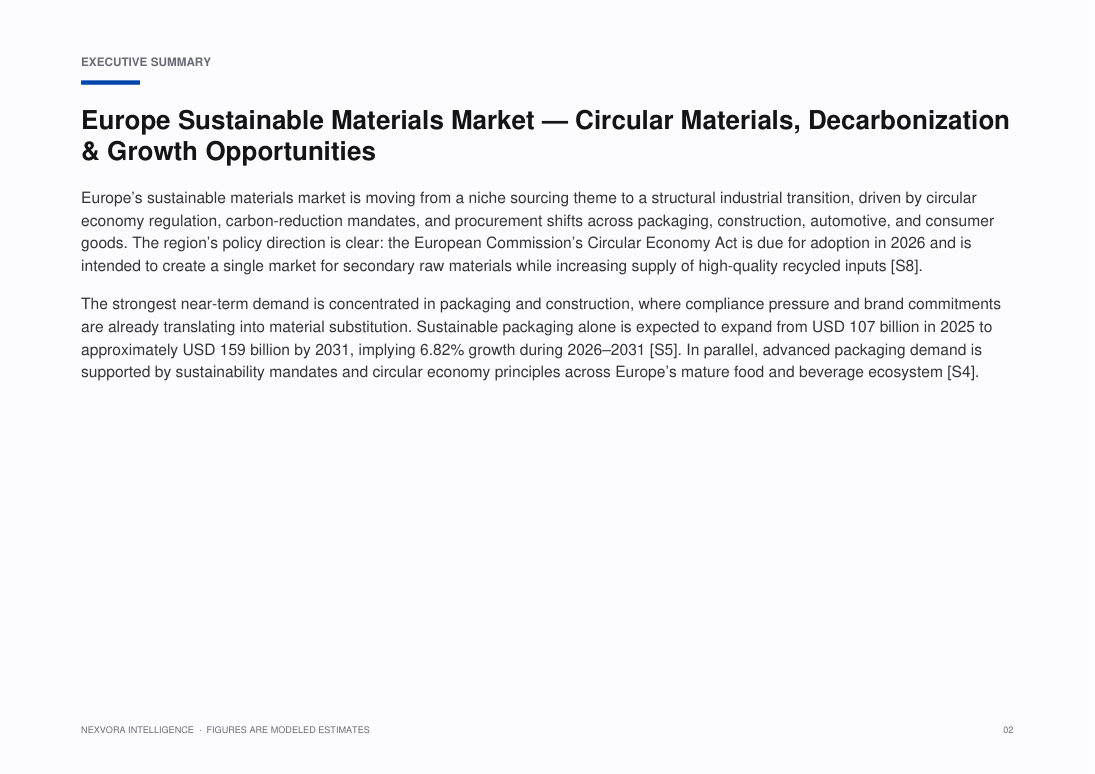
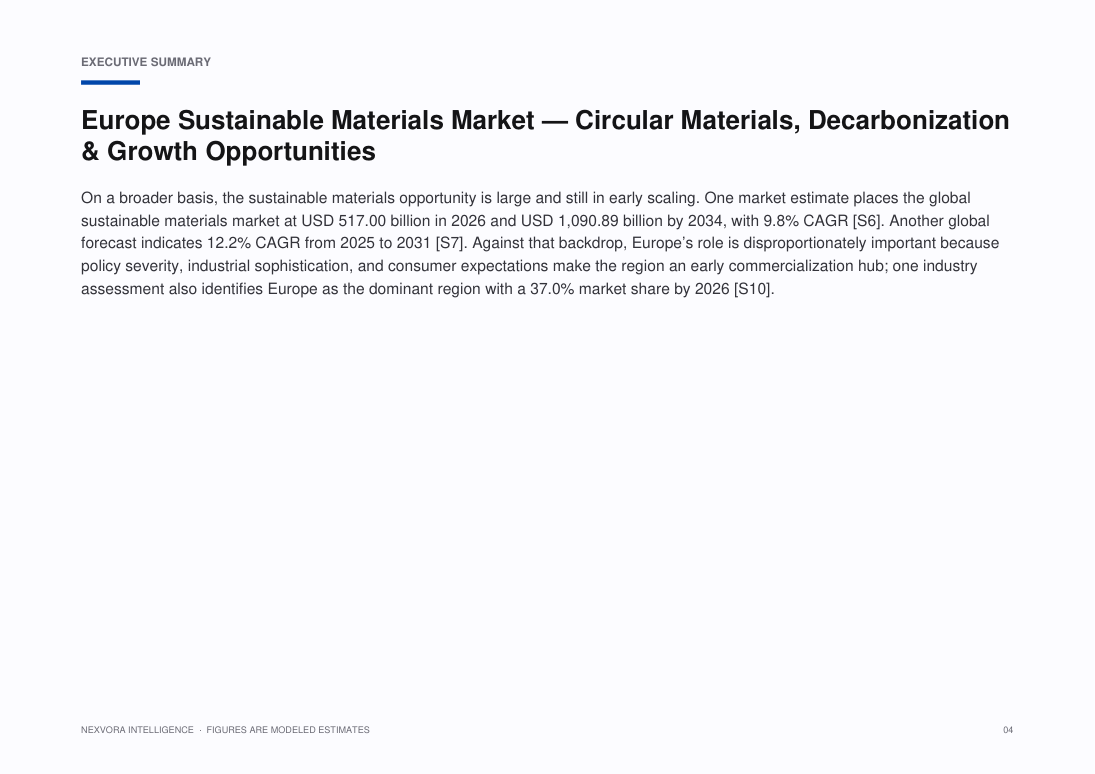
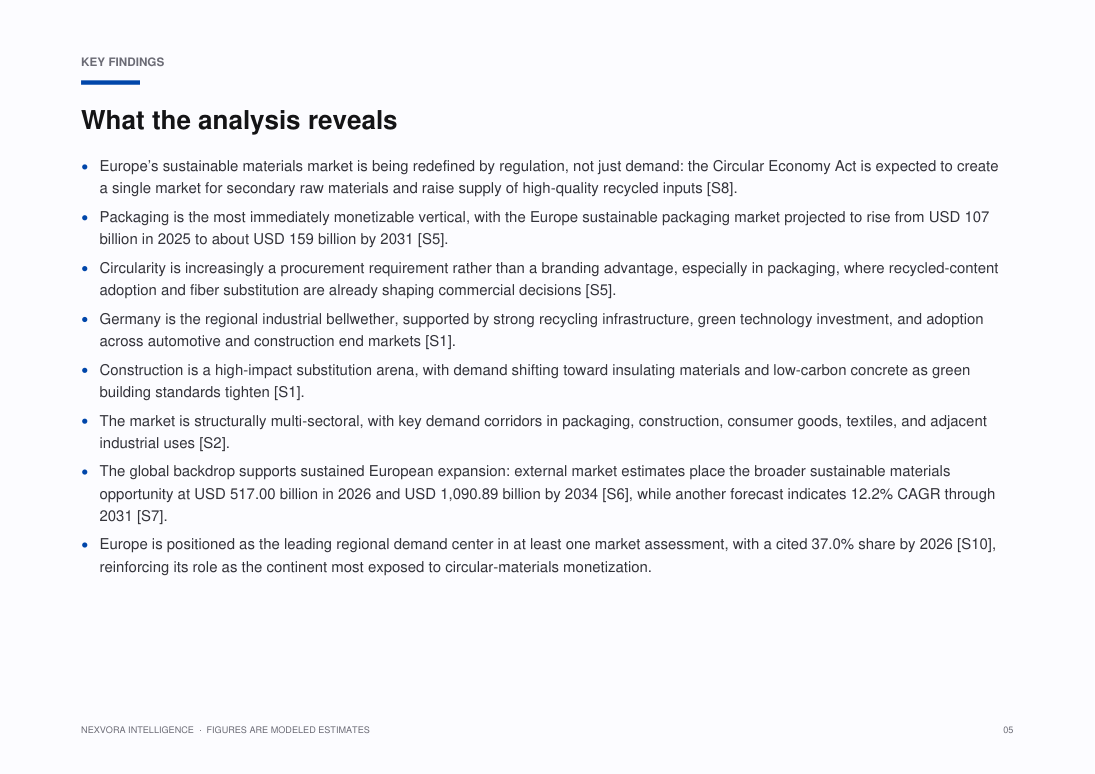
Europe’s sustainable materials market is moving from a niche sourcing theme to a structural industrial transition, driven by circular economy regulation, carbon-reduction mandates, and procurement shifts across packaging, construction, automotive, and consumer goods. The region’s policy direction is clear: the European Commission’s Circular Economy Act is due for adoption in 2026 and is intended to create a single market for secondary raw materials while increasing supply of high-quality recycled inputs [S8].
The strongest near-term demand is concentrated in packaging and construction, where compliance pressure and brand commitments are already translating into material substitution. Sustainable packaging alone is expected to expand from USD ••• billion in 2025 to approximately USD ••• billion by 2031, implying ••% growth during 2026–2031 [S5]. In parallel, advanced packaging demand is supported by sustainability mandates and circular economy principles across Europe’s mature food and beverage ecosystem [S4].
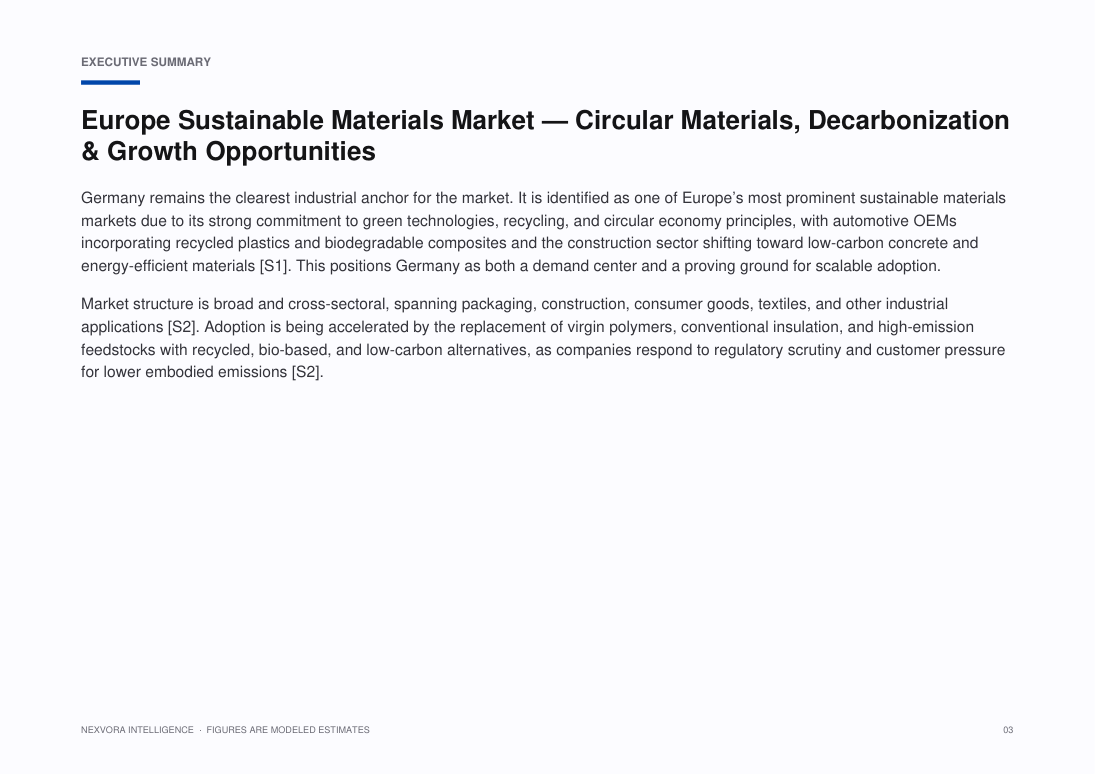
Germany remains the clearest industrial anchor for the market. It is identified as one of Europe’s most prominent sustainable materials markets due to its strong commitment to green technologies, recycling, and circular economy principles, with automotive OEMs incorporating recycled plastics and biodegradable composites and the construction sector shifting toward low-carbon concrete and energy-efficient materials [S1]. This positions Germany as both a demand center and a proving ground for scalable adoption.
Market structure is broad and cross-sectoral, spanning packaging, construction, consumer goods, textiles, and other industrial applications [S2]. Adoption is being accelerated by the replacement of virgin polymers, conventional insulation, and high-emission feedstocks with recycled, bio-based, and low-carbon alternatives, as companies respond to regulatory scrutiny and customer pressure for lower embodied emissions [S2].
Specific figures are hidden in this free preview. Unlock the report to see all modeled market sizes, forecasts and growth rates.
What this report covers.
2026–2031 outlook for circular feedstocks, low-carbon material substitution, and regulatory-driven market expansion
Who this report is for.
- Corporate strategy, planning and M&A teams evaluating the market
- Investors, private equity and venture teams sizing the opportunity
- Product, marketing and go-to-market leaders
- Consultants and analysts building the competitive picture
- Executives planning market entry, expansion or investment
How this report is built.
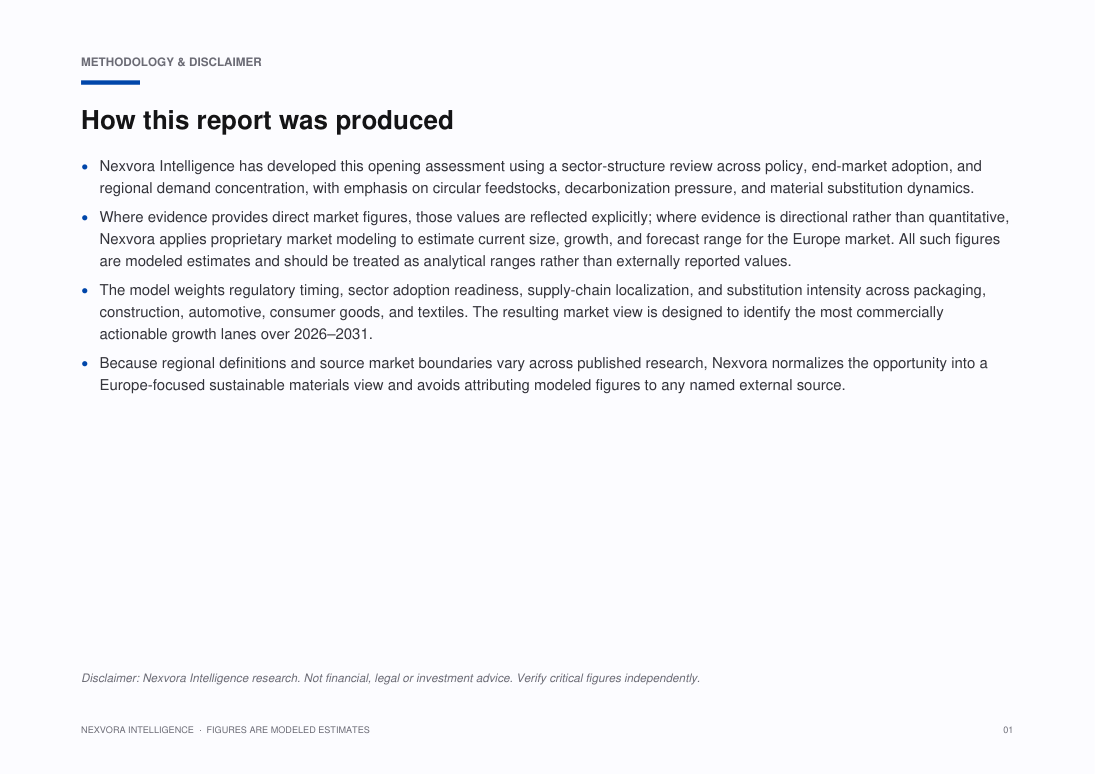
Nexvora Intelligence has developed this opening assessment using a sector-structure review across policy, end-market adoption, and regional demand concentration, with emphasis on circular feedstocks, decarbonization pressure, and material substitution dynamics.
Where evidence provides direct market figures, those values are reflected explicitly; where evidence is directional rather than quantitative, Nexvora applies proprietary market modeling to estimate current size, growth, and forecast range for the Europe market. All such figures are modeled estimates and should be treated as analytical ranges rather than externally reported values.
The model weights regulatory timing, sector adoption readiness, supply-chain localization, and substitution intensity across packaging, construction, automotive, consumer goods, and textiles. The resulting market view is designed to identify the most commercially actionable growth lanes over 2026–2031.
Because regional definitions and source market boundaries vary across published research, Nexvora normalizes the opportunity into a Europe-focused sustainable materials view and avoids attributing modeled figures to any named external source.
What's inside — a number-free look.
A full outline of the figures and tables you'll get. Specific data, market sizes and forecasts are unlocked with purchase.
List of Figures
- Figure 1: Market Overview and Structure — Europe Sustainable Materials — Circular Materials, Decarbonization & Growth Opportunities
- Figure 2: Market Size and Forecast Framework — Europe Sustainable Materials — Circular Materials, Decarbonization & Growth Opportunities
- Figure 3: Value Chain and Ecosystem Analysis — Europe Sustainable Materials — Circular Materials, Decarbonization & Growth Opportunities
- Figure 4: Market Dynamics — Drivers, Restraints and Opportunities — Europe Sustainable Materials — Circular Materials, Decarbonization & Growth Opportunities
- Figure 5: Segment Contribution Analysis — Europe Sustainable Materials — Circular Materials, Decarbonization & Growth Opportunities
- Figure 6: Regional Market Landscape — Europe Sustainable Materials — Circular Materials, Decarbonization & Growth Opportunities
- Figure 7: Country-level Opportunity Mapping — Europe Sustainable Materials — Circular Materials, Decarbonization & Growth Opportunities
- Figure 8: Competitive Positioning Matrix — Europe Sustainable Materials — Circular Materials, Decarbonization & Growth Opportunities
- Figure 9: Market Share of Leading Players — Europe Sustainable Materials — Circular Materials, Decarbonization & Growth Opportunities
- Figure 10: Adoption and Penetration Trends — Europe Sustainable Materials — Circular Materials, Decarbonization & Growth Opportunities
- Figure 11: Technology and Innovation Landscape — Europe Sustainable Materials — Circular Materials, Decarbonization & Growth Opportunities
- Figure 12: Pricing and Business Model Analysis — Europe Sustainable Materials — Circular Materials, Decarbonization & Growth Opportunities
- Figure 13: Investment, Funding and M&A Landscape — Europe Sustainable Materials — Circular Materials, Decarbonization & Growth Opportunities
- Figure 14: Regulatory and Policy Framework — Europe Sustainable Materials — Circular Materials, Decarbonization & Growth Opportunities
- Figure 15: Porter's Five Forces Analysis — Europe Sustainable Materials — Circular Materials, Decarbonization & Growth Opportunities
- Figure 16: PESTLE Analysis — Europe Sustainable Materials — Circular Materials, Decarbonization & Growth Opportunities
- Figure 17: Growth Opportunity Heat Map — Europe Sustainable Materials — Circular Materials, Decarbonization & Growth Opportunities
- Figure 18: Future Outlook and Strategic Roadmap — Europe Sustainable Materials — Circular Materials, Decarbonization & Growth Opportunities
List of Tables
- Table 1: Market Segmentation Overview — Europe Sustainable Materials — Circular Materials, Decarbonization & Growth Opportunities
- Table 2: Segment Definitions and Scope — Europe Sustainable Materials — Circular Materials, Decarbonization & Growth Opportunities
- Table 3: Regional and Country Coverage Summary — Europe Sustainable Materials — Circular Materials, Decarbonization & Growth Opportunities
- Table 4: Key Company Profiles and Offerings — Europe Sustainable Materials — Circular Materials, Decarbonization & Growth Opportunities
- Table 5: Competitive Benchmarking Matrix — Europe Sustainable Materials — Circular Materials, Decarbonization & Growth Opportunities
- Table 6: Product and Service Portfolio Mapping — Europe Sustainable Materials — Circular Materials, Decarbonization & Growth Opportunities
- Table 7: Market Drivers, Restraints and Trends — Europe Sustainable Materials — Circular Materials, Decarbonization & Growth Opportunities
- Table 8: Strategic Initiatives and Developments — Europe Sustainable Materials — Circular Materials, Decarbonization & Growth Opportunities
- Table 9: Partnerships and Collaborations — Europe Sustainable Materials — Circular Materials, Decarbonization & Growth Opportunities
- Table 10: Research Assumptions and Limitations — Europe Sustainable Materials — Circular Materials, Decarbonization & Growth Opportunities
- Table 11: Data Sources and References — Europe Sustainable Materials — Circular Materials, Decarbonization & Growth Opportunities
- Table 12: Report Scope and Coverage Summary — Europe Sustainable Materials — Circular Materials, Decarbonization & Growth Opportunities
A look at the pages.
108 pages · 20 sections · charts & tables
A genuine peek at the opening pages. Unlock to read every page in full.
6 of 108 pages shown
Turn this market into a plan for your business.
Answer a few quick questions and unlock a personalised operational read — your maturity score, prioritised focus areas and quick wins — mapped to where this market is heading. Result delivered instantly and emailed to you.
- Maturity score & prioritised focus areas
- Practical quick wins and a recommended next step
Questions, answered.
How big is the Europe Sustainable Materials Market?
Nexvora models the Europe Sustainable Materials Market at approximately USD 142 billion (modeled estimate). Full market sizing, segmentation and forecasts are inside the report (modeled estimate).
What is the growth rate (CAGR) of the Europe Sustainable Materials Market?
The Europe Sustainable Materials Market is projected to grow at a CAGR of about 8.1% (modeled estimate) over the forecast period — a Nexvora modeled estimate detailed across the report's 20 sections.
What does this report include?
A complete market intelligence report — market sizing and forecasts, segmentation, regional and industry analysis, competitive landscape, trends, and strategic recommendations across 20 sections.
How do I access it after purchase?
Instantly, in your secure online viewer. Reports are view-only and available on any device from your library.
Are the figures sourced?
Quantitative figures are Nexvora modeled estimates unless explicitly cited to a referenced source within the report.
Can I buy access for my team?
Yes — add user seats at checkout, or subscribe for bulk access across multiple reports.
Nexvora Intelligence research report. All quantitative figures are modeled estimates — not audited data. Not financial or investment advice.
More market reports
Keep exploring intelligence in this and related sectors.

Global Semiconductor Chemicals Market — Electronic Chemicals, Manufacturing Demand & Technology Outlook
Global Sustainable Chemicals Market — Green Chemistry, Circular Economy & Industry Transformation Intelligence Report

Global Humanoid Robotics Market — Industrial & Service Automation Intelligence Report
