
Australia Logistics & Warehousing Market — E-Commerce, Cold Chain, Distribution & Supply Chain Infrastructure
Strategic Market Intelligence and Modeled Outlook, 2026–2031
Nexvora Intelligence market report on Australia Logistics & Warehousing Market: E-Commerce, Cold Chain, Distribution & Supply Chain Infrastructure, 2026–2031.

per extra user
Instant access after payment. Secure via Razorpay.
The opening view — free.
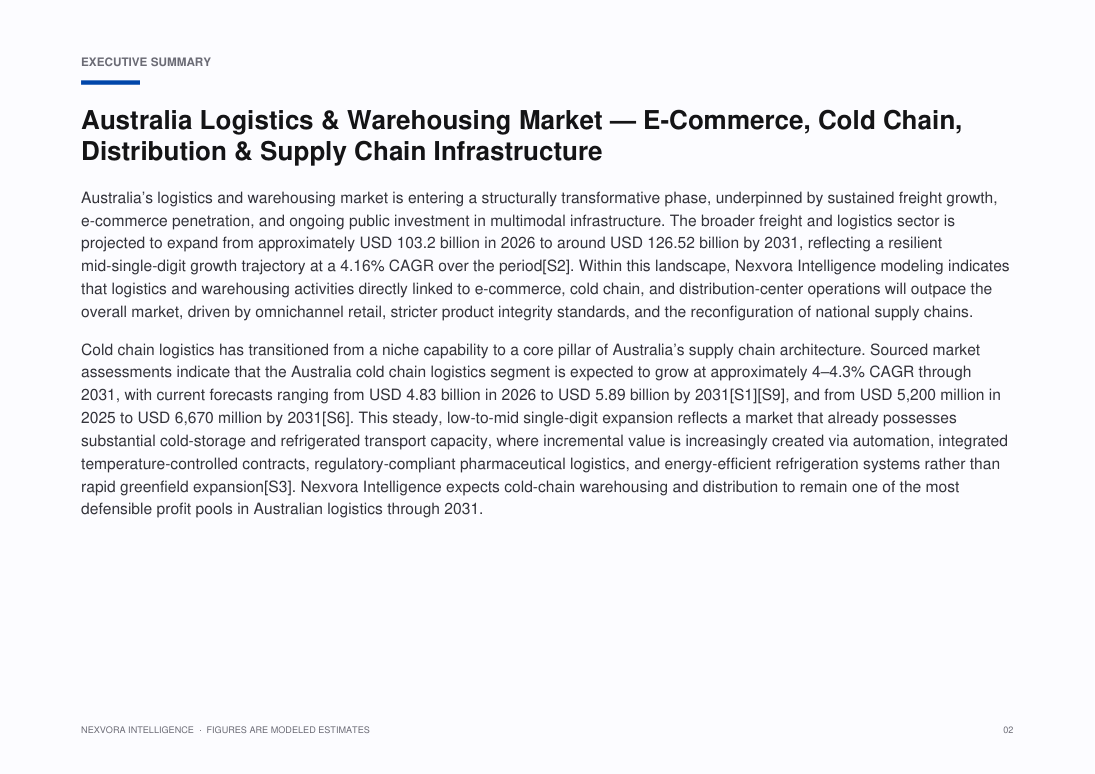
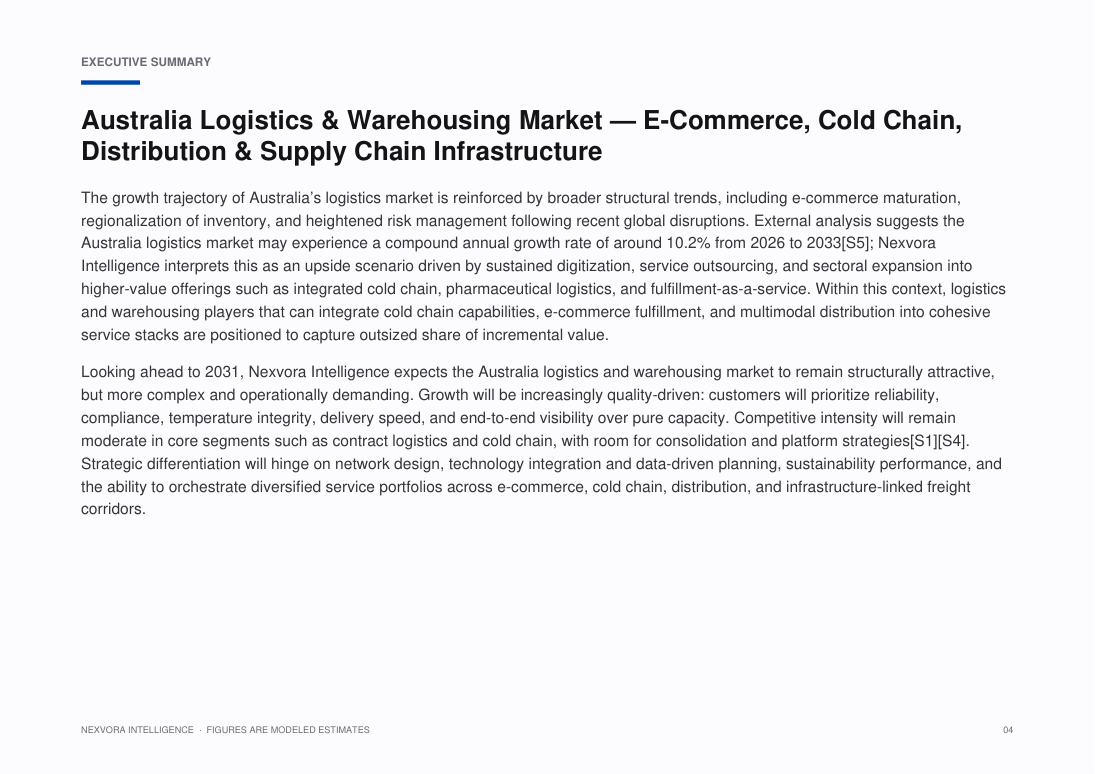
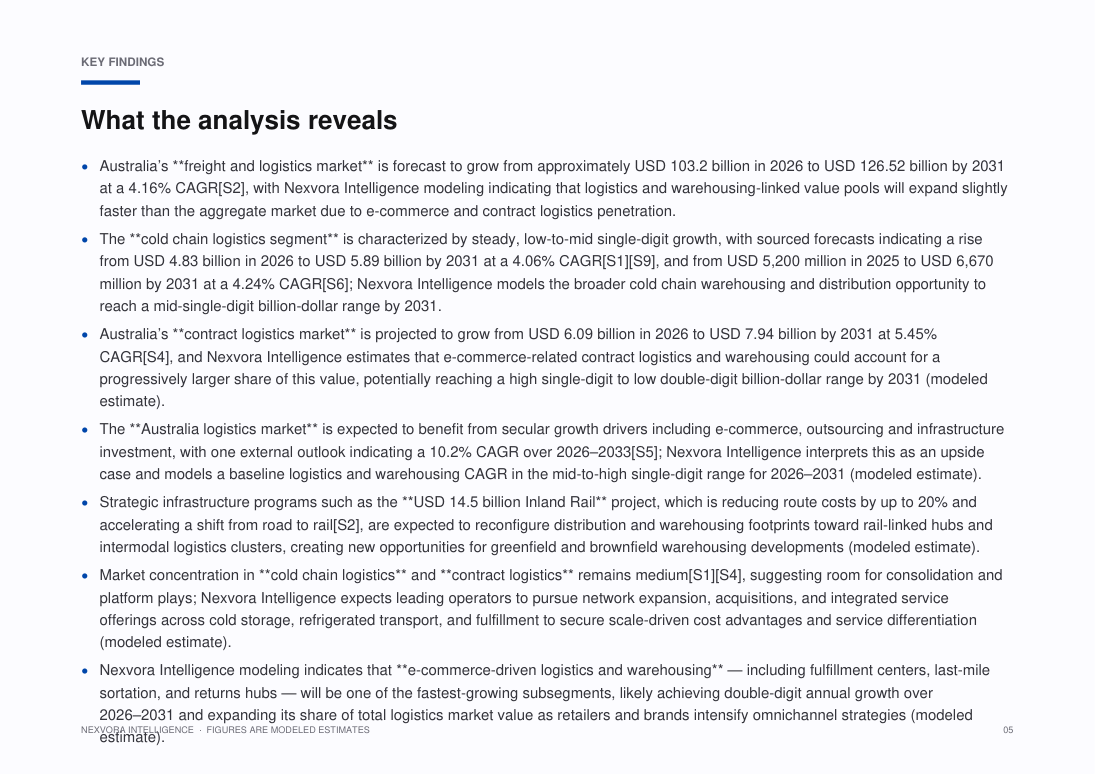
Australia’s logistics and warehousing market is entering a structurally transformative phase, underpinned by sustained freight growth, e-commerce penetration, and ongoing public investment in multimodal infrastructure. The broader freight and logistics sector is projected to expand from approximately USD ••• billion in 2026 to around USD ••• billion by 2031, reflecting a resilient mid-single-digit growth trajectory at a ••% CAGR over the period[S2]. Within this landscape, Nexvora Intelligence modeling indicates that logistics and warehousing activities directly linked to e-commerce, cold chain, and distribution-center operations will outpace the overall market, driven by omnichannel retail, stricter product integrity standards, and the reconfiguration of national supply chains.
Cold chain logistics has transitioned from a niche capability to a core pillar of Australia’s supply chain architecture. Sourced market assessments indicate that the Australia cold chain logistics segment is expected to grow at approximately 4–••% CAGR through 2031, with current forecasts ranging from USD ••• billion in 2026 to USD ••• billion by 2031[S1][S9], and from USD ••• million in 2025 to USD ••• million by 2031[S6]. This steady, low-to-mid single-digit expansion reflects a market that already possesses substantial cold-storage and refrigerated transport capacity, where incremental value is increasingly created via automation, integrated temperature-controlled contracts, regulatory-compliant pharmaceutical logistics, and energy-efficient refrigeration systems rather than rapid greenfield expansion[S3]. Nexvora Intelligence expects cold-chain warehousing and distribution to remain one of the most defensible profit pools in Australian logistics through 2031.
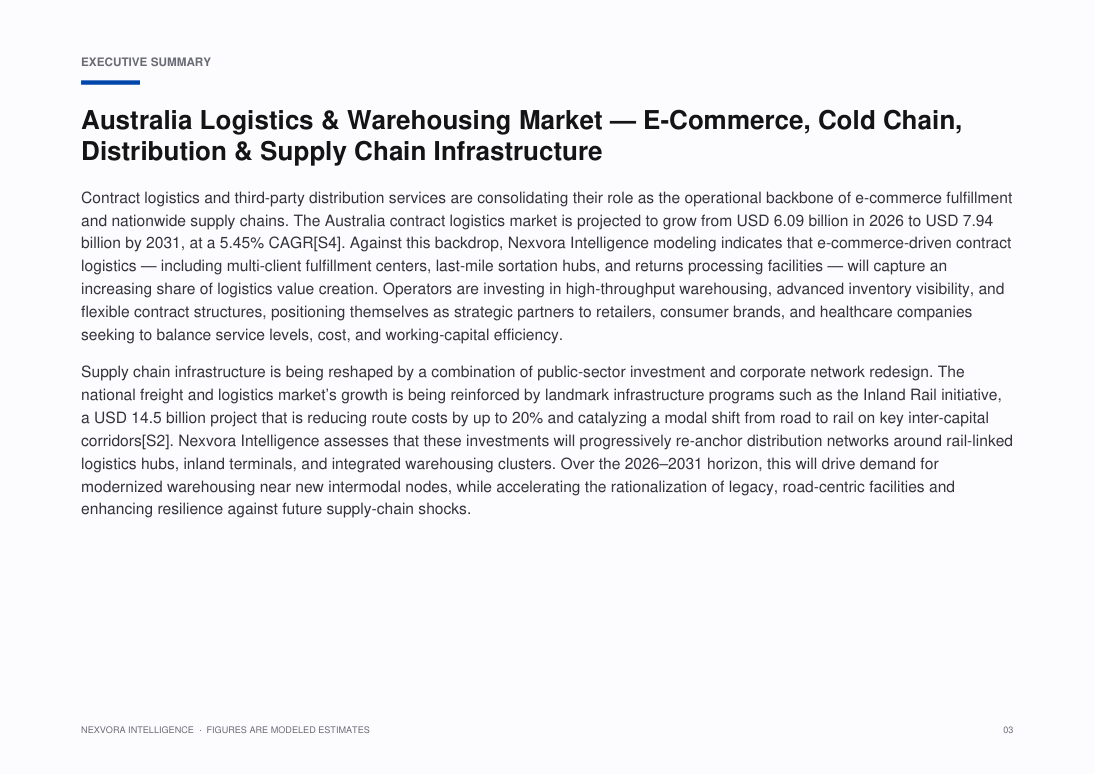
Contract logistics and third-party distribution services are consolidating their role as the operational backbone of e-commerce fulfillment and nationwide supply chains. The Australia contract logistics market is projected to grow from USD ••• billion in 2026 to USD ••• billion by 2031, at a ••% CAGR[S4]. Against this backdrop, Nexvora Intelligence modeling indicates that e-commerce-driven contract logistics — including multi-client fulfillment centers, last-mile sortation hubs, and returns processing facilities — will capture an increasing share of logistics value creation. Operators are investing in high-throughput warehousing, advanced inventory visibility, and flexible contract structures, positioning themselves as strategic partners to retailers, consumer brands, and healthcare companies seeking to balance service levels, cost, and working-capital efficiency.
Supply chain infrastructure is being reshaped by a combination of public-sector investment and corporate network redesign. The national freight and logistics market’s growth is being reinforced by landmark infrastructure programs such as the Inland Rail initiative, a USD ••• billion project that is reducing route costs by up to ••% and catalyzing a modal shift from road to rail on key inter-capital corridors[S2]. Nexvora Intelligence assesses that these investments will progressively re-anchor distribution networks around rail-linked logistics hubs, inland terminals, and integrated warehousing clusters. Over the 2026–2031 horizon, this will drive demand for modernized warehousing near new intermodal nodes, while accelerating the rationalization of legacy, road-centric facilities and enhancing resilience against future supply-chain shocks.
Specific figures are hidden in this free preview. Unlock the report to see all modeled market sizes, forecasts and growth rates.
What this report covers.
Strategic Market Intelligence and Modeled Outlook, 2026–2031
Who this report is for.
- Corporate strategy, planning and M&A teams evaluating the market
- Investors, private equity and venture teams sizing the opportunity
- Product, marketing and go-to-market leaders
- Consultants and analysts building the competitive picture
- Executives planning market entry, expansion or investment
How this report is built.
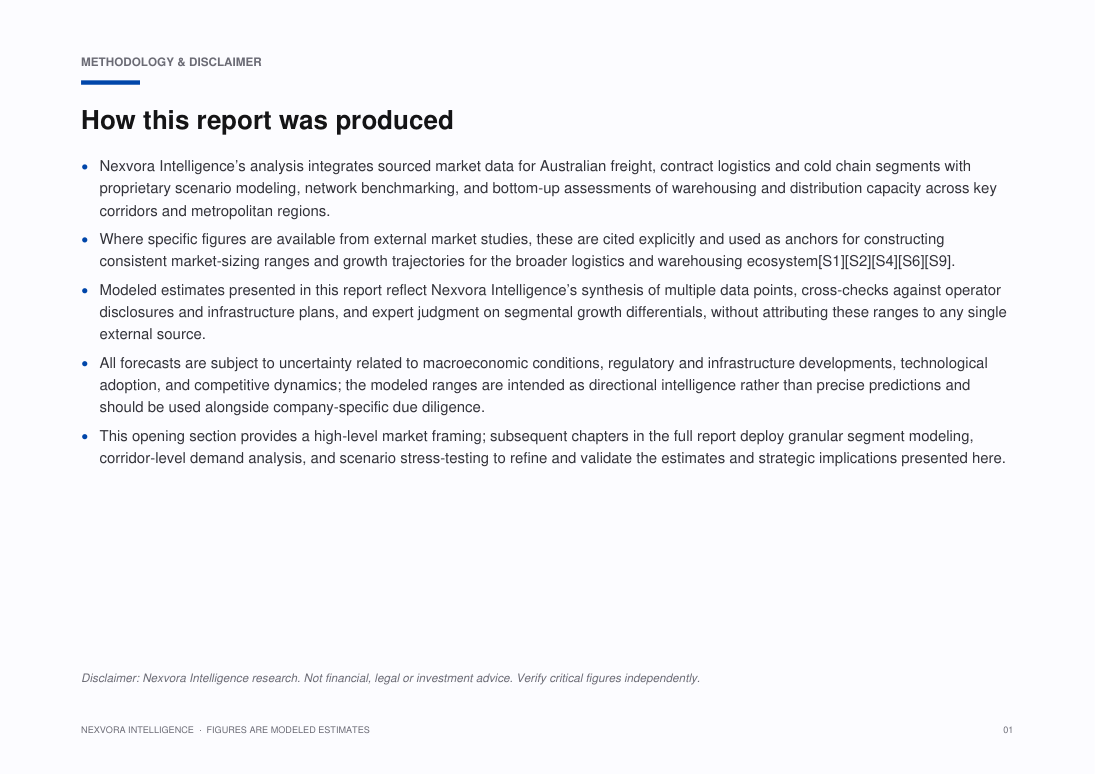
Nexvora Intelligence’s analysis integrates sourced market data for Australian freight, contract logistics and cold chain segments with proprietary scenario modeling, network benchmarking, and bottom-up assessments of warehousing and distribution capacity across key corridors and metropolitan regions.
Where specific figures are available from external market studies, these are cited explicitly and used as anchors for constructing consistent market-sizing ranges and growth trajectories for the broader logistics and warehousing ecosystem[S1][S2][S4][S6][S9].
Modeled estimates presented in this report reflect Nexvora Intelligence’s synthesis of multiple data points, cross-checks against operator disclosures and infrastructure plans, and expert judgment on segmental growth differentials, without attributing these ranges to any single external source.
All forecasts are subject to uncertainty related to macroeconomic conditions, regulatory and infrastructure developments, technological adoption, and competitive dynamics; the modeled ranges are intended as directional intelligence rather than precise predictions and should be used alongside company-specific due diligence.
This opening section provides a high-level market framing; subsequent chapters in the full report deploy granular segment modeling, corridor-level demand analysis, and scenario stress-testing to refine and validate the estimates and strategic implications presented here.
What's inside — a number-free look.
A full outline of the figures and tables you'll get. Specific data, market sizes and forecasts are unlocked with purchase.
List of Figures
- Figure 1: Market Overview and Structure — Australia Logistics & Warehousing — E-Commerce, Cold Chain, Distribution & Supply Chain Infrastructure
- Figure 2: Market Size and Forecast Framework — Australia Logistics & Warehousing — E-Commerce, Cold Chain, Distribution & Supply Chain Infrastructure
- Figure 3: Value Chain and Ecosystem Analysis — Australia Logistics & Warehousing — E-Commerce, Cold Chain, Distribution & Supply Chain Infrastructure
- Figure 4: Market Dynamics — Drivers, Restraints and Opportunities — Australia Logistics & Warehousing — E-Commerce, Cold Chain, Distribution & Supply Chain Infrastructure
- Figure 5: Segment Contribution Analysis — Australia Logistics & Warehousing — E-Commerce, Cold Chain, Distribution & Supply Chain Infrastructure
- Figure 6: Regional Market Landscape — Australia Logistics & Warehousing — E-Commerce, Cold Chain, Distribution & Supply Chain Infrastructure
- Figure 7: Country-level Opportunity Mapping — Australia Logistics & Warehousing — E-Commerce, Cold Chain, Distribution & Supply Chain Infrastructure
- Figure 8: Competitive Positioning Matrix — Australia Logistics & Warehousing — E-Commerce, Cold Chain, Distribution & Supply Chain Infrastructure
- Figure 9: Market Share of Leading Players — Australia Logistics & Warehousing — E-Commerce, Cold Chain, Distribution & Supply Chain Infrastructure
- Figure 10: Adoption and Penetration Trends — Australia Logistics & Warehousing — E-Commerce, Cold Chain, Distribution & Supply Chain Infrastructure
- Figure 11: Technology and Innovation Landscape — Australia Logistics & Warehousing — E-Commerce, Cold Chain, Distribution & Supply Chain Infrastructure
- Figure 12: Pricing and Business Model Analysis — Australia Logistics & Warehousing — E-Commerce, Cold Chain, Distribution & Supply Chain Infrastructure
- Figure 13: Investment, Funding and M&A Landscape — Australia Logistics & Warehousing — E-Commerce, Cold Chain, Distribution & Supply Chain Infrastructure
- Figure 14: Regulatory and Policy Framework — Australia Logistics & Warehousing — E-Commerce, Cold Chain, Distribution & Supply Chain Infrastructure
- Figure 15: Porter's Five Forces Analysis — Australia Logistics & Warehousing — E-Commerce, Cold Chain, Distribution & Supply Chain Infrastructure
- Figure 16: PESTLE Analysis — Australia Logistics & Warehousing — E-Commerce, Cold Chain, Distribution & Supply Chain Infrastructure
- Figure 17: Growth Opportunity Heat Map — Australia Logistics & Warehousing — E-Commerce, Cold Chain, Distribution & Supply Chain Infrastructure
- Figure 18: Future Outlook and Strategic Roadmap — Australia Logistics & Warehousing — E-Commerce, Cold Chain, Distribution & Supply Chain Infrastructure
List of Tables
- Table 1: Market Segmentation Overview — Australia Logistics & Warehousing — E-Commerce, Cold Chain, Distribution & Supply Chain Infrastructure
- Table 2: Segment Definitions and Scope — Australia Logistics & Warehousing — E-Commerce, Cold Chain, Distribution & Supply Chain Infrastructure
- Table 3: Regional and Country Coverage Summary — Australia Logistics & Warehousing — E-Commerce, Cold Chain, Distribution & Supply Chain Infrastructure
- Table 4: Key Company Profiles and Offerings — Australia Logistics & Warehousing — E-Commerce, Cold Chain, Distribution & Supply Chain Infrastructure
- Table 5: Competitive Benchmarking Matrix — Australia Logistics & Warehousing — E-Commerce, Cold Chain, Distribution & Supply Chain Infrastructure
- Table 6: Product and Service Portfolio Mapping — Australia Logistics & Warehousing — E-Commerce, Cold Chain, Distribution & Supply Chain Infrastructure
- Table 7: Market Drivers, Restraints and Trends — Australia Logistics & Warehousing — E-Commerce, Cold Chain, Distribution & Supply Chain Infrastructure
- Table 8: Strategic Initiatives and Developments — Australia Logistics & Warehousing — E-Commerce, Cold Chain, Distribution & Supply Chain Infrastructure
- Table 9: Partnerships and Collaborations — Australia Logistics & Warehousing — E-Commerce, Cold Chain, Distribution & Supply Chain Infrastructure
- Table 10: Research Assumptions and Limitations — Australia Logistics & Warehousing — E-Commerce, Cold Chain, Distribution & Supply Chain Infrastructure
- Table 11: Data Sources and References — Australia Logistics & Warehousing — E-Commerce, Cold Chain, Distribution & Supply Chain Infrastructure
- Table 12: Report Scope and Coverage Summary — Australia Logistics & Warehousing — E-Commerce, Cold Chain, Distribution & Supply Chain Infrastructure
A look at the pages.
108 pages · 20 sections · charts & tables
A genuine peek at the opening pages. Unlock to read every page in full.
6 of 108 pages shown
Turn this market into a plan for your business.
Answer a few quick questions and unlock a personalised operational read — your maturity score, prioritised focus areas and quick wins — mapped to where this market is heading. Result delivered instantly and emailed to you.
- Maturity score & prioritised focus areas
- Practical quick wins and a recommended next step
Questions, answered.
How big is the Australia Logistics & Warehousing Market?
Nexvora models the Australia Logistics & Warehousing Market at approximately USD 110–130 billion (modeled range, total logistics & warehousing, 2026). Full market sizing, segmentation and forecasts are inside the report (modeled estimate).
What is the growth rate (CAGR) of the Australia Logistics & Warehousing Market?
The Australia Logistics & Warehousing Market is projected to grow at a CAGR of about 6–8% (modeled baseline for logistics & warehousing, 2026–2031) over the forecast period — a Nexvora modeled estimate detailed across the report's 20 sections.
What does this report include?
A complete market intelligence report — market sizing and forecasts, segmentation, regional and industry analysis, competitive landscape, trends, and strategic recommendations across 20 sections.
How do I access it after purchase?
Instantly, in your secure online viewer. Reports are view-only and available on any device from your library.
Are the figures sourced?
Quantitative figures are Nexvora modeled estimates unless explicitly cited to a referenced source within the report.
Can I buy access for my team?
Yes — add user seats at checkout, or subscribe for bulk access across multiple reports.
Nexvora Intelligence research report. All quantitative figures are modeled estimates — not audited data. Not financial or investment advice.
More market reports
Keep exploring intelligence in this and related sectors.

Japan Logistics & Warehousing Market — Automation, Robotics, E-Commerce & Last-Mile Delivery Outlook

France Logistics & Warehousing Market — Intelligence Report

China Logistics & Warehousing Market — Manufacturing, E-Commerce, Smart Warehousing & Supply Chain Transformation