
Japan Logistics & Warehousing Market — Automation, Robotics, E-Commerce & Last-Mile Delivery Outlook
Strategic Market Intelligence and Forecast Outlook, 2026–2031
Nexvora Intelligence market report on Japan Logistics & Warehousing Market: Automation, Robotics, E-Commerce & Last-Mile Delivery Outlook, 2026–2031.

per extra user
Instant access after payment. Secure via Razorpay.
The opening view — free.
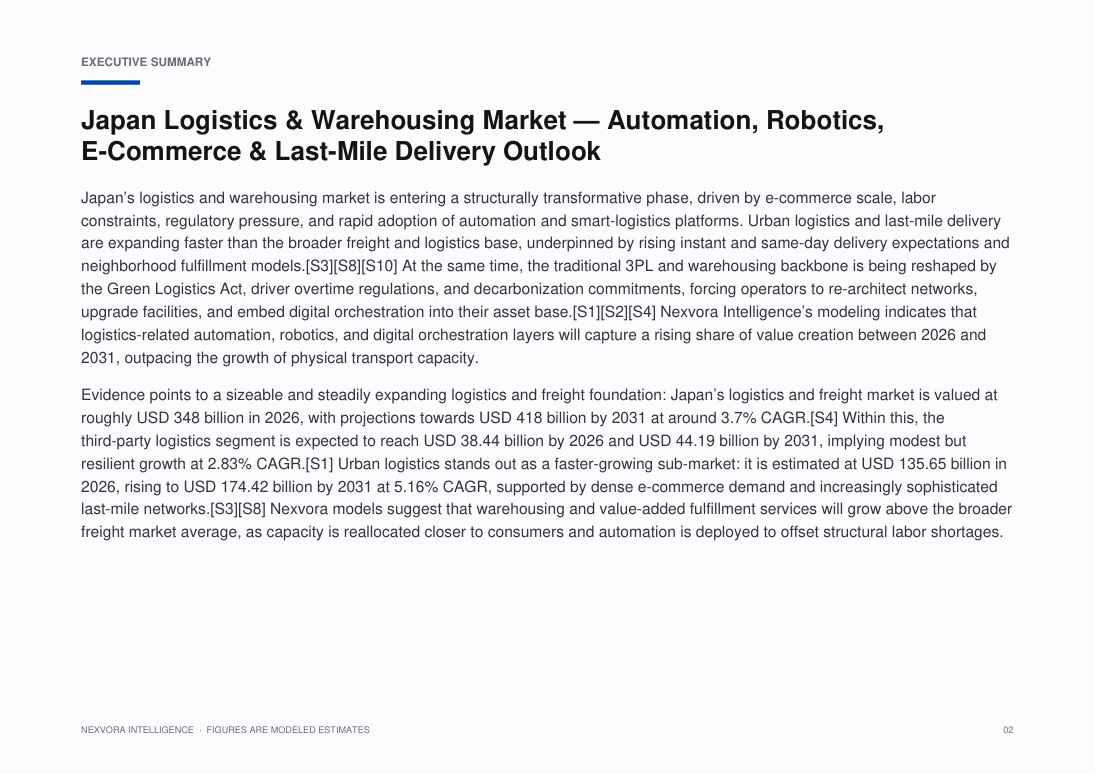
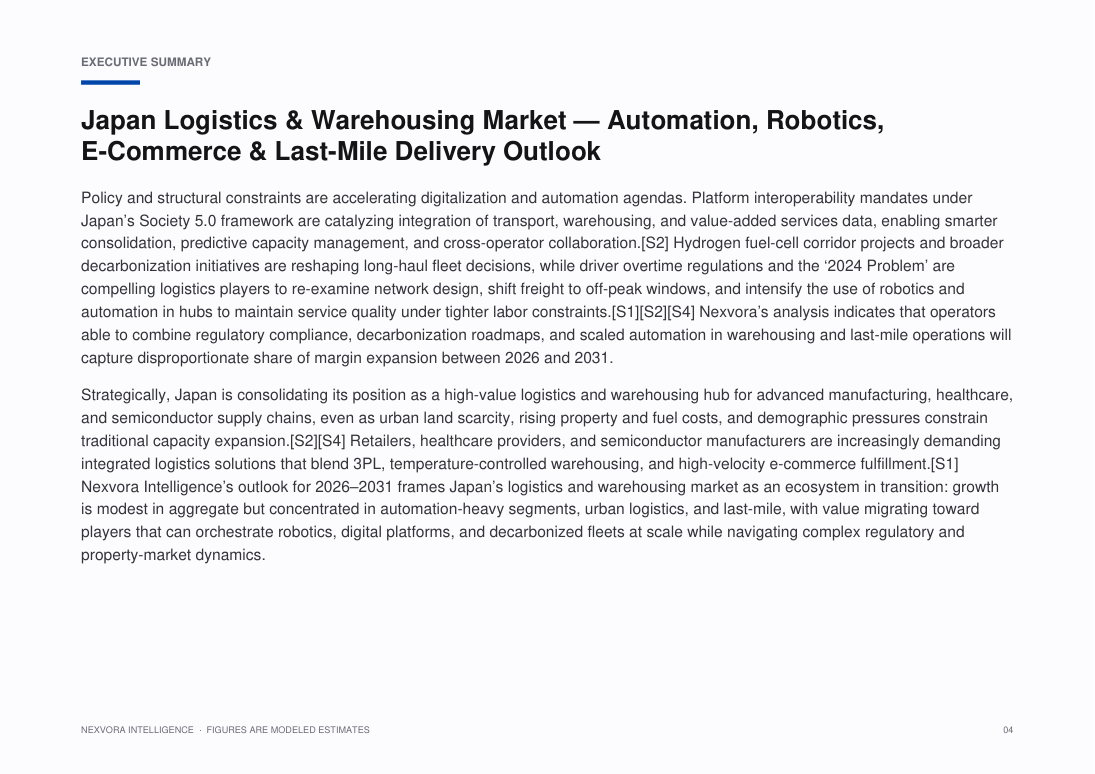
Japan’s logistics and warehousing market is entering a structurally transformative phase, driven by e-commerce scale, labor constraints, regulatory pressure, and rapid adoption of automation and smart-logistics platforms. Urban logistics and last-mile delivery are expanding faster than the broader freight and logistics base, underpinned by rising instant and same-day delivery expectations and neighborhood fulfillment models.[S3][S8][S10] At the same time, the traditional 3PL and warehousing backbone is being reshaped by the Green Logistics Act, driver overtime regulations, and decarbonization commitments, forcing operators to re-architect networks, upgrade facilities, and embed digital orchestration into their asset base.[S1][S2][S4] Nexvora Intelligence’s modeling indicates that logistics-related automation, robotics, and digital orchestration layers will capture a rising share of value creation between 2026 and 2031, outpacing the growth of physical transport capacity.
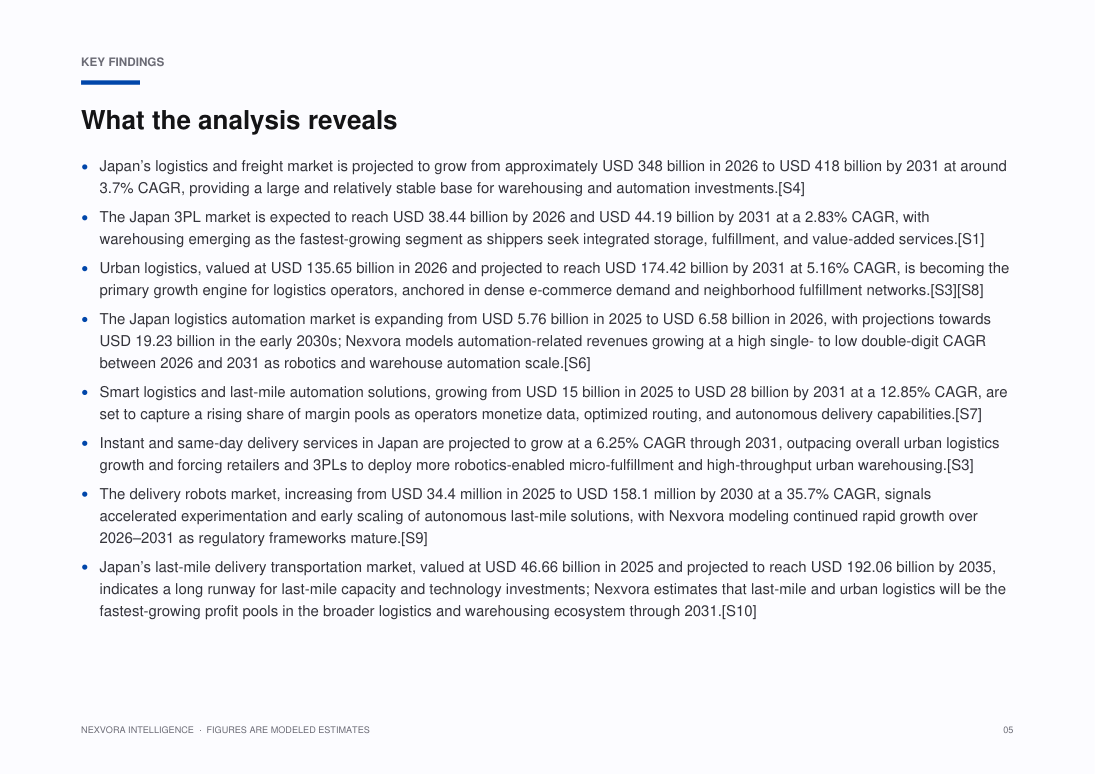
Evidence points to a sizeable and steadily expanding logistics and freight foundation: Japan’s logistics and freight market is valued at roughly USD ••• billion in 2026, with projections towards USD ••• billion by 2031 at around ••% CAGR.[S4] Within this, the third-party logistics segment is expected to reach USD ••• billion by 2026 and USD ••• billion by 2031, implying modest but resilient growth at ••% CAGR.[S1] Urban logistics stands out as a faster-growing sub-market: it is estimated at USD ••• billion in 2026, rising to USD ••• billion by 2031 at ••% CAGR, supported by dense e-commerce demand and increasingly sophisticated last-mile networks.[S3][S8] Nexvora models suggest that warehousing and value-added fulfillment services will grow above the broader freight market average, as capacity is reallocated closer to consumers and automation is deployed to offset structural labor shortages.
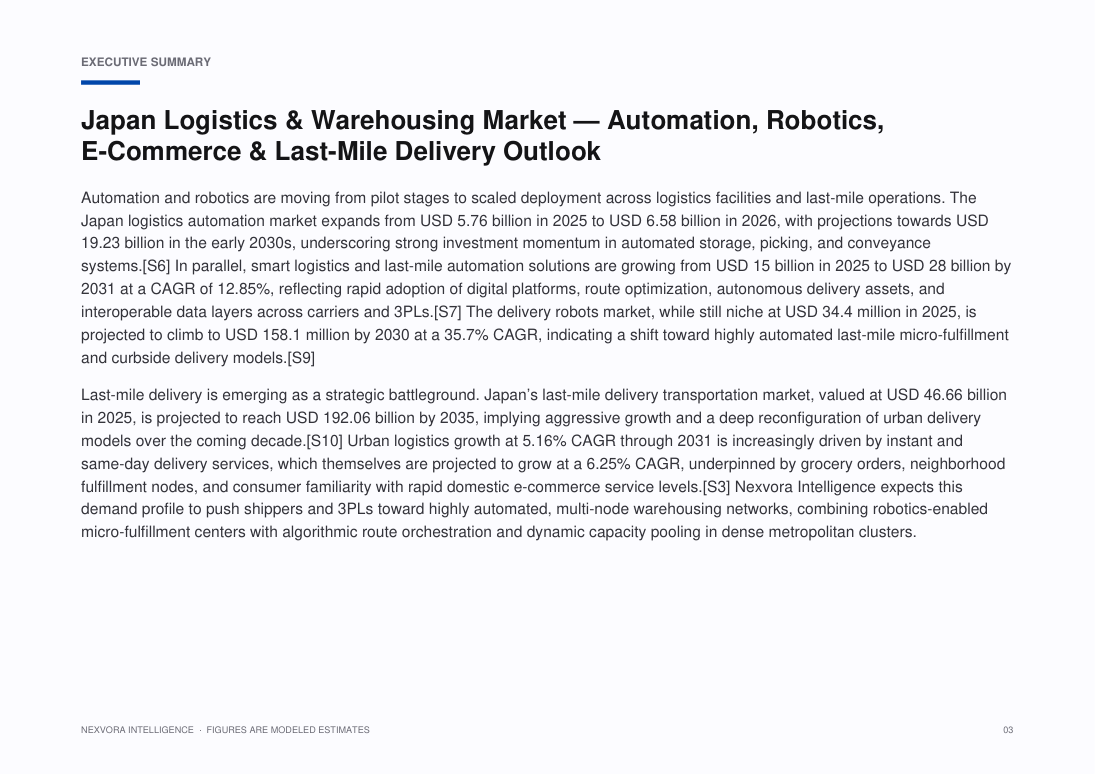
Automation and robotics are moving from pilot stages to scaled deployment across logistics facilities and last-mile operations. The Japan logistics automation market expands from USD ••• billion in 2025 to USD ••• billion in 2026, with projections towards USD ••• billion in the early 2030s, underscoring strong investment momentum in automated storage, picking, and conveyance systems.[S6] In parallel, smart logistics and last-mile automation solutions are growing from USD ••• billion in 2025 to USD ••• billion by 2031 at a CAGR of ••%, reflecting rapid adoption of digital platforms, route optimization, autonomous delivery assets, and interoperable data layers across carriers and 3PLs.[S7] The delivery robots market, while still niche at USD ••• million in 2025, is projected to climb to USD ••• million by 2030 at a ••% CAGR, indicating a shift toward highly automated last-mile micro-fulfillment and curbside delivery models.[S9]
Last-mile delivery is emerging as a strategic battleground. Japan’s last-mile delivery transportation market, valued at USD ••• billion in 2025, is projected to reach USD ••• billion by 2035, implying aggressive growth and a deep reconfiguration of urban delivery models over the coming decade.[S10] Urban logistics growth at ••% CAGR through 2031 is increasingly driven by instant and same-day delivery services, which themselves are projected to grow at a ••% CAGR, underpinned by grocery orders, neighborhood fulfillment nodes, and consumer familiarity with rapid domestic e-commerce service levels.[S3] Nexvora Intelligence expects this demand profile to push shippers and 3PLs toward highly automated, multi-node warehousing networks, combining robotics-enabled micro-fulfillment centers with algorithmic route orchestration and dynamic capacity pooling in dense metropolitan clusters.
Specific figures are hidden in this free preview. Unlock the report to see all modeled market sizes, forecasts and growth rates.
What this report covers.
Strategic Market Intelligence and Forecast Outlook, 2026–2031
Who this report is for.
- Corporate strategy, planning and M&A teams evaluating the market
- Investors, private equity and venture teams sizing the opportunity
- Product, marketing and go-to-market leaders
- Consultants and analysts building the competitive picture
- Executives planning market entry, expansion or investment
How this report is built.
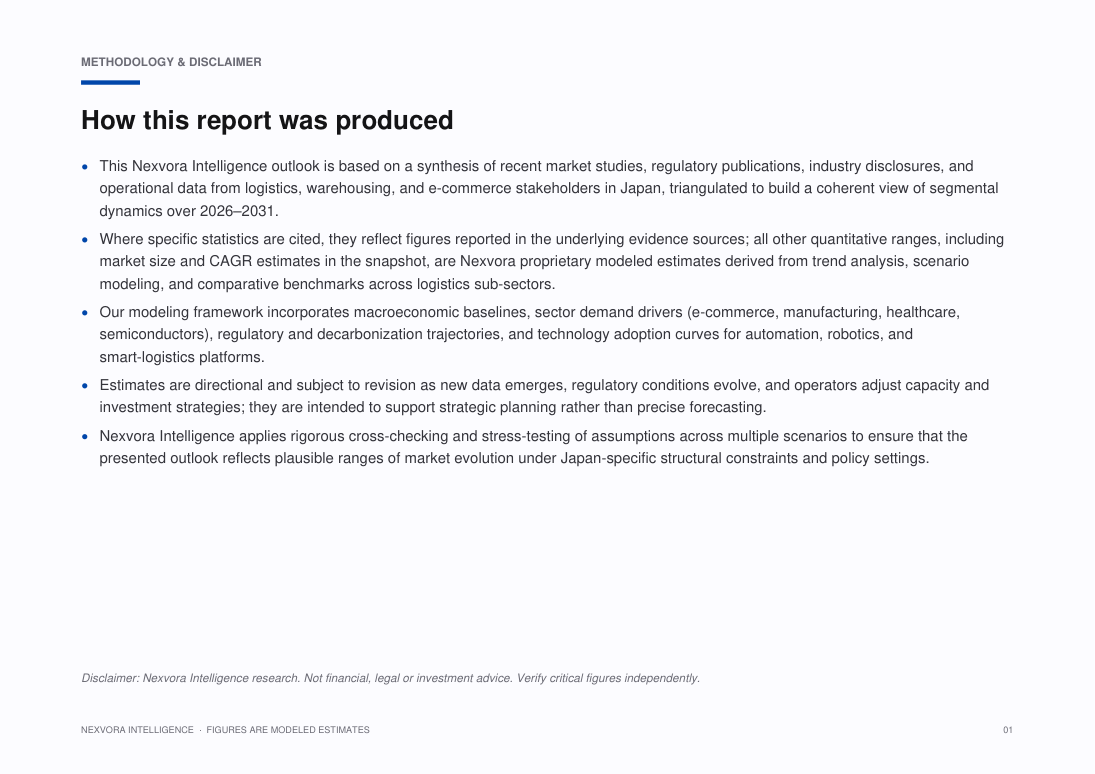
This Nexvora Intelligence outlook is based on a synthesis of recent market studies, regulatory publications, industry disclosures, and operational data from logistics, warehousing, and e-commerce stakeholders in Japan, triangulated to build a coherent view of segmental dynamics over 2026–2031.
Where specific statistics are cited, they reflect figures reported in the underlying evidence sources; all other quantitative ranges, including market size and CAGR estimates in the snapshot, are Nexvora proprietary modeled estimates derived from trend analysis, scenario modeling, and comparative benchmarks across logistics sub-sectors.
Our modeling framework incorporates macroeconomic baselines, sector demand drivers (e-commerce, manufacturing, healthcare, semiconductors), regulatory and decarbonization trajectories, and technology adoption curves for automation, robotics, and smart-logistics platforms.
Estimates are directional and subject to revision as new data emerges, regulatory conditions evolve, and operators adjust capacity and investment strategies; they are intended to support strategic planning rather than precise forecasting.
Nexvora Intelligence applies rigorous cross-checking and stress-testing of assumptions across multiple scenarios to ensure that the presented outlook reflects plausible ranges of market evolution under Japan-specific structural constraints and policy settings.
What's inside — a number-free look.
A full outline of the figures and tables you'll get. Specific data, market sizes and forecasts are unlocked with purchase.
List of Figures
- Figure 1: Market Overview and Structure — Japan Logistics & Warehousing — Automation, Robotics, E-Commerce & Last-Mile Delivery Outlook
- Figure 2: Market Size and Forecast Framework — Japan Logistics & Warehousing — Automation, Robotics, E-Commerce & Last-Mile Delivery Outlook
- Figure 3: Value Chain and Ecosystem Analysis — Japan Logistics & Warehousing — Automation, Robotics, E-Commerce & Last-Mile Delivery Outlook
- Figure 4: Market Dynamics — Drivers, Restraints and Opportunities — Japan Logistics & Warehousing — Automation, Robotics, E-Commerce & Last-Mile Delivery Outlook
- Figure 5: Segment Contribution Analysis — Japan Logistics & Warehousing — Automation, Robotics, E-Commerce & Last-Mile Delivery Outlook
- Figure 6: Regional Market Landscape — Japan Logistics & Warehousing — Automation, Robotics, E-Commerce & Last-Mile Delivery Outlook
- Figure 7: Country-level Opportunity Mapping — Japan Logistics & Warehousing — Automation, Robotics, E-Commerce & Last-Mile Delivery Outlook
- Figure 8: Competitive Positioning Matrix — Japan Logistics & Warehousing — Automation, Robotics, E-Commerce & Last-Mile Delivery Outlook
- Figure 9: Market Share of Leading Players — Japan Logistics & Warehousing — Automation, Robotics, E-Commerce & Last-Mile Delivery Outlook
- Figure 10: Adoption and Penetration Trends — Japan Logistics & Warehousing — Automation, Robotics, E-Commerce & Last-Mile Delivery Outlook
- Figure 11: Technology and Innovation Landscape — Japan Logistics & Warehousing — Automation, Robotics, E-Commerce & Last-Mile Delivery Outlook
- Figure 12: Pricing and Business Model Analysis — Japan Logistics & Warehousing — Automation, Robotics, E-Commerce & Last-Mile Delivery Outlook
- Figure 13: Investment, Funding and M&A Landscape — Japan Logistics & Warehousing — Automation, Robotics, E-Commerce & Last-Mile Delivery Outlook
- Figure 14: Regulatory and Policy Framework — Japan Logistics & Warehousing — Automation, Robotics, E-Commerce & Last-Mile Delivery Outlook
- Figure 15: Porter's Five Forces Analysis — Japan Logistics & Warehousing — Automation, Robotics, E-Commerce & Last-Mile Delivery Outlook
- Figure 16: PESTLE Analysis — Japan Logistics & Warehousing — Automation, Robotics, E-Commerce & Last-Mile Delivery Outlook
- Figure 17: Growth Opportunity Heat Map — Japan Logistics & Warehousing — Automation, Robotics, E-Commerce & Last-Mile Delivery Outlook
- Figure 18: Future Outlook and Strategic Roadmap — Japan Logistics & Warehousing — Automation, Robotics, E-Commerce & Last-Mile Delivery Outlook
List of Tables
- Table 1: Market Segmentation Overview — Japan Logistics & Warehousing — Automation, Robotics, E-Commerce & Last-Mile Delivery Outlook
- Table 2: Segment Definitions and Scope — Japan Logistics & Warehousing — Automation, Robotics, E-Commerce & Last-Mile Delivery Outlook
- Table 3: Regional and Country Coverage Summary — Japan Logistics & Warehousing — Automation, Robotics, E-Commerce & Last-Mile Delivery Outlook
- Table 4: Key Company Profiles and Offerings — Japan Logistics & Warehousing — Automation, Robotics, E-Commerce & Last-Mile Delivery Outlook
- Table 5: Competitive Benchmarking Matrix — Japan Logistics & Warehousing — Automation, Robotics, E-Commerce & Last-Mile Delivery Outlook
- Table 6: Product and Service Portfolio Mapping — Japan Logistics & Warehousing — Automation, Robotics, E-Commerce & Last-Mile Delivery Outlook
- Table 7: Market Drivers, Restraints and Trends — Japan Logistics & Warehousing — Automation, Robotics, E-Commerce & Last-Mile Delivery Outlook
- Table 8: Strategic Initiatives and Developments — Japan Logistics & Warehousing — Automation, Robotics, E-Commerce & Last-Mile Delivery Outlook
- Table 9: Partnerships and Collaborations — Japan Logistics & Warehousing — Automation, Robotics, E-Commerce & Last-Mile Delivery Outlook
- Table 10: Research Assumptions and Limitations — Japan Logistics & Warehousing — Automation, Robotics, E-Commerce & Last-Mile Delivery Outlook
- Table 11: Data Sources and References — Japan Logistics & Warehousing — Automation, Robotics, E-Commerce & Last-Mile Delivery Outlook
- Table 12: Report Scope and Coverage Summary — Japan Logistics & Warehousing — Automation, Robotics, E-Commerce & Last-Mile Delivery Outlook
A look at the pages.
107 pages · 20 sections · charts & tables
A genuine peek at the opening pages. Unlock to read every page in full.
6 of 107 pages shown
Turn this market into a plan for your business.
Answer a few quick questions and unlock a personalised operational read — your maturity score, prioritised focus areas and quick wins — mapped to where this market is heading. Result delivered instantly and emailed to you.
- Maturity score & prioritised focus areas
- Practical quick wins and a recommended next step
Questions, answered.
How big is the Japan Logistics & Warehousing Market?
Nexvora models the Japan Logistics & Warehousing Market at approximately USD 360–400 billion (logistics & warehousing, 2026). Full market sizing, segmentation and forecasts are inside the report (modeled estimate).
What is the growth rate (CAGR) of the Japan Logistics & Warehousing Market?
The Japan Logistics & Warehousing Market is projected to grow at a CAGR of about 3.5–4.5% (2026–2031, aggregate logistics & warehousing) over the forecast period — a Nexvora modeled estimate detailed across the report's 20 sections.
What does this report include?
A complete market intelligence report — market sizing and forecasts, segmentation, regional and industry analysis, competitive landscape, trends, and strategic recommendations across 20 sections.
How do I access it after purchase?
Instantly, in your secure online viewer. Reports are view-only and available on any device from your library.
Are the figures sourced?
Quantitative figures are Nexvora modeled estimates unless explicitly cited to a referenced source within the report.
Can I buy access for my team?
Yes — add user seats at checkout, or subscribe for bulk access across multiple reports.
Nexvora Intelligence research report. All quantitative figures are modeled estimates — not audited data. Not financial or investment advice.
More market reports
Keep exploring intelligence in this and related sectors.

Australia Logistics & Warehousing Market — E-Commerce, Cold Chain, Distribution & Supply Chain Infrastructure

France Logistics & Warehousing Market — Intelligence Report

China Logistics & Warehousing Market — Manufacturing, E-Commerce, Smart Warehousing & Supply Chain Transformation