
Space-Based Solar Power Infrastructure Market — Intelligence Report
Strategic assessment of the orbital power race, enabling infrastructure, and likely winners, 2025–2035
Nexvora Intelligence market report on Space-Based Solar Power: Why the Infrastructure Race Is Already Underway — and Who Will Win It.

per extra user
Instant access after payment. Secure via Razorpay.
The opening view — free.
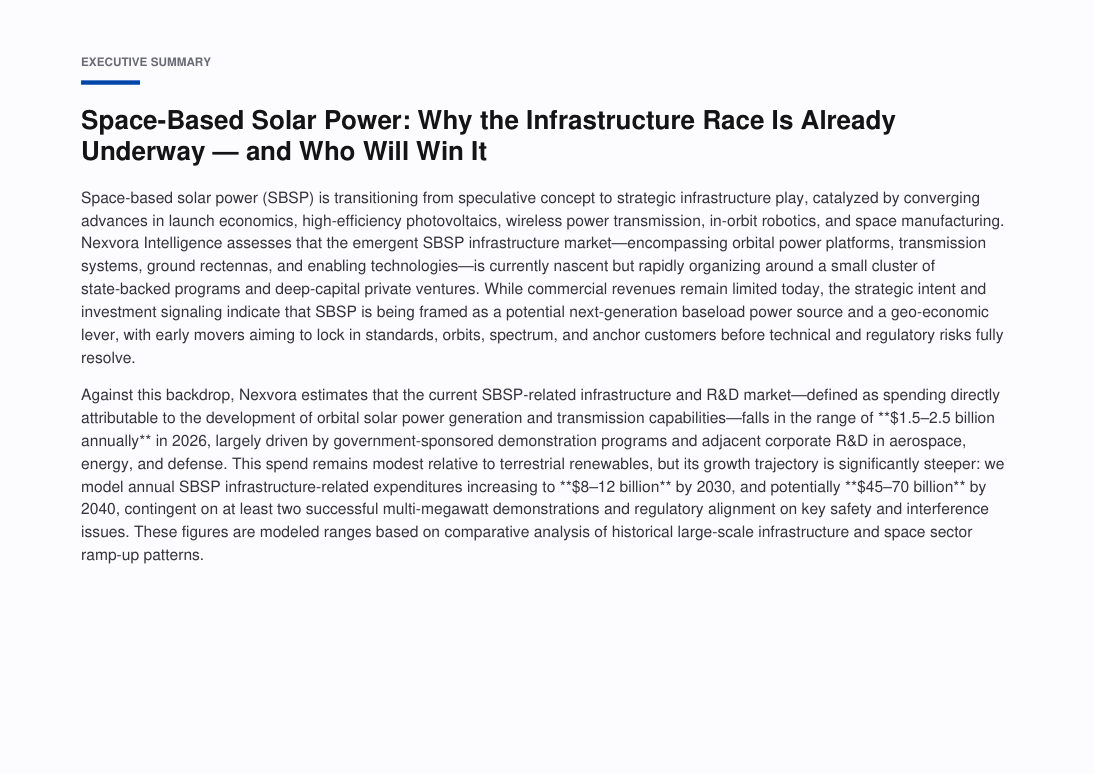
Space-based solar power is shifting from a speculative energy concept into an infrastructure contest. The market remains pre-commercial, but the competitive axis is now clear: launch economics, in-space assembly, high-efficiency photovoltaics, wireless power transmission, thermal management, orbital servicing, and ground-based receiving infrastructure. Nexvora Intelligence estimates the current global space-based solar power infrastructure market at approximately $••• to $••• in 2025, primarily composed of public R&D programs, defense-linked demonstrations, component prototyping, and early systems engineering.
The near-term race will not be won by the entity with the most elegant power-beaming architecture; it will be won by the ecosystem that can industrialize orbital infrastructure at scale. Cost-effective heavy launch, autonomous assembly, reusable in-space transport, modular solar arrays, and standardized power transmission payloads are becoming the decisive layers. Nexvora’s modeled view is that the market could expand at a ••% to ••% CAGR through 2035, reaching approximately $••• to $••• in annual infrastructure spending if demonstration milestones translate into deployable pilot constellations.
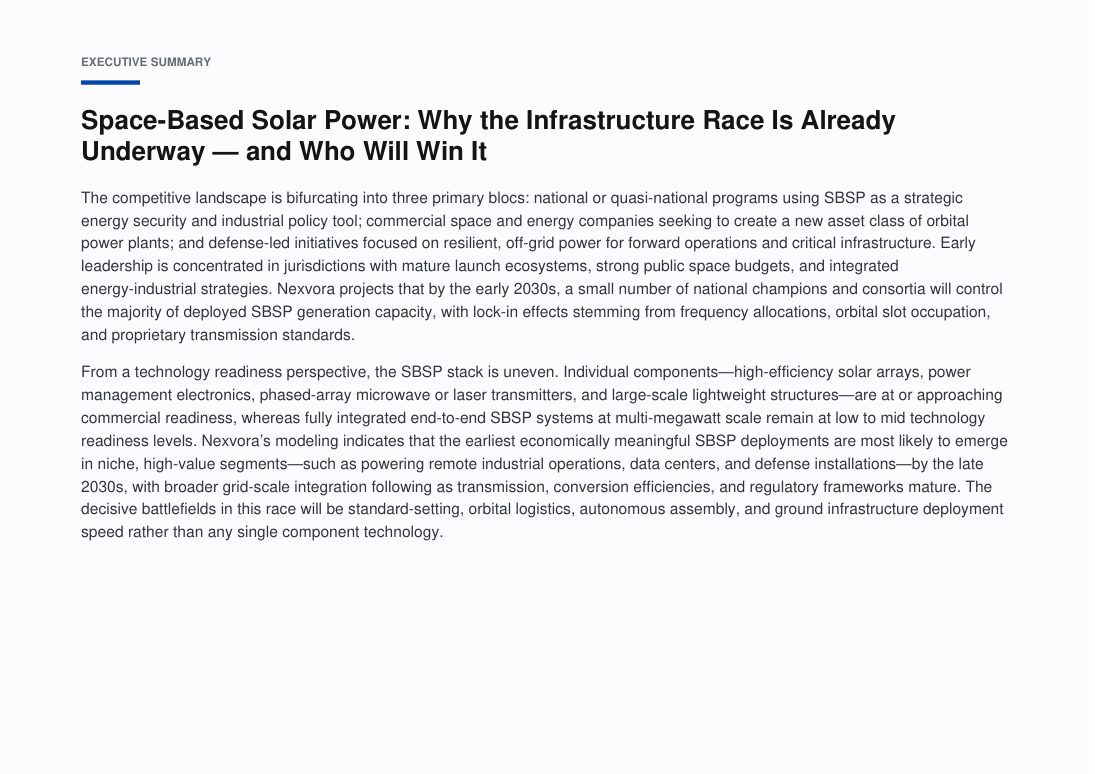
The strategic case for space-based solar power is strengthening because it addresses two hard problems simultaneously: clean baseload power and energy security. Unlike terrestrial solar, orbital generation can provide near-continuous collection potential, while power beaming enables geographically flexible delivery to grids, military bases, disaster zones, islands, mining operations, and remote industrial loads. The initial commercial market is unlikely to be utility-scale baseload electricity for major urban grids; it is more likely to emerge first in premium, resilience-critical power segments where delivered energy costs can justify early infrastructure economics.
China, the United States, Japan, and Europe are the core contenders, but they are competing with different advantages. China benefits from state-directed infrastructure planning and patient capital for large demonstration programs. The United States has the deepest commercial launch, spacecraft, robotics, and venture-backed space infrastructure ecosystem. Japan has long-standing technical depth in wireless power transmission and policy continuity around orbital solar concepts. Europe is positioned around systems integration, industrial consortium development, and dual-use energy resilience. Nexvora’s assessment is that leadership through 2030 will likely be measured by demonstration credibility, while leadership after 2030 will be determined by manufacturing cadence and orbital assembly throughput.
Specific figures are hidden in this free preview. Unlock the report to see all modeled market sizes, forecasts and growth rates.
What this report covers.
Strategic assessment of the orbital power race, enabling infrastructure, and likely winners, 2025–2035
Who this report is for.
- Corporate strategy, planning and M&A teams evaluating the market
- Investors, private equity and venture teams sizing the opportunity
- Product, marketing and go-to-market leaders
- Consultants and analysts building the competitive picture
- Executives planning market entry, expansion or investment
How this report is built.
Nexvora Intelligence developed this opening assessment using proprietary market modeling across public program activity, launch cost trajectories, orbital infrastructure readiness, energy-market addressability, and dual-use procurement potential.
Market sizing reflects modeled annual spending on space-based solar power infrastructure, including system R&D, demonstration missions, launch and integration, orbital assembly capabilities, power transmission payloads, and ground receiving infrastructure.
Forecast ranges incorporate scenario-weighted assumptions for launch cost decline, system mass intensity, demonstration cadence, regulatory progress, and conversion of government-backed pilots into commercial or strategic infrastructure programs.
All figures in this report opening are Nexvora modeled estimates and should be interpreted as directional ranges for a pre-commercial market rather than audited industry revenue.
What's inside — a number-free look.
A full outline of the figures and tables you'll get. Specific data, market sizes and forecasts are unlocked with purchase.
List of Figures
- Figure 1: Market Overview and Structure — Space-Based Solar Power Infrastructure
- Figure 2: Market Size and Forecast Framework — Space-Based Solar Power Infrastructure
- Figure 3: Value Chain and Ecosystem Analysis — Space-Based Solar Power Infrastructure
- Figure 4: Market Dynamics — Drivers, Restraints and Opportunities — Space-Based Solar Power Infrastructure
- Figure 5: Segment Contribution Analysis — Space-Based Solar Power Infrastructure
- Figure 6: Regional Market Landscape — Space-Based Solar Power Infrastructure
- Figure 7: Country-level Opportunity Mapping — Space-Based Solar Power Infrastructure
- Figure 8: Competitive Positioning Matrix — Space-Based Solar Power Infrastructure
- Figure 9: Market Share of Leading Players — Space-Based Solar Power Infrastructure
- Figure 10: Adoption and Penetration Trends — Space-Based Solar Power Infrastructure
- Figure 11: Technology and Innovation Landscape — Space-Based Solar Power Infrastructure
- Figure 12: Pricing and Business Model Analysis — Space-Based Solar Power Infrastructure
- Figure 13: Investment, Funding and M&A Landscape — Space-Based Solar Power Infrastructure
- Figure 14: Regulatory and Policy Framework — Space-Based Solar Power Infrastructure
- Figure 15: Porter's Five Forces Analysis — Space-Based Solar Power Infrastructure
- Figure 16: PESTLE Analysis — Space-Based Solar Power Infrastructure
- Figure 17: Growth Opportunity Heat Map — Space-Based Solar Power Infrastructure
- Figure 18: Future Outlook and Strategic Roadmap — Space-Based Solar Power Infrastructure
List of Tables
- Table 1: Market Segmentation Overview — Space-Based Solar Power Infrastructure
- Table 2: Segment Definitions and Scope — Space-Based Solar Power Infrastructure
- Table 3: Regional and Country Coverage Summary — Space-Based Solar Power Infrastructure
- Table 4: Key Company Profiles and Offerings — Space-Based Solar Power Infrastructure
- Table 5: Competitive Benchmarking Matrix — Space-Based Solar Power Infrastructure
- Table 6: Product and Service Portfolio Mapping — Space-Based Solar Power Infrastructure
- Table 7: Market Drivers, Restraints and Trends — Space-Based Solar Power Infrastructure
- Table 8: Strategic Initiatives and Developments — Space-Based Solar Power Infrastructure
- Table 9: Partnerships and Collaborations — Space-Based Solar Power Infrastructure
- Table 10: Research Assumptions and Limitations — Space-Based Solar Power Infrastructure
- Table 11: Data Sources and References — Space-Based Solar Power Infrastructure
- Table 12: Report Scope and Coverage Summary — Space-Based Solar Power Infrastructure
A look at the pages.
Landscape report · 20 sections · charts & tables
A genuine peek at the opening pages. Unlock to read every page in full.

4 of many pages shown
Turn this market into a plan for your business.
Answer a few quick questions and unlock a personalised operational read — your maturity score, prioritised focus areas and quick wins — mapped to where this market is heading. Result delivered instantly and emailed to you.
- Maturity score & prioritised focus areas
- Practical quick wins and a recommended next step
Questions, answered.
How big is the Space-Based Solar Power Infrastructure Market?
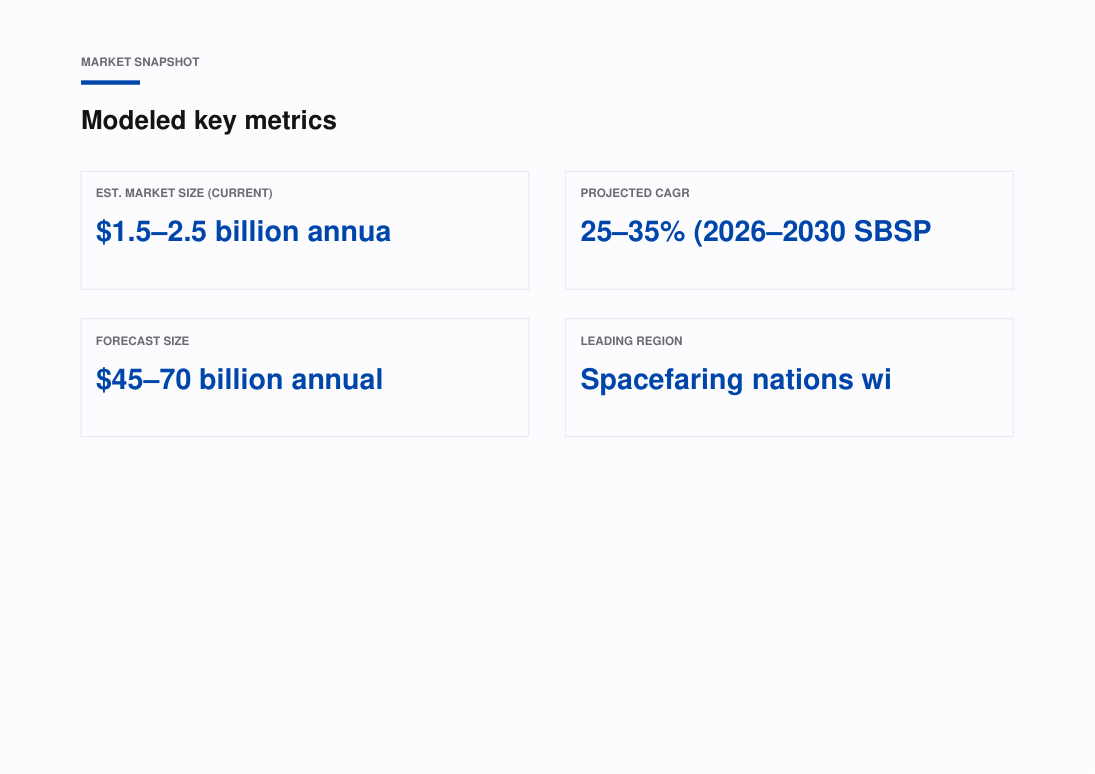
Nexvora models the Space-Based Solar Power Infrastructure Market at approximately $0.9B–$1.4B. Full market sizing, segmentation and forecasts are inside the report (modeled estimate).
What is the growth rate (CAGR) of the Space-Based Solar Power Infrastructure Market?
The Space-Based Solar Power Infrastructure Market is projected to grow at a CAGR of about 30%–38% over the forecast period — a Nexvora modeled estimate detailed across the report's 20 sections.
What does this report include?
A complete market intelligence report — market sizing and forecasts, segmentation, regional and industry analysis, competitive landscape, trends, and strategic recommendations across 20 sections.
How do I access it after purchase?
Instantly, in your secure online viewer. Reports are view-only and available on any device from your library.
Are the figures sourced?
Quantitative figures are Nexvora modeled estimates unless explicitly cited to a referenced source within the report.
Can I buy access for my team?
Yes — add user seats at checkout, or subscribe for bulk access across multiple reports.
Nexvora Intelligence research report. All quantitative figures are modeled estimates — not audited data. Not financial or investment advice.
More market reports
Keep exploring intelligence in this and related sectors.

Nexvora vs. McKinsey: Technology & Software Advisory Market — Competitive Intelligence Report

Global Intelligent PCs, On-Device Generative Computing and NPU Software Ecosystem — Intelligence Report

Global Security Posture Management, Prompt Firewalls and Agentic Threat Defense Market — Intelligence Report