
Middle East Agritech Market — Water-Efficient Agriculture, Smart Farming & Food Security Intelligence Report
Strategic outlook on controlled-environment agriculture, precision systems, irrigation efficiency and food-security investment, 2026–2031
Nexvora Intelligence market report on Middle East Agritech Market: Water-Efficient Agriculture, Smart Farming & Food Security Outlook, 2026–2031.
per extra user
Instant access after payment. Secure via Razorpay.
The opening view — free.
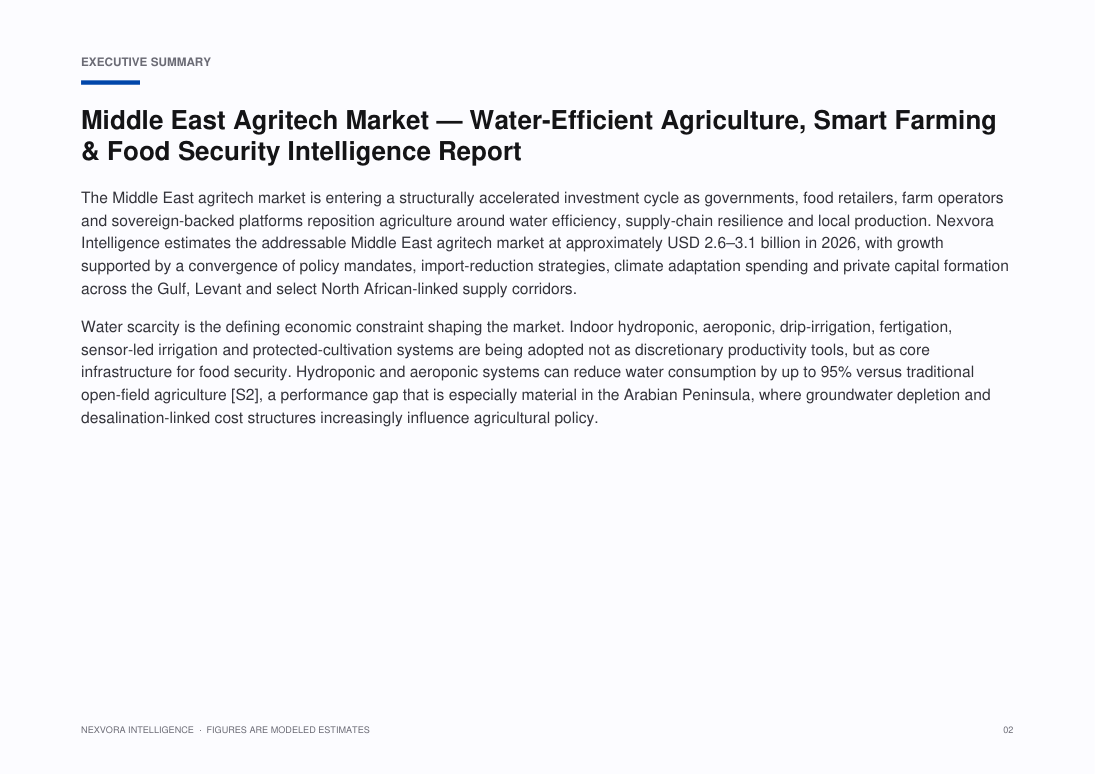
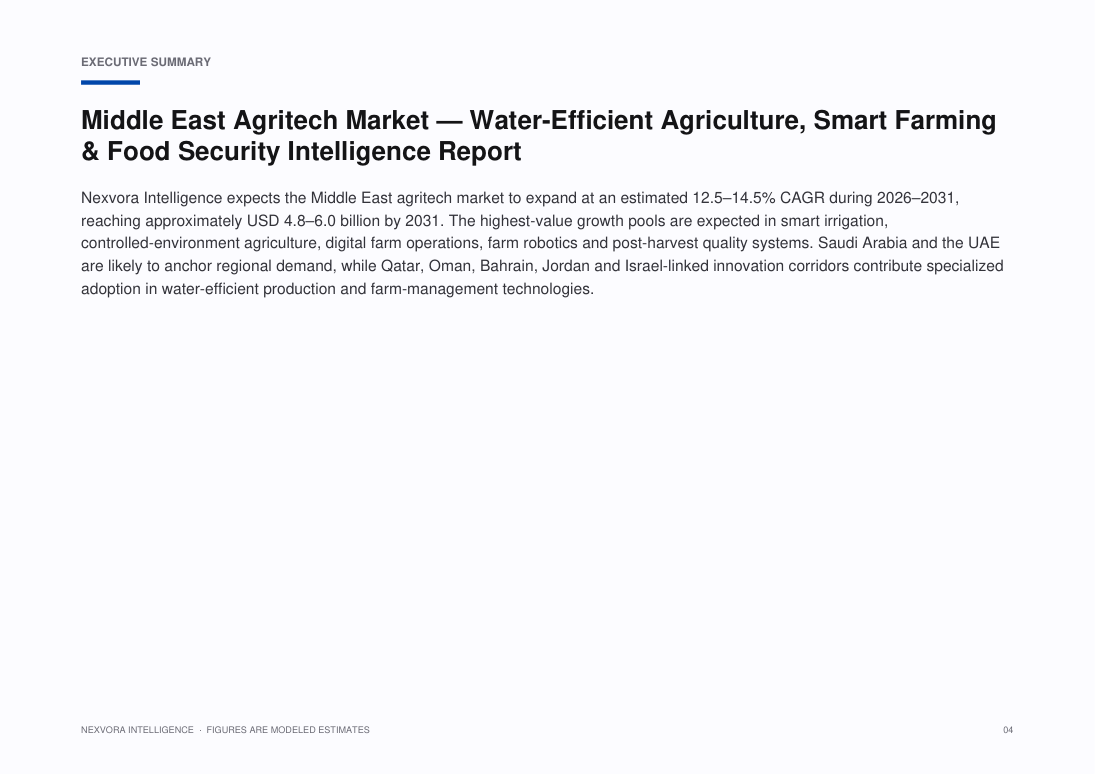
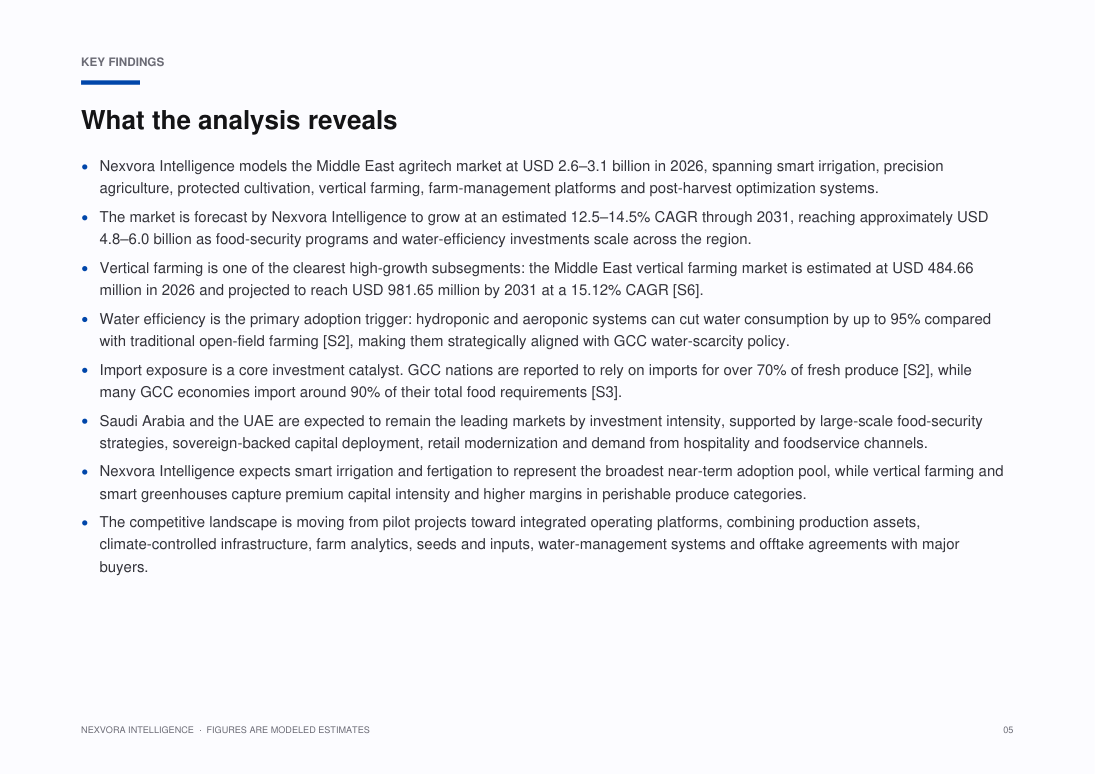
The Middle East agritech market is entering a structurally accelerated investment cycle as governments, food retailers, farm operators and sovereign-backed platforms reposition agriculture around water efficiency, supply-chain resilience and local production. Nexvora Intelligence estimates the addressable Middle East agritech market at approximately USD 2.6–••• billion in 2026, with growth supported by a convergence of policy mandates, import-reduction strategies, climate adaptation spending and private capital formation across the Gulf, Levant and select North African-linked supply corridors.
Water scarcity is the defining economic constraint shaping the market. Indoor hydroponic, aeroponic, drip-irrigation, fertigation, sensor-led irrigation and protected-cultivation systems are being adopted not as discretionary productivity tools, but as core infrastructure for food security. Hydroponic and aeroponic systems can reduce water consumption by up to ••% versus traditional open-field agriculture [S2], a performance gap that is especially material in the Arabian Peninsula, where groundwater depletion and desalination-linked cost structures increasingly influence agricultural policy.
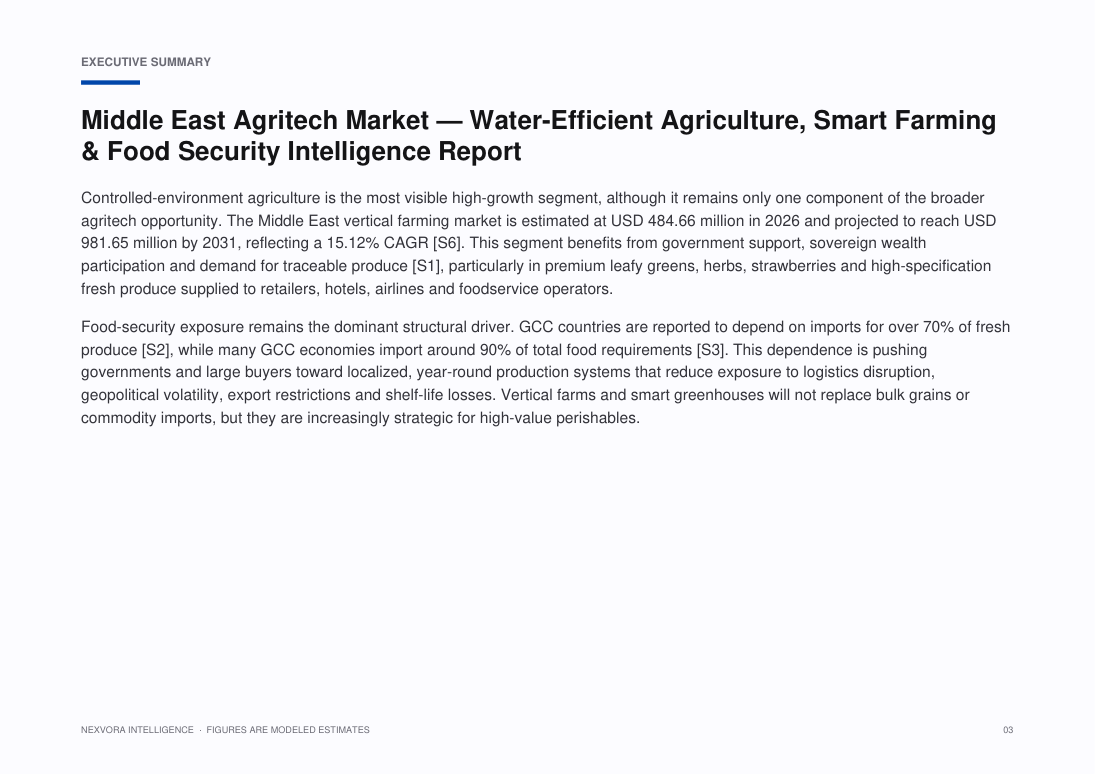
Controlled-environment agriculture is the most visible high-growth segment, although it remains only one component of the broader agritech opportunity. The Middle East vertical farming market is estimated at USD ••• million in 2026 and projected to reach USD ••• million by 2031, reflecting a ••% CAGR [S6]. This segment benefits from government support, sovereign wealth participation and demand for traceable produce [S1], particularly in premium leafy greens, herbs, strawberries and high-specification fresh produce supplied to retailers, hotels, airlines and foodservice operators.
Food-security exposure remains the dominant structural driver. GCC countries are reported to depend on imports for over ••% of fresh produce [S2], while many GCC economies import around ••% of total food requirements [S3]. This dependence is pushing governments and large buyers toward localized, year-round production systems that reduce exposure to logistics disruption, geopolitical volatility, export restrictions and shelf-life losses. Vertical farms and smart greenhouses will not replace bulk grains or commodity imports, but they are increasingly strategic for high-value perishables.
Specific figures are hidden in this free preview. Unlock the report to see all modeled market sizes, forecasts and growth rates.
What this report covers.
Strategic outlook on controlled-environment agriculture, precision systems, irrigation efficiency and food-security investment, 2026–2031
Who this report is for.
- Corporate strategy, planning and M&A teams evaluating the market
- Investors, private equity and venture teams sizing the opportunity
- Product, marketing and go-to-market leaders
- Consultants and analysts building the competitive picture
- Executives planning market entry, expansion or investment
How this report is built.
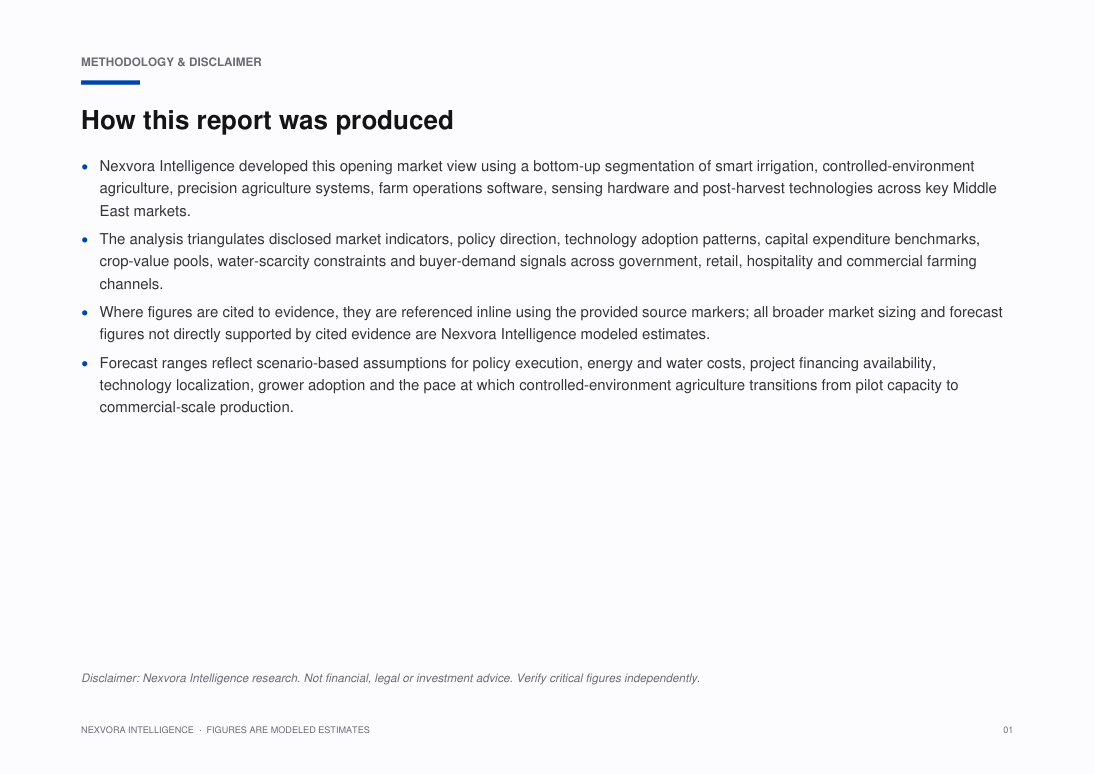
Nexvora Intelligence developed this opening market view using a bottom-up segmentation of smart irrigation, controlled-environment agriculture, precision agriculture systems, farm operations software, sensing hardware and post-harvest technologies across key Middle East markets.
The analysis triangulates disclosed market indicators, policy direction, technology adoption patterns, capital expenditure benchmarks, crop-value pools, water-scarcity constraints and buyer-demand signals across government, retail, hospitality and commercial farming channels.
Where figures are cited to evidence, they are referenced inline using the provided source markers; all broader market sizing and forecast figures not directly supported by cited evidence are Nexvora Intelligence modeled estimates.
Forecast ranges reflect scenario-based assumptions for policy execution, energy and water costs, project financing availability, technology localization, grower adoption and the pace at which controlled-environment agriculture transitions from pilot capacity to commercial-scale production.
What's inside — a number-free look.
A full outline of the figures and tables you'll get. Specific data, market sizes and forecasts are unlocked with purchase.
List of Figures
- Figure 1: Market Overview and Structure — Middle East Agritech — Water-Efficient Agriculture, Smart Farming & Food Security
- Figure 2: Market Size and Forecast Framework — Middle East Agritech — Water-Efficient Agriculture, Smart Farming & Food Security
- Figure 3: Value Chain and Ecosystem Analysis — Middle East Agritech — Water-Efficient Agriculture, Smart Farming & Food Security
- Figure 4: Market Dynamics — Drivers, Restraints and Opportunities — Middle East Agritech — Water-Efficient Agriculture, Smart Farming & Food Security
- Figure 5: Segment Contribution Analysis — Middle East Agritech — Water-Efficient Agriculture, Smart Farming & Food Security
- Figure 6: Regional Market Landscape — Middle East Agritech — Water-Efficient Agriculture, Smart Farming & Food Security
- Figure 7: Country-level Opportunity Mapping — Middle East Agritech — Water-Efficient Agriculture, Smart Farming & Food Security
- Figure 8: Competitive Positioning Matrix — Middle East Agritech — Water-Efficient Agriculture, Smart Farming & Food Security
- Figure 9: Market Share of Leading Players — Middle East Agritech — Water-Efficient Agriculture, Smart Farming & Food Security
- Figure 10: Adoption and Penetration Trends — Middle East Agritech — Water-Efficient Agriculture, Smart Farming & Food Security
- Figure 11: Technology and Innovation Landscape — Middle East Agritech — Water-Efficient Agriculture, Smart Farming & Food Security
- Figure 12: Pricing and Business Model Analysis — Middle East Agritech — Water-Efficient Agriculture, Smart Farming & Food Security
- Figure 13: Investment, Funding and M&A Landscape — Middle East Agritech — Water-Efficient Agriculture, Smart Farming & Food Security
- Figure 14: Regulatory and Policy Framework — Middle East Agritech — Water-Efficient Agriculture, Smart Farming & Food Security
- Figure 15: Porter's Five Forces Analysis — Middle East Agritech — Water-Efficient Agriculture, Smart Farming & Food Security
- Figure 16: PESTLE Analysis — Middle East Agritech — Water-Efficient Agriculture, Smart Farming & Food Security
- Figure 17: Growth Opportunity Heat Map — Middle East Agritech — Water-Efficient Agriculture, Smart Farming & Food Security
- Figure 18: Future Outlook and Strategic Roadmap — Middle East Agritech — Water-Efficient Agriculture, Smart Farming & Food Security
List of Tables
- Table 1: Market Segmentation Overview — Middle East Agritech — Water-Efficient Agriculture, Smart Farming & Food Security
- Table 2: Segment Definitions and Scope — Middle East Agritech — Water-Efficient Agriculture, Smart Farming & Food Security
- Table 3: Regional and Country Coverage Summary — Middle East Agritech — Water-Efficient Agriculture, Smart Farming & Food Security
- Table 4: Key Company Profiles and Offerings — Middle East Agritech — Water-Efficient Agriculture, Smart Farming & Food Security
- Table 5: Competitive Benchmarking Matrix — Middle East Agritech — Water-Efficient Agriculture, Smart Farming & Food Security
- Table 6: Product and Service Portfolio Mapping — Middle East Agritech — Water-Efficient Agriculture, Smart Farming & Food Security
- Table 7: Market Drivers, Restraints and Trends — Middle East Agritech — Water-Efficient Agriculture, Smart Farming & Food Security
- Table 8: Strategic Initiatives and Developments — Middle East Agritech — Water-Efficient Agriculture, Smart Farming & Food Security
- Table 9: Partnerships and Collaborations — Middle East Agritech — Water-Efficient Agriculture, Smart Farming & Food Security
- Table 10: Research Assumptions and Limitations — Middle East Agritech — Water-Efficient Agriculture, Smart Farming & Food Security
- Table 11: Data Sources and References — Middle East Agritech — Water-Efficient Agriculture, Smart Farming & Food Security
- Table 12: Report Scope and Coverage Summary — Middle East Agritech — Water-Efficient Agriculture, Smart Farming & Food Security
A look at the pages.
108 pages · 20 sections · charts & tables
A genuine peek at the opening pages. Unlock to read every page in full.
6 of 108 pages shown
Turn this market into a plan for your business.
Answer a few quick questions and unlock a personalised operational read — your maturity score, prioritised focus areas and quick wins — mapped to where this market is heading. Result delivered instantly and emailed to you.
- Maturity score & prioritised focus areas
- Practical quick wins and a recommended next step
Questions, answered.
How big is the Middle East Agritech Market?
Nexvora models the Middle East Agritech Market at approximately USD 2.6–3.1 billion, 2026. Full market sizing, segmentation and forecasts are inside the report (modeled estimate).
What is the growth rate (CAGR) of the Middle East Agritech Market?
The Middle East Agritech Market is projected to grow at a CAGR of about 12.5–14.5%, 2026–2031 over the forecast period — a Nexvora modeled estimate detailed across the report's 20 sections.
What does this report include?
A complete market intelligence report — market sizing and forecasts, segmentation, regional and industry analysis, competitive landscape, trends, and strategic recommendations across 20 sections.
How do I access it after purchase?
Instantly, in your secure online viewer. Reports are view-only and available on any device from your library.
Are the figures sourced?
Quantitative figures are Nexvora modeled estimates unless explicitly cited to a referenced source within the report.
Can I buy access for my team?
Yes — add user seats at checkout, or subscribe for bulk access across multiple reports.
Nexvora Intelligence research report. All quantitative figures are modeled estimates — not audited data. Not financial or investment advice.
More market reports
Keep exploring intelligence in this and related sectors.
Global Smart Farming Market — Intelligence Report
Asia-Pacific Agritech Market — Digital Agriculture, Farm Automation & Technology Adoption Intelligence Report
India Agritech Market: Digital Farming, Precision Agriculture & Investment Opportunities — Intelligence Report
