
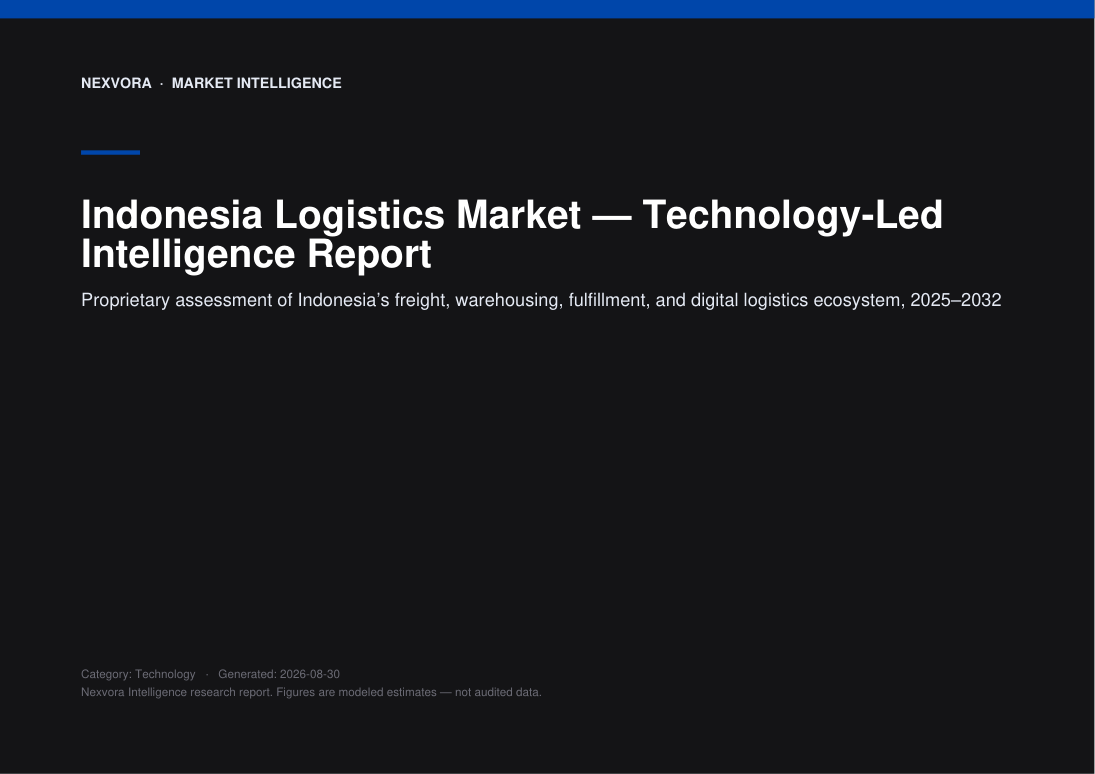
Indonesia Logistics Market — Technology-Led Intelligence Report
Proprietary assessment of Indonesia’s freight, warehousing, fulfillment, and digital logistics ecosystem, 2025–2032
Nexvora Intelligence market report on INDONESIA LOGISTIC MARKET.
per extra user
Instant access after payment. Secure via Razorpay.
The opening view — free.
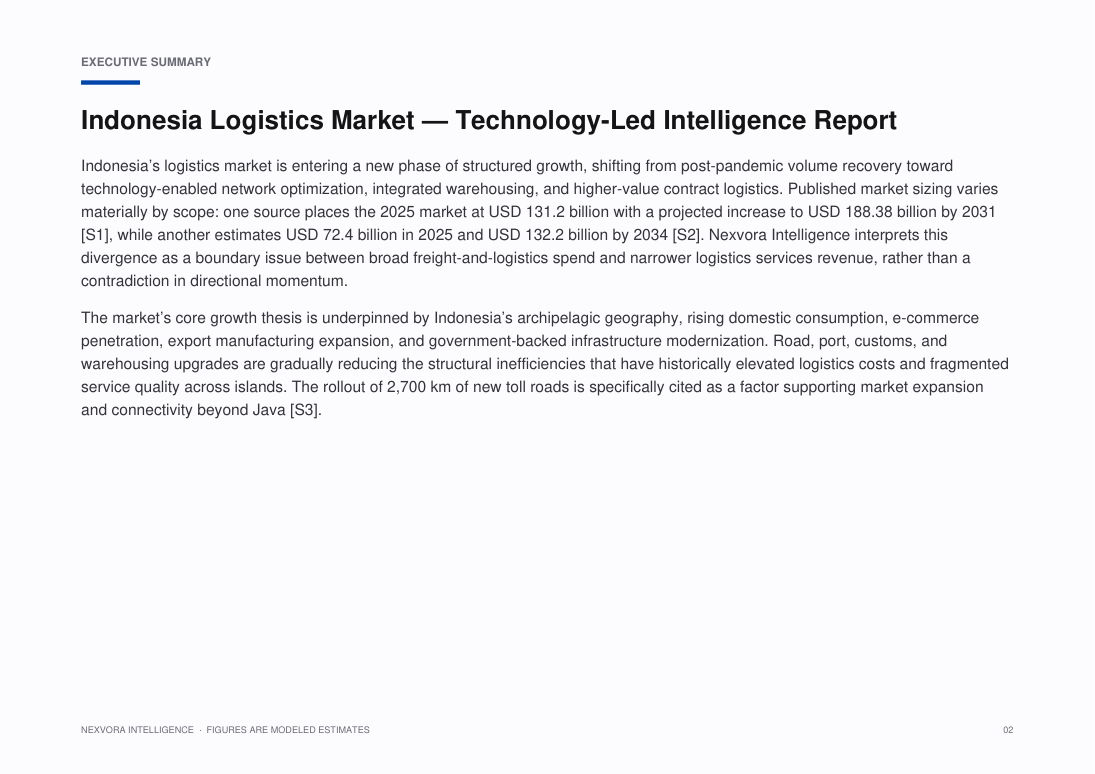
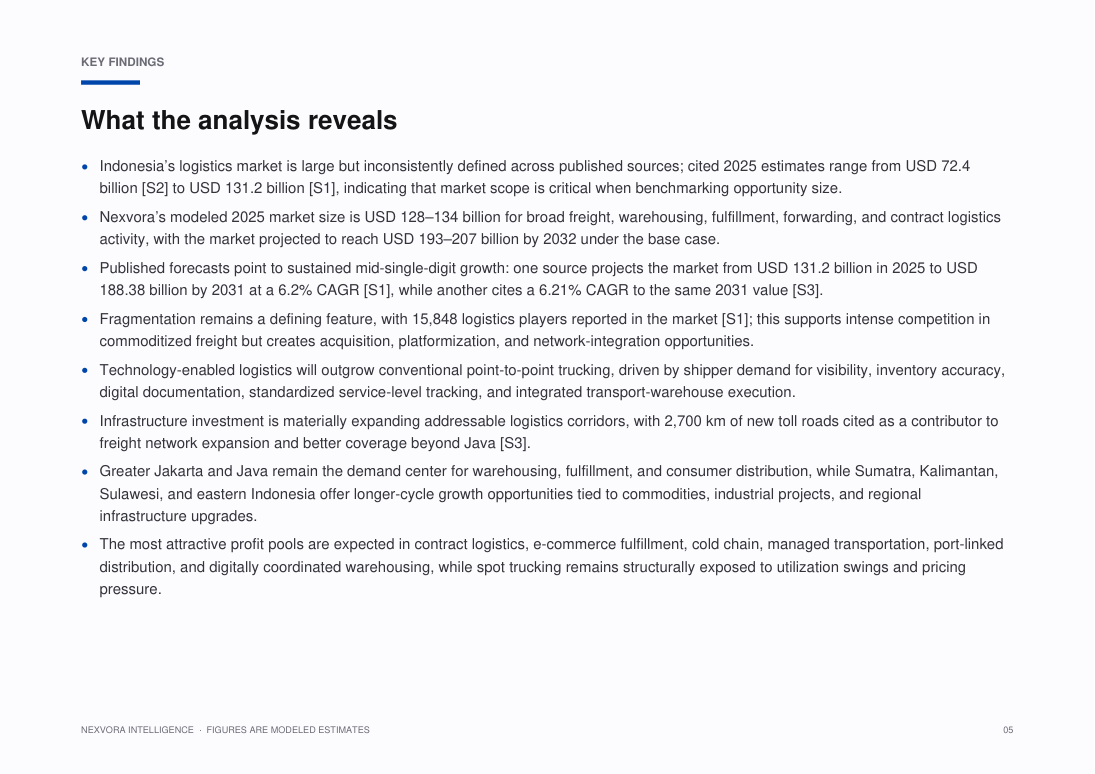
Indonesia’s logistics market is entering a new phase of structured growth, shifting from post-pandemic volume recovery toward technology-enabled network optimization, integrated warehousing, and higher-value contract logistics. Published market sizing varies materially by scope: one source places the 2025 market at USD ••• billion with a projected increase to USD ••• billion by 2031 [S1], while another estimates USD ••• billion in 2025 and USD ••• billion by 2034 [S2]. Nexvora Intelligence interprets this divergence as a boundary issue between broad freight-and-logistics spend and narrower logistics services revenue, rather than a contradiction in directional momentum.
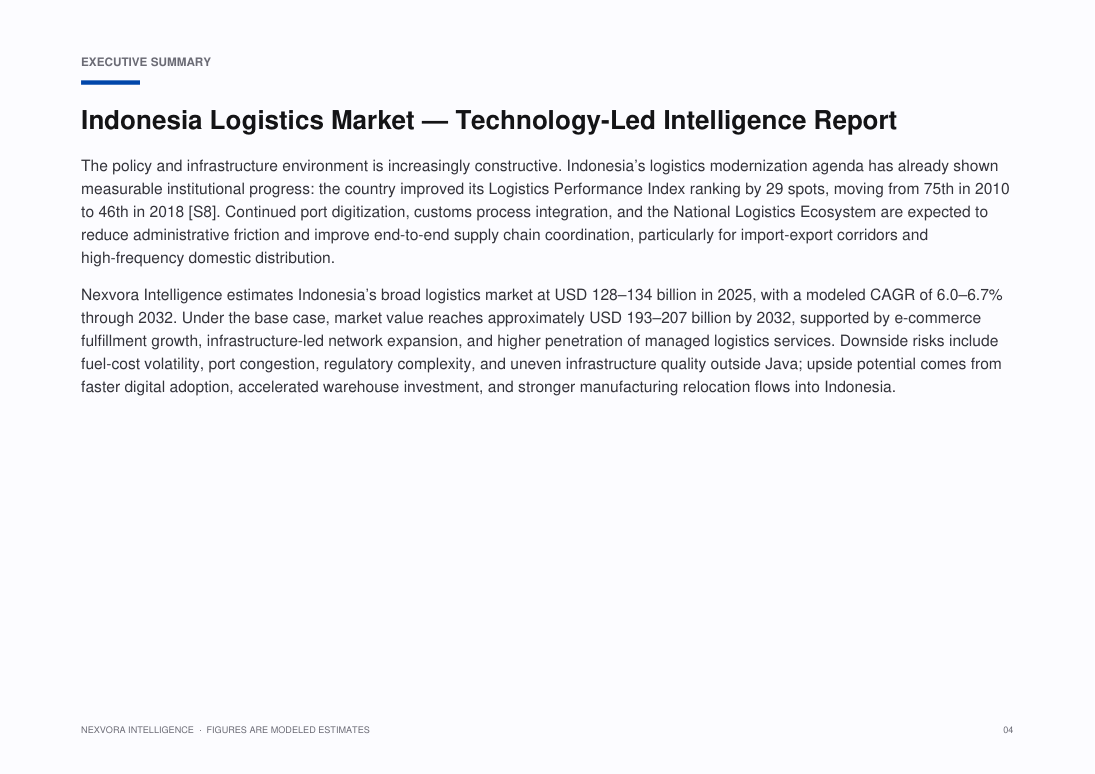
The market’s core growth thesis is underpinned by Indonesia’s archipelagic geography, rising domestic consumption, e-commerce penetration, export manufacturing expansion, and government-backed infrastructure modernization. Road, port, customs, and warehousing upgrades are gradually reducing the structural inefficiencies that have historically elevated logistics costs and fragmented service quality across islands. The rollout of 2,700 km of new toll roads is specifically cited as a factor supporting market expansion and connectivity beyond Java [S3].
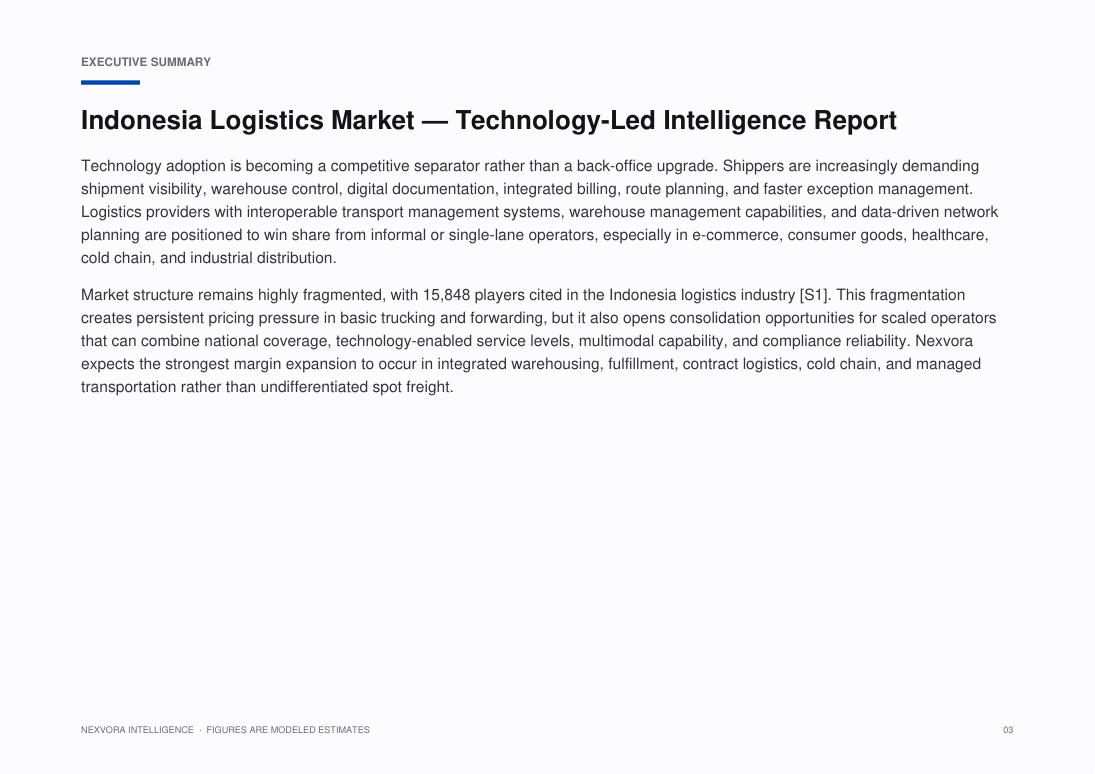
Technology adoption is becoming a competitive separator rather than a back-office upgrade. Shippers are increasingly demanding shipment visibility, warehouse control, digital documentation, integrated billing, route planning, and faster exception management. Logistics providers with interoperable transport management systems, warehouse management capabilities, and data-driven network planning are positioned to win share from informal or single-lane operators, especially in e-commerce, consumer goods, healthcare, cold chain, and industrial distribution.
Market structure remains highly fragmented, with 15,848 players cited in the Indonesia logistics industry [S1]. This fragmentation creates persistent pricing pressure in basic trucking and forwarding, but it also opens consolidation opportunities for scaled operators that can combine national coverage, technology-enabled service levels, multimodal capability, and compliance reliability. Nexvora expects the strongest margin expansion to occur in integrated warehousing, fulfillment, contract logistics, cold chain, and managed transportation rather than undifferentiated spot freight.
Specific figures are hidden in this free preview. Unlock the report to see all modeled market sizes, forecasts and growth rates.
What this report covers.
Proprietary assessment of Indonesia’s freight, warehousing, fulfillment, and digital logistics ecosystem, 2025–2032
Who this report is for.
- Corporate strategy, planning and M&A teams evaluating the market
- Investors, private equity and venture teams sizing the opportunity
- Product, marketing and go-to-market leaders
- Consultants and analysts building the competitive picture
- Executives planning market entry, expansion or investment
How this report is built.
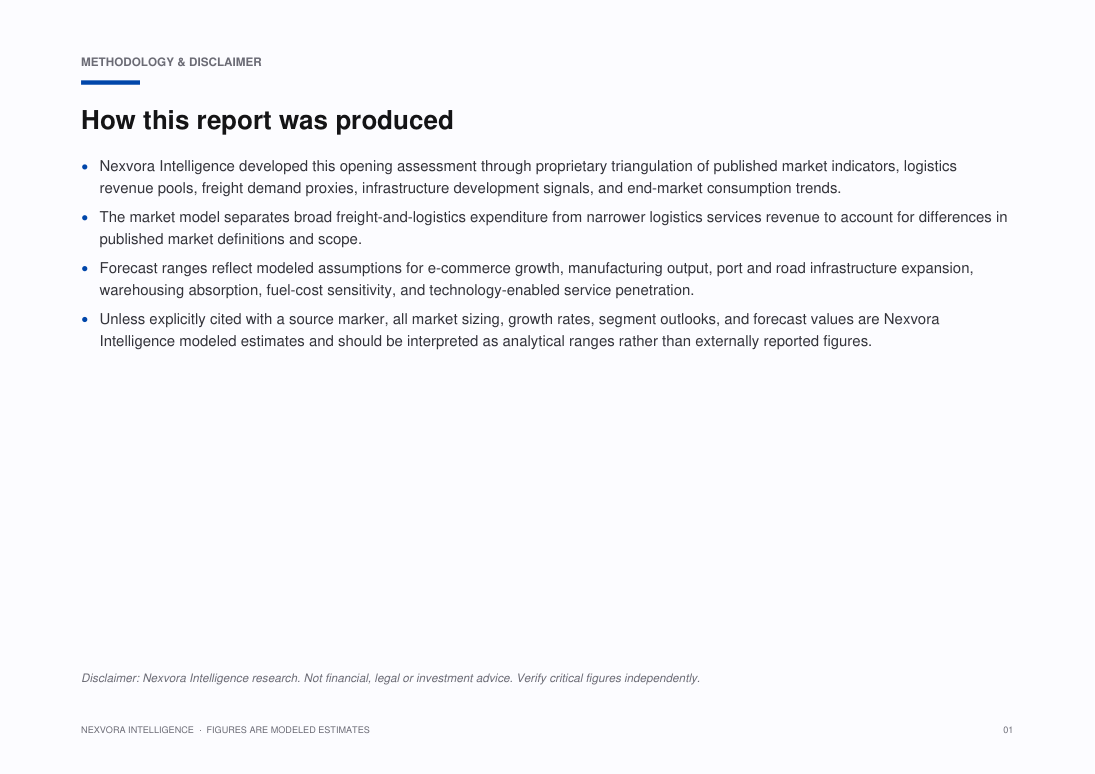
Nexvora Intelligence developed this opening assessment through proprietary triangulation of published market indicators, logistics revenue pools, freight demand proxies, infrastructure development signals, and end-market consumption trends.
The market model separates broad freight-and-logistics expenditure from narrower logistics services revenue to account for differences in published market definitions and scope.
Forecast ranges reflect modeled assumptions for e-commerce growth, manufacturing output, port and road infrastructure expansion, warehousing absorption, fuel-cost sensitivity, and technology-enabled service penetration.
Unless explicitly cited with a source marker, all market sizing, growth rates, segment outlooks, and forecast values are Nexvora Intelligence modeled estimates and should be interpreted as analytical ranges rather than externally reported figures.
What's inside — a number-free look.
A full outline of the figures and tables you'll get. Specific data, market sizes and forecasts are unlocked with purchase.
List of Figures
- Figure 1: Market Overview and Structure — Indonesia Logistics — Technology-Led
- Figure 2: Market Size and Forecast Framework — Indonesia Logistics — Technology-Led
- Figure 3: Value Chain and Ecosystem Analysis — Indonesia Logistics — Technology-Led
- Figure 4: Market Dynamics — Drivers, Restraints and Opportunities — Indonesia Logistics — Technology-Led
- Figure 5: Segment Contribution Analysis — Indonesia Logistics — Technology-Led
- Figure 6: Regional Market Landscape — Indonesia Logistics — Technology-Led
- Figure 7: Country-level Opportunity Mapping — Indonesia Logistics — Technology-Led
- Figure 8: Competitive Positioning Matrix — Indonesia Logistics — Technology-Led
- Figure 9: Market Share of Leading Players — Indonesia Logistics — Technology-Led
- Figure 10: Adoption and Penetration Trends — Indonesia Logistics — Technology-Led
- Figure 11: Technology and Innovation Landscape — Indonesia Logistics — Technology-Led
- Figure 12: Pricing and Business Model Analysis — Indonesia Logistics — Technology-Led
- Figure 13: Investment, Funding and M&A Landscape — Indonesia Logistics — Technology-Led
- Figure 14: Regulatory and Policy Framework — Indonesia Logistics — Technology-Led
- Figure 15: Porter's Five Forces Analysis — Indonesia Logistics — Technology-Led
- Figure 16: PESTLE Analysis — Indonesia Logistics — Technology-Led
- Figure 17: Growth Opportunity Heat Map — Indonesia Logistics — Technology-Led
- Figure 18: Future Outlook and Strategic Roadmap — Indonesia Logistics — Technology-Led
List of Tables
- Table 1: Market Segmentation Overview — Indonesia Logistics — Technology-Led
- Table 2: Segment Definitions and Scope — Indonesia Logistics — Technology-Led
- Table 3: Regional and Country Coverage Summary — Indonesia Logistics — Technology-Led
- Table 4: Key Company Profiles and Offerings — Indonesia Logistics — Technology-Led
- Table 5: Competitive Benchmarking Matrix — Indonesia Logistics — Technology-Led
- Table 6: Product and Service Portfolio Mapping — Indonesia Logistics — Technology-Led
- Table 7: Market Drivers, Restraints and Trends — Indonesia Logistics — Technology-Led
- Table 8: Strategic Initiatives and Developments — Indonesia Logistics — Technology-Led
- Table 9: Partnerships and Collaborations — Indonesia Logistics — Technology-Led
- Table 10: Research Assumptions and Limitations — Indonesia Logistics — Technology-Led
- Table 11: Data Sources and References — Indonesia Logistics — Technology-Led
- Table 12: Report Scope and Coverage Summary — Indonesia Logistics — Technology-Led
A look at the pages.
108 pages · 20 sections · charts & tables
A genuine peek at the opening pages. Unlock to read every page in full.
6 of 108 pages shown
Turn this market into a plan for your business.
Answer a few quick questions and unlock a personalised operational read — your maturity score, prioritised focus areas and quick wins — mapped to where this market is heading. Result delivered instantly and emailed to you.
- Maturity score & prioritised focus areas
- Practical quick wins and a recommended next step
Questions, answered.
How big is the Indonesia Logistics Market?
Nexvora models the Indonesia Logistics Market at approximately USD 128–134 billion, 2025. Full market sizing, segmentation and forecasts are inside the report (modeled estimate).
What is the growth rate (CAGR) of the Indonesia Logistics Market?
The Indonesia Logistics Market is projected to grow at a CAGR of about 6.0–6.7%, 2025–2032 over the forecast period — a Nexvora modeled estimate detailed across the report's 20 sections.
What does this report include?
A complete market intelligence report — market sizing and forecasts, segmentation, regional and industry analysis, competitive landscape, trends, and strategic recommendations across 20 sections.
How do I access it after purchase?
Instantly, in your secure online viewer. Reports are view-only and available on any device from your library.
Are the figures sourced?
Quantitative figures are Nexvora modeled estimates unless explicitly cited to a referenced source within the report.
Can I buy access for my team?
Yes — add user seats at checkout, or subscribe for bulk access across multiple reports.
Nexvora Intelligence research report. All quantitative figures are modeled estimates — not audited data. Not financial or investment advice.
High-Performance Computing Systems vs Quantum Computing Systems
Choose Dell High-Performance Computing Systems if you need a configurable HPC infrastructure solution built from Dell server, storage, networking, software, and services portfolio. Choose IBM Quantum Computing Systems if you specifically need gate-based quantum computing using superconducting qubits, cloud access through IBM Quantum services, and the Qiskit software ecosystem. The right choice depends on whether the buyer’s priority is configurable HPC infrastructure or access to IBM’s quantum computing model and tools.
Grounded in published specifications — guidance, not an endorsement.
More market reports
Keep exploring intelligence in this and related sectors.

Global Security Operations Copilots & Autonomous SOC Market — Intelligence Report

India Digital Freight Brokerage Market — Intelligence Report

Global Sovereign Compute Cloud & GPU-as-a-Service Infrastructure Market — Intelligence Report

Global Enterprise Agentic Orchestration & Workflow Automation Market — Intelligence Report
AI Analyst
Insights and answers generated live from Indonesia Logistics Market — Technology-Led Intelligence Report's verified data. Modeled estimates — not investment advice.
- The report covers Indonesia’s technology-led logistics market, including freight, warehousing, fulfillment, and digital logistics.
- The market assessment is positioned for the 2025–2032 forecast period.
- The report focuses on technology-led intelligence for Indonesia’s logistics ecosystem within the Technology sector.
- Notable: No market size, share, growth rate, or forecast figures are provided in the supplied data.