
India Supply Chain Management Market — Intelligence Report
Logistics and warehousing platforms, software and services outlook, 2026–2030
Nexvora Intelligence market report on India Supply Chain Management Market Report 2026–2030.

per extra user
Instant access after payment. Secure via Razorpay.
The opening view — free.
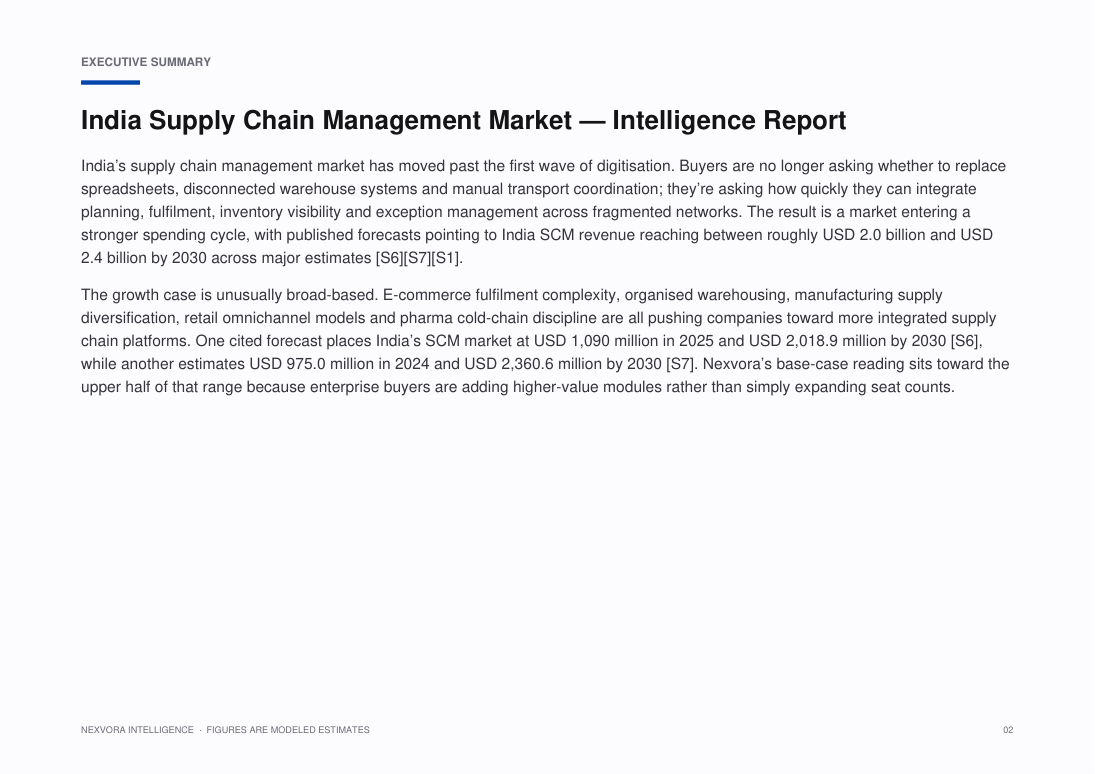
India’s supply chain management market has moved past the first wave of digitisation. Buyers are no longer asking whether to replace spreadsheets, disconnected warehouse systems and manual transport coordination; they’re asking how quickly they can integrate planning, fulfilment, inventory visibility and exception management across fragmented networks. The result is a market entering a stronger spending cycle, with published forecasts pointing to India SCM revenue reaching between roughly USD ••• billion and USD ••• billion by 2030 across major estimates [S6][S7][S1].
The growth case is unusually broad-based. E-commerce fulfilment complexity, organised warehousing, manufacturing supply diversification, retail omnichannel models and pharma cold-chain discipline are all pushing companies toward more integrated supply chain platforms. One cited forecast places India’s SCM market at USD ••• million in 2025 and USD ••• million by 2030 [S6], while another estimates USD ••• million in 2024 and USD ••• million by 2030 [S7]. Nexvora’s base-case reading sits toward the upper half of that range because enterprise buyers are adding higher-value modules rather than simply expanding seat counts.
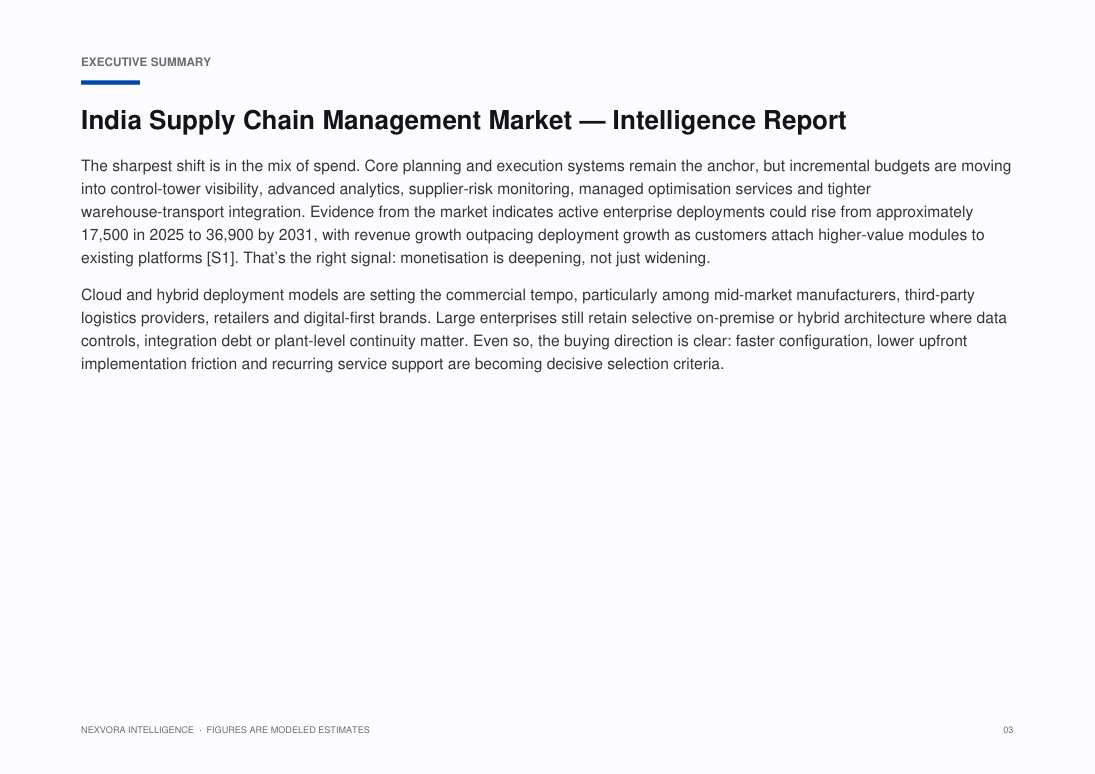
The sharpest shift is in the mix of spend. Core planning and execution systems remain the anchor, but incremental budgets are moving into control-tower visibility, advanced analytics, supplier-risk monitoring, managed optimisation services and tighter warehouse-transport integration. Evidence from the market indicates active enterprise deployments could rise from approximately 17,500 in 2025 to 36,900 by 2031, with revenue growth outpacing deployment growth as customers attach higher-value modules to existing platforms [S1]. That’s the right signal: monetisation is deepening, not just widening.
Cloud and hybrid deployment models are setting the commercial tempo, particularly among mid-market manufacturers, third-party logistics providers, retailers and digital-first brands. Large enterprises still retain selective on-premise or hybrid architecture where data controls, integration debt or plant-level continuity matter. Even so, the buying direction is clear: faster configuration, lower upfront implementation friction and recurring service support are becoming decisive selection criteria.
Specific figures are hidden in this free preview. Unlock the report to see all modeled market sizes, forecasts and growth rates.
What this report covers.
Logistics and warehousing platforms, software and services outlook, 2026–2030
Who this report is for.
- Corporate strategy, planning and M&A teams evaluating the market
- Investors, private equity and venture teams sizing the opportunity
- Product, marketing and go-to-market leaders
- Consultants and analysts building the competitive picture
- Executives planning market entry, expansion or investment
How this report is built.
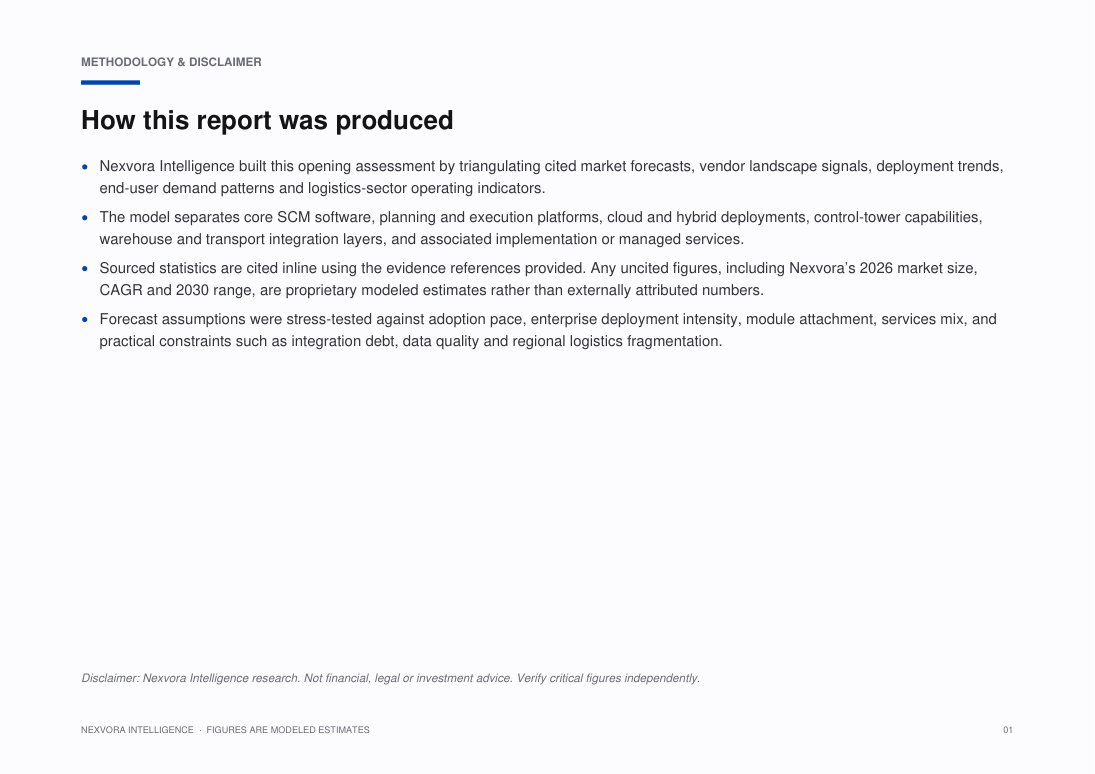
Nexvora Intelligence built this opening assessment by triangulating cited market forecasts, vendor landscape signals, deployment trends, end-user demand patterns and logistics-sector operating indicators.
The model separates core SCM software, planning and execution platforms, cloud and hybrid deployments, control-tower capabilities, warehouse and transport integration layers, and associated implementation or managed services.
Sourced statistics are cited inline using the evidence references provided. Any uncited figures, including Nexvora’s 2026 market size, CAGR and 2030 range, are proprietary modeled estimates rather than externally attributed numbers.
Forecast assumptions were stress-tested against adoption pace, enterprise deployment intensity, module attachment, services mix, and practical constraints such as integration debt, data quality and regional logistics fragmentation.
What's inside — a number-free look.
A full outline of the figures and tables you'll get. Specific data, market sizes and forecasts are unlocked with purchase.
List of Figures
- Figure 1: Market Overview and Structure — India Supply Chain Management
- Figure 2: Market Size and Forecast Framework — India Supply Chain Management
- Figure 3: Value Chain and Ecosystem Analysis — India Supply Chain Management
- Figure 4: Market Dynamics — Drivers, Restraints and Opportunities — India Supply Chain Management
- Figure 5: Segment Contribution Analysis — India Supply Chain Management
- Figure 6: Regional Market Landscape — India Supply Chain Management
- Figure 7: Country-level Opportunity Mapping — India Supply Chain Management
- Figure 8: Competitive Positioning Matrix — India Supply Chain Management
- Figure 9: Market Share of Leading Players — India Supply Chain Management
- Figure 10: Adoption and Penetration Trends — India Supply Chain Management
- Figure 11: Technology and Innovation Landscape — India Supply Chain Management
- Figure 12: Pricing and Business Model Analysis — India Supply Chain Management
- Figure 13: Investment, Funding and M&A Landscape — India Supply Chain Management
- Figure 14: Regulatory and Policy Framework — India Supply Chain Management
- Figure 15: Porter's Five Forces Analysis — India Supply Chain Management
- Figure 16: PESTLE Analysis — India Supply Chain Management
- Figure 17: Growth Opportunity Heat Map — India Supply Chain Management
- Figure 18: Future Outlook and Strategic Roadmap — India Supply Chain Management
List of Tables
- Table 1: Market Segmentation Overview — India Supply Chain Management
- Table 2: Segment Definitions and Scope — India Supply Chain Management
- Table 3: Regional and Country Coverage Summary — India Supply Chain Management
- Table 4: Key Company Profiles and Offerings — India Supply Chain Management
- Table 5: Competitive Benchmarking Matrix — India Supply Chain Management
- Table 6: Product and Service Portfolio Mapping — India Supply Chain Management
- Table 7: Market Drivers, Restraints and Trends — India Supply Chain Management
- Table 8: Strategic Initiatives and Developments — India Supply Chain Management
- Table 9: Partnerships and Collaborations — India Supply Chain Management
- Table 10: Research Assumptions and Limitations — India Supply Chain Management
- Table 11: Data Sources and References — India Supply Chain Management
- Table 12: Report Scope and Coverage Summary — India Supply Chain Management
A look at the pages.
106 pages · 20 sections · charts & tables
A genuine peek at the opening pages. Unlock to read every page in full.
6 of 106 pages shown
Turn this market into a plan for your business.
Answer a few quick questions and unlock a personalised operational read — your maturity score, prioritised focus areas and quick wins — mapped to where this market is heading. Result delivered instantly and emailed to you.
- Maturity score & prioritised focus areas
- Practical quick wins and a recommended next step
Questions, answered.
How big is the India Supply Chain Management Market?
Nexvora models the India Supply Chain Management Market at approximately USD 1.25–1.35 billion (2026). Full market sizing, segmentation and forecasts are inside the report (modeled estimate).
What is the growth rate (CAGR) of the India Supply Chain Management Market?
The India Supply Chain Management Market is projected to grow at a CAGR of about 14–16% (2026–2030) over the forecast period — a Nexvora modeled estimate detailed across the report's 20 sections.
What does this report include?
A complete market intelligence report — market sizing and forecasts, segmentation, regional and industry analysis, competitive landscape, trends, and strategic recommendations across 20 sections.
How do I access it after purchase?
Instantly, in your secure online viewer. Reports are view-only and available on any device from your library.
Are the figures sourced?
Quantitative figures are Nexvora modeled estimates unless explicitly cited to a referenced source within the report.
Can I buy access for my team?
Yes — add user seats at checkout, or subscribe for bulk access across multiple reports.
Nexvora Intelligence research report. All quantitative figures are modeled estimates — not audited data. Not financial or investment advice.
Cold Chain Logistics Solutions vs Enterprise Resource Planning Software
The right choice depends on whether the buyer needs enterprise software or logistics services. Choose SAP Enterprise Resource Planning Software if you need ERP capabilities from the SAP S/4HANA and SAP ERP portfolio, with cloud and on-premises options available. Choose DHL Supply Chain Cold Chain Logistics Solutions if you need cold chain logistics and temperature-controlled warehousing.
Grounded in published specifications — guidance, not an endorsement.
More market reports
Keep exploring intelligence in this and related sectors.
India Logistics Infrastructure Market — Intelligence Report
India Contract Logistics Market — Intelligence Report
India E-Commerce Logistics Market — Intelligence Report
India Last-Mile Delivery Market — Intelligence Report
AI Analyst
Insights and answers generated live from India Supply Chain Management Market — Intelligence Report's verified data. Modeled estimates — not investment advice.
- The report covers the India Supply Chain Management market for the 2026–2030 forecast period.
- The market report is positioned within the Logistics and Warehousing sector.
- The outlook focuses on logistics and warehousing platforms, software, and services in India.
- Notable: The keyword set emphasizes market size, market share, forecast, trends, and industry analysis for India Supply Chain Management during 2026–2030.