
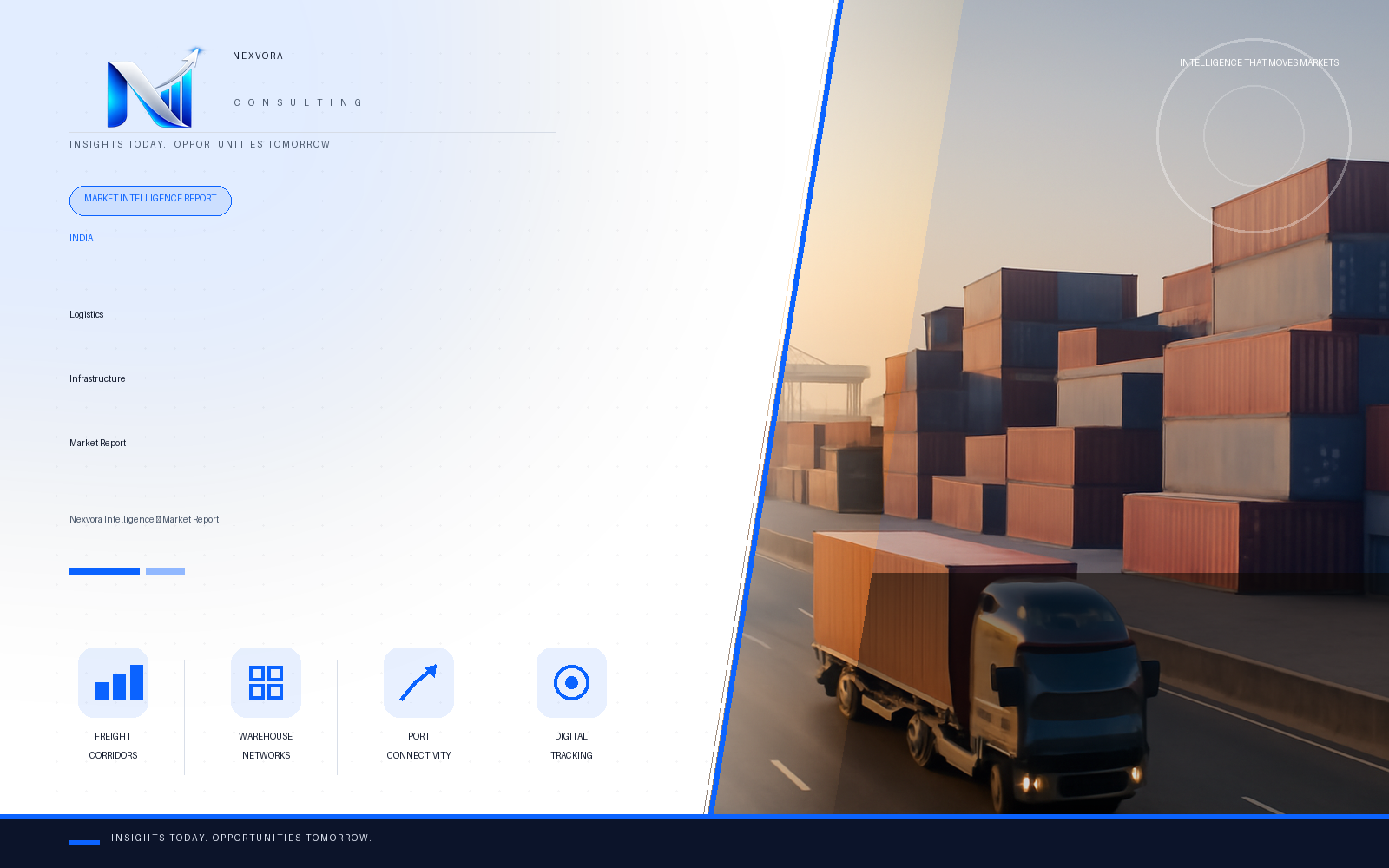
India Logistics Infrastructure Market — Intelligence Report
Proprietary market assessment of logistics parks, warehousing, cold chain, intermodal nodes, and supporting infrastructure, 2026–2030
Nexvora Intelligence market report on India Logistics Infrastructure Market Report 2026–2030.
per extra user
Instant access after payment. Secure via Razorpay.
The opening view — free.
India’s logistics infrastructure market is moving from capacity catch-up to network redesign. The old model — fragmented warehouses near tax boundaries, high road dependence, and thin technology adoption — is being replaced by corridor-led distribution, larger Grade-A parks, multimodal nodes, and more disciplined national supply chain planning. Nexvora Intelligence estimates the India logistics infrastructure market at USD 39–••• billion in 2026, with the addressable market likely to reach USD 62–••• billion by 2030 under our base-case scenario.
The underlying freight economy gives the infrastructure story unusual depth. India’s broader logistics sector is projected to expand from approximately USD 300–••• billion today to more than USD ••• billion by 2030 [S2]. That scale matters: every percentage-point shift toward organized warehousing, faster fulfilment, cold-chain reliability, or intermodal efficiency creates a large investable pool for logistics real estate developers, infrastructure operators, 3PLs, port-linked parks, rail terminal owners, and automation vendors.
Policy is no longer a side note. The National Logistics Policy, PM Gati Shakti, Dedicated Freight Corridors, GST-led network rationalization, and e-way bill discipline are pushing logistics assets into formal, higher-utilization networks. Brickwork Ratings notes that the organized market now covers ••%, supported by GST and e-way bill reforms [S7]. This formalization is widening the gap between institutional-grade assets and legacy stock, particularly in warehousing, cold chain, and regional distribution infrastructure.
Demand is broad-based, but not evenly distributed. Manufacturing, consumer goods, automotive, pharmaceuticals, food and beverage, e-commerce, and quick commerce are all pulling capacity in different directions. Express logistics is expected to nearly double to USD 18–••• billion by FY2030 [S1], while India’s third-party logistics market is expected to add USD ••• billion between 2026 and 2030 at a ••% CAGR [S3]. These are not just service-market numbers; they translate directly into sorting hubs, last-mile depots, fulfilment centres, truck terminals, and urban logistics formats.
Specific figures are hidden in this free preview. Unlock the report to see all modeled market sizes, forecasts and growth rates.
What this report covers.
Proprietary market assessment of logistics parks, warehousing, cold chain, intermodal nodes, and supporting infrastructure, 2026–2030
Who this report is for.
- Corporate strategy, planning and M&A teams evaluating the market
- Investors, private equity and venture teams sizing the opportunity
- Product, marketing and go-to-market leaders
- Consultants and analysts building the competitive picture
- Executives planning market entry, expansion or investment
How this report is built.
Nexvora Intelligence defines the India logistics infrastructure market as the monetizable infrastructure base serving freight movement, storage, consolidation, fulfilment, temperature-controlled distribution, inland connectivity, and multimodal logistics operations.
Our estimates are built from a bottom-up assessment of warehousing stock, logistics park development, cold-chain capacity, terminal infrastructure, corridor activity, occupier demand, rental and utilization assumptions, and capital deployment patterns across major Indian logistics clusters.
We cross-check modeled outputs against disclosed industry indicators, policy-linked infrastructure activity, public market commentary, occupier expansion patterns, and third-party market evidence where available.
All figures not explicitly cited to provided sources are Nexvora Intelligence modeled estimates and should be read as directional ranges rather than audited market statistics.
What's inside — a number-free look.
A full outline of the figures and tables you'll get. Specific data, market sizes and forecasts are unlocked with purchase.
List of Figures
- Figure 1: Market Overview and Structure — India Logistics Infrastructure
- Figure 2: Market Size and Forecast Framework — India Logistics Infrastructure
- Figure 3: Value Chain and Ecosystem Analysis — India Logistics Infrastructure
- Figure 4: Market Dynamics — Drivers, Restraints and Opportunities — India Logistics Infrastructure
- Figure 5: Segment Contribution Analysis — India Logistics Infrastructure
- Figure 6: Regional Market Landscape — India Logistics Infrastructure
- Figure 7: Country-level Opportunity Mapping — India Logistics Infrastructure
- Figure 8: Competitive Positioning Matrix — India Logistics Infrastructure
- Figure 9: Market Share of Leading Players — India Logistics Infrastructure
- Figure 10: Adoption and Penetration Trends — India Logistics Infrastructure
- Figure 11: Technology and Innovation Landscape — India Logistics Infrastructure
- Figure 12: Pricing and Business Model Analysis — India Logistics Infrastructure
- Figure 13: Investment, Funding and M&A Landscape — India Logistics Infrastructure
- Figure 14: Regulatory and Policy Framework — India Logistics Infrastructure
- Figure 15: Porter's Five Forces Analysis — India Logistics Infrastructure
- Figure 16: PESTLE Analysis — India Logistics Infrastructure
- Figure 17: Growth Opportunity Heat Map — India Logistics Infrastructure
- Figure 18: Future Outlook and Strategic Roadmap — India Logistics Infrastructure
List of Tables
- Table 1: Market Segmentation Overview — India Logistics Infrastructure
- Table 2: Segment Definitions and Scope — India Logistics Infrastructure
- Table 3: Regional and Country Coverage Summary — India Logistics Infrastructure
- Table 4: Key Company Profiles and Offerings — India Logistics Infrastructure
- Table 5: Competitive Benchmarking Matrix — India Logistics Infrastructure
- Table 6: Product and Service Portfolio Mapping — India Logistics Infrastructure
- Table 7: Market Drivers, Restraints and Trends — India Logistics Infrastructure
- Table 8: Strategic Initiatives and Developments — India Logistics Infrastructure
- Table 9: Partnerships and Collaborations — India Logistics Infrastructure
- Table 10: Research Assumptions and Limitations — India Logistics Infrastructure
- Table 11: Data Sources and References — India Logistics Infrastructure
- Table 12: Report Scope and Coverage Summary — India Logistics Infrastructure
Turn this market into a plan for your business.
Answer a few quick questions and unlock a personalised operational read — your maturity score, prioritised focus areas and quick wins — mapped to where this market is heading. Result delivered instantly and emailed to you.
- Maturity score & prioritised focus areas
- Practical quick wins and a recommended next step
Questions, answered.
How big is the India Logistics Infrastructure Market?
Nexvora models the India Logistics Infrastructure Market at approximately USD 39–45 billion, 2026. Full market sizing, segmentation and forecasts are inside the report (modeled estimate).
What is the growth rate (CAGR) of the India Logistics Infrastructure Market?
The India Logistics Infrastructure Market is projected to grow at a CAGR of about 9–11%, 2026–2030 over the forecast period — a Nexvora modeled estimate detailed across the report's 20 sections.
What does this report include?
A complete market intelligence report — market sizing and forecasts, segmentation, regional and industry analysis, competitive landscape, trends, and strategic recommendations across 20 sections.
How do I access it after purchase?
Instantly, in your secure online viewer. Reports are view-only and available on any device from your library.
Are the figures sourced?
Quantitative figures are Nexvora modeled estimates unless explicitly cited to a referenced source within the report.
Can I buy access for my team?
Yes — add user seats at checkout, or subscribe for bulk access across multiple reports.
Nexvora Intelligence research report. All quantitative figures are modeled estimates — not audited data. Not financial or investment advice.
Last-Mile Delivery Technology vs Cold Chain Logistics Solutions
Choose DHL’s Cold Chain Logistics Solutions if you need logistics and warehousing with a clear focus on cold chain operations and temperature-controlled storage. Choose FedEx’s Last-Mile Delivery Technology if your priority is last-mile delivery capabilities within logistics and warehousing, and you are less concerned with explicitly defined cold chain functionality. Since solution type and pricing are not fully disclosed for FedEx, and release years and pricing are undisclosed for both, the right choice ultimately depends on whether your core requirement is temperature-controlled logistics or last-mile delivery technology.
Grounded in published specifications — guidance, not an endorsement.
More market reports
Keep exploring intelligence in this and related sectors.

India Supply Chain Management Market — Intelligence Report
India Contract Logistics Market — Intelligence Report
India E-Commerce Logistics Market — Intelligence Report
India Last-Mile Delivery Market — Intelligence Report
AI Analyst
Insights and answers generated live from India Logistics Infrastructure Market — Intelligence Report's verified data. Modeled estimates — not investment advice.