
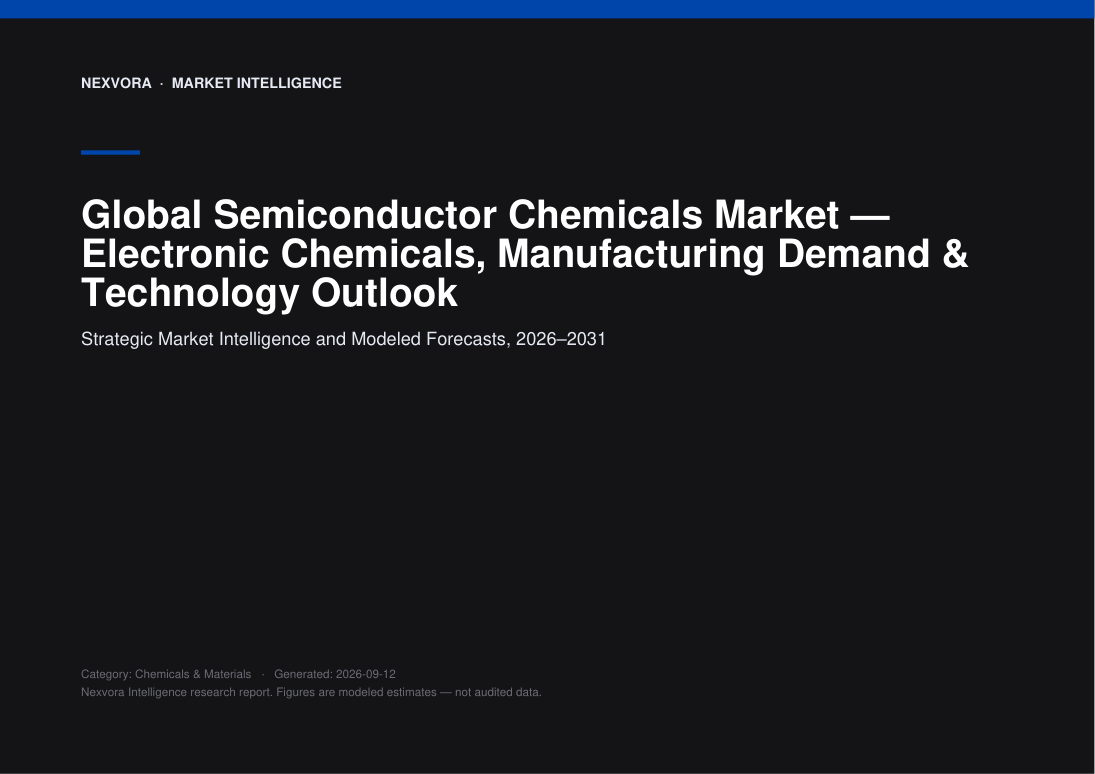
Global Semiconductor Chemicals Market — Electronic Chemicals, Manufacturing Demand & Technology Outlook
Strategic Market Intelligence and Modeled Forecasts, 2026–2031
Nexvora Intelligence market report on Global Semiconductor Chemicals Market: Electronic Chemicals, Manufacturing Demand & Technology Outlook, 2026–2031.
per extra user
Instant access after payment. Secure via Razorpay.
The opening view — free.
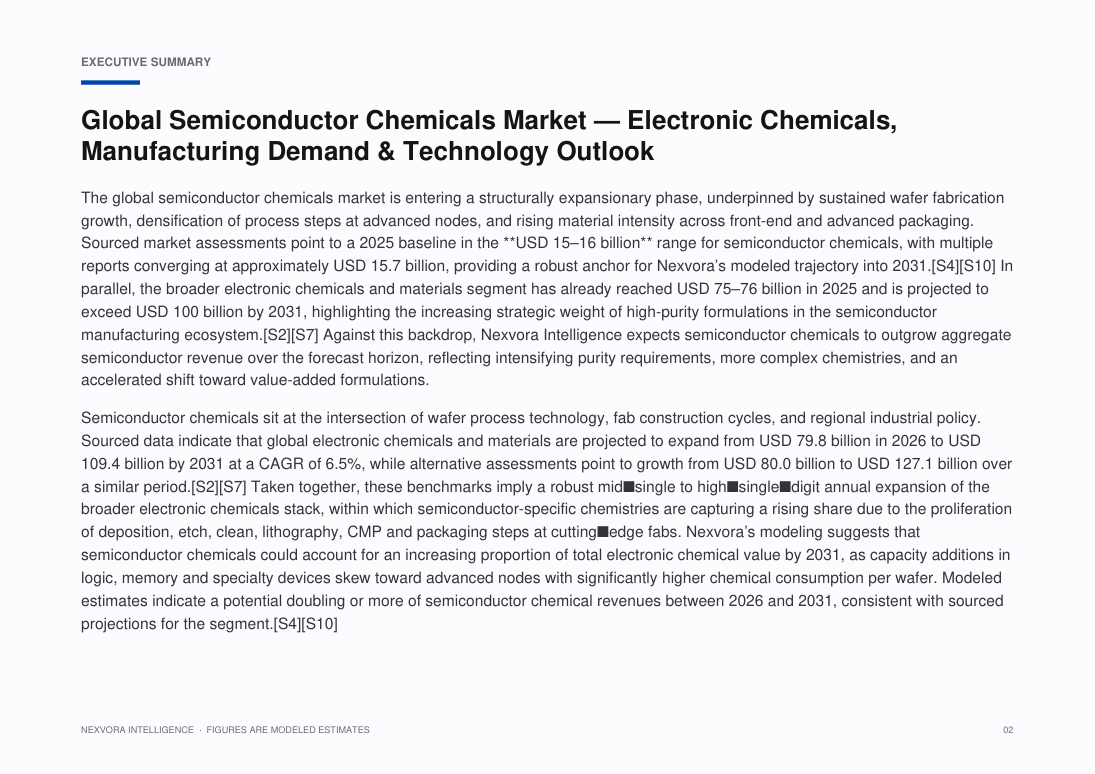
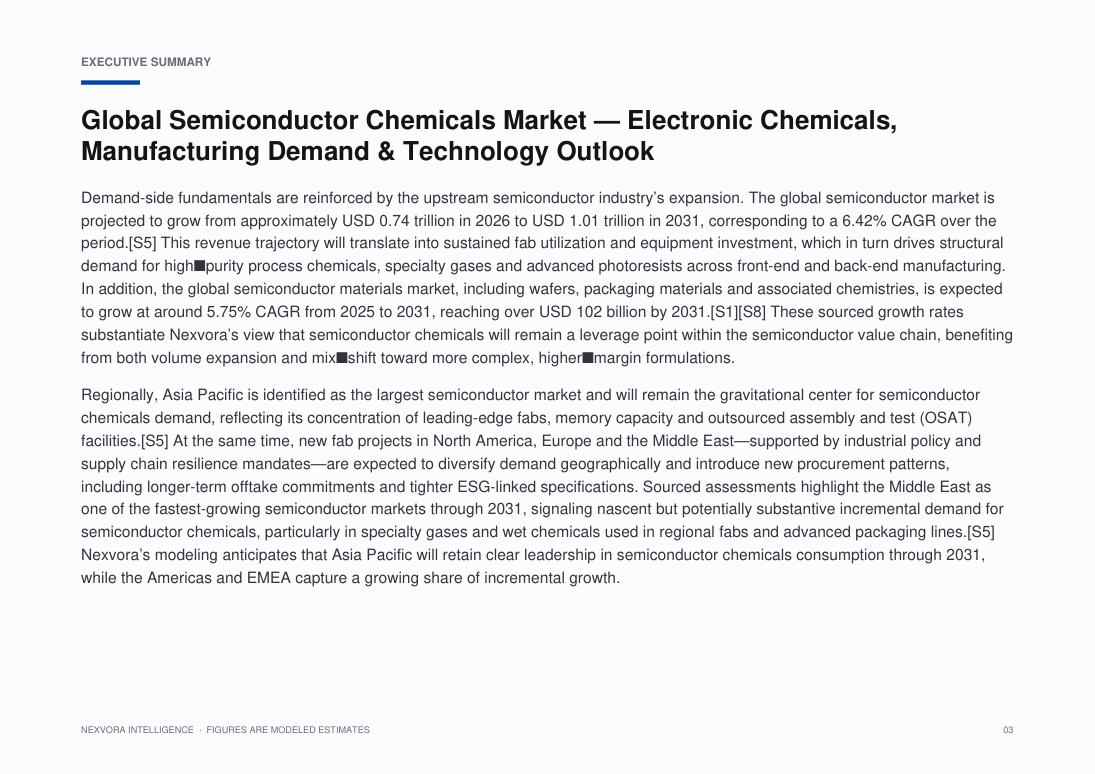
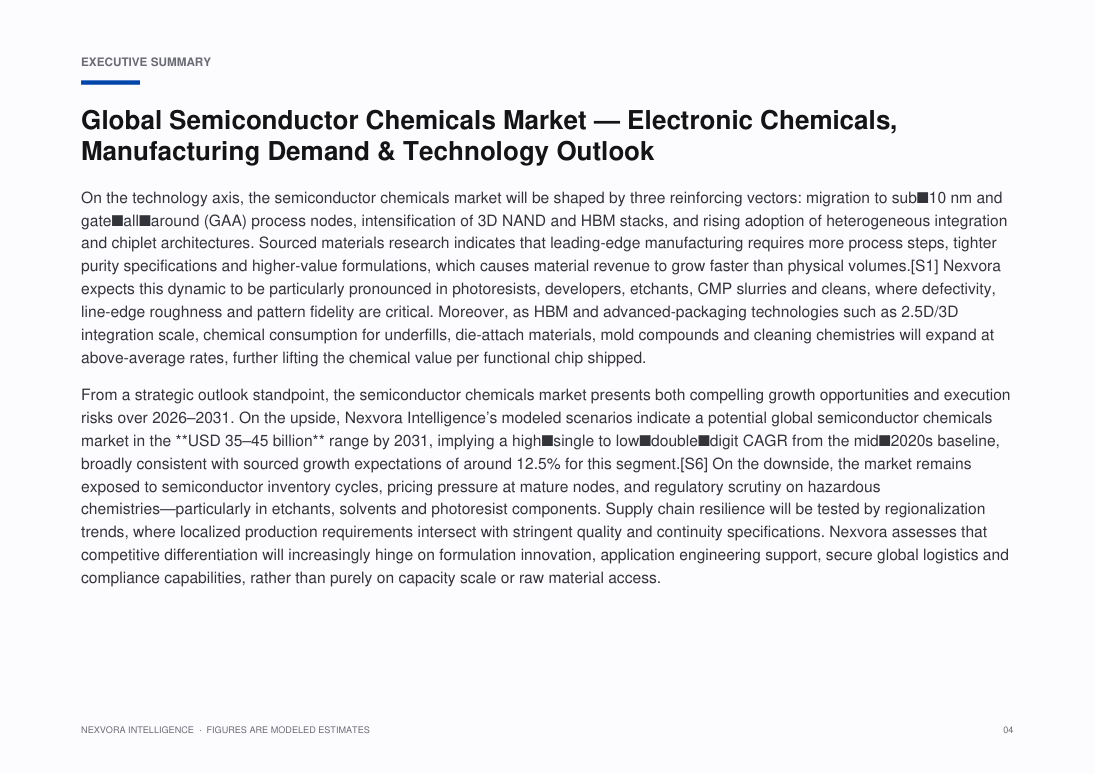
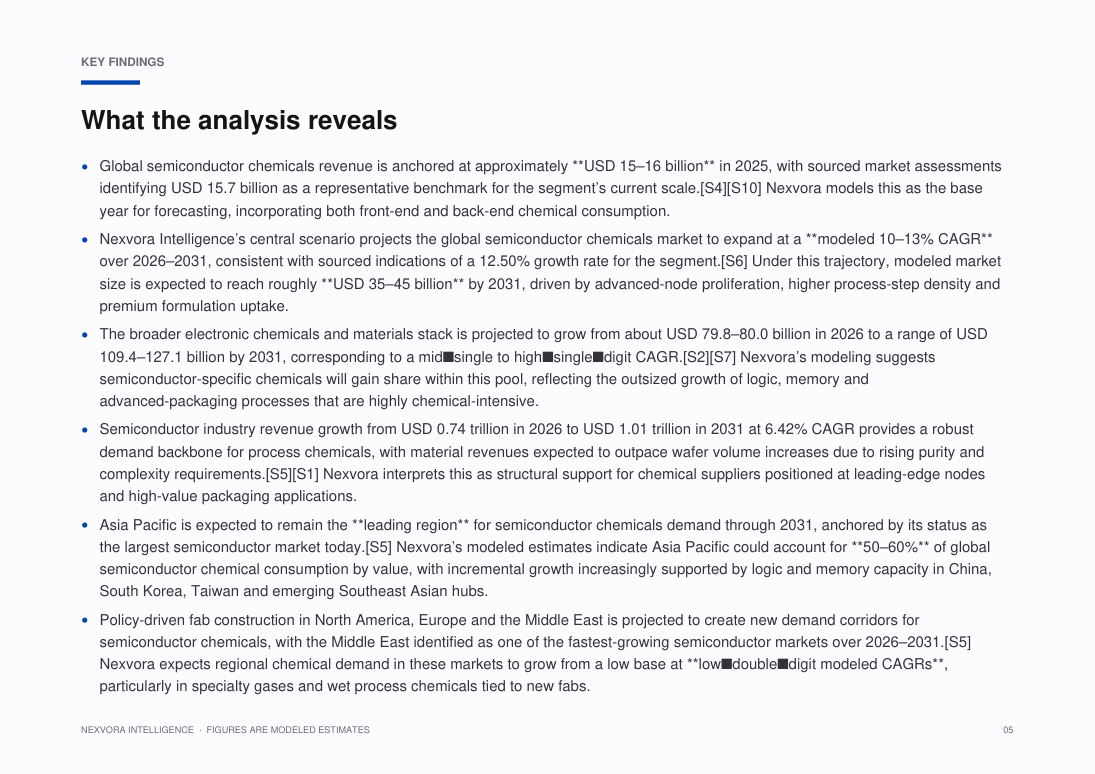
The global semiconductor chemicals market is entering a structurally expansionary phase, underpinned by sustained wafer fabrication growth, densification of process steps at advanced nodes, and rising material intensity across front-end and advanced packaging. Sourced market assessments point to a 2025 baseline in the **USD 15–••• billion** range for semiconductor chemicals, with multiple reports converging at approximately USD ••• billion, providing a robust anchor for Nexvora’s modeled trajectory into 2031.[S4][S10] In parallel, the broader electronic chemicals and materials segment has already reached USD 75–••• billion in 2025 and is projected to exceed USD ••• billion by 2031, highlighting the increasing strategic weight of high-purity formulations in the semiconductor manufacturing ecosystem.[S2][S7] Against this backdrop, Nexvora Intelligence expects semiconductor chemicals to outgrow aggregate semiconductor revenue over the forecast horizon, reflecting intensifying purity requirements, more complex chemistries, and an accelerated shift toward value-added formulations.
Semiconductor chemicals sit at the intersection of wafer process technology, fab construction cycles, and regional industrial policy. Sourced data indicate that global electronic chemicals and materials are projected to expand from USD ••• billion in 2026 to USD ••• billion by 2031 at a CAGR of ••%, while alternative assessments point to growth from USD ••• billion to USD ••• billion over a similar period.[S2][S7] Taken together, these benchmarks imply a robust mid‑single to high‑single‑digit annual expansion of the broader electronic chemicals stack, within which semiconductor-specific chemistries are capturing a rising share due to the proliferation of deposition, etch, clean, lithography, CMP and packaging steps at cutting‑edge fabs. Nexvora’s modeling suggests that semiconductor chemicals could account for an increasing proportion of total electronic chemical value by 2031, as capacity additions in logic, memory and specialty devices skew toward advanced nodes with significantly higher chemical consumption per wafer. Modeled estimates indicate a potential doubling or more of semiconductor chemical revenues between 2026 and 2031, consistent with sourced projections for the segment.[S4][S10]
Demand-side fundamentals are reinforced by the upstream semiconductor industry’s expansion. The global semiconductor market is projected to grow from approximately USD ••• trillion in 2026 to USD ••• trillion in 2031, corresponding to a ••% CAGR over the period.[S5] This revenue trajectory will translate into sustained fab utilization and equipment investment, which in turn drives structural demand for high‑purity process chemicals, specialty gases and advanced photoresists across front-end and back-end manufacturing. In addition, the global semiconductor materials market, including wafers, packaging materials and associated chemistries, is expected to grow at around ••% CAGR from 2025 to 2031, reaching over USD ••• billion by 2031.[S1][S8] These sourced growth rates substantiate Nexvora’s view that semiconductor chemicals will remain a leverage point within the semiconductor value chain, benefiting from both volume expansion and mix‑shift toward more complex, higher‑margin formulations.
Regionally, Asia Pacific is identified as the largest semiconductor market and will remain the gravitational center for semiconductor chemicals demand, reflecting its concentration of leading-edge fabs, memory capacity and outsourced assembly and test (OSAT) facilities.[S5] At the same time, new fab projects in North America, Europe and the Middle East—supported by industrial policy and supply chain resilience mandates—are expected to diversify demand geographically and introduce new procurement patterns, including longer-term offtake commitments and tighter ESG-linked specifications. Sourced assessments highlight the Middle East as one of the fastest-growing semiconductor markets through 2031, signaling nascent but potentially substantive incremental demand for semiconductor chemicals, particularly in specialty gases and wet chemicals used in regional fabs and advanced packaging lines.[S5] Nexvora’s modeling anticipates that Asia Pacific will retain clear leadership in semiconductor chemicals consumption through 2031, while the Americas and EMEA capture a growing share of incremental growth.
Specific figures are hidden in this free preview. Unlock the report to see all modeled market sizes, forecasts and growth rates.
What this report covers.
Strategic Market Intelligence and Modeled Forecasts, 2026–2031
Who this report is for.
- Corporate strategy, planning and M&A teams evaluating the market
- Investors, private equity and venture teams sizing the opportunity
- Product, marketing and go-to-market leaders
- Consultants and analysts building the competitive picture
- Executives planning market entry, expansion or investment
How this report is built.
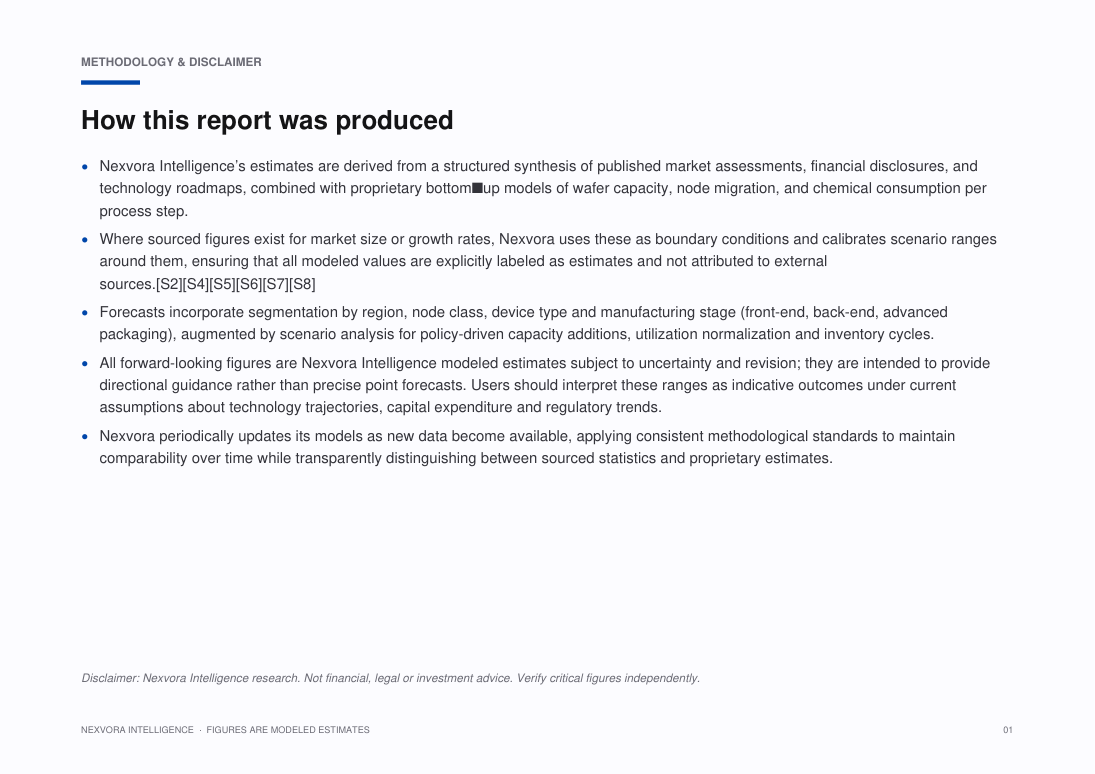
Nexvora Intelligence’s estimates are derived from a structured synthesis of published market assessments, financial disclosures, and technology roadmaps, combined with proprietary bottom‑up models of wafer capacity, node migration, and chemical consumption per process step.
Where sourced figures exist for market size or growth rates, Nexvora uses these as boundary conditions and calibrates scenario ranges around them, ensuring that all modeled values are explicitly labeled as estimates and not attributed to external sources.[S2][S4][S5][S6][S7][S8]
Forecasts incorporate segmentation by region, node class, device type and manufacturing stage (front-end, back-end, advanced packaging), augmented by scenario analysis for policy-driven capacity additions, utilization normalization and inventory cycles.
All forward-looking figures are Nexvora Intelligence modeled estimates subject to uncertainty and revision; they are intended to provide directional guidance rather than precise point forecasts. Users should interpret these ranges as indicative outcomes under current assumptions about technology trajectories, capital expenditure and regulatory trends.
Nexvora periodically updates its models as new data become available, applying consistent methodological standards to maintain comparability over time while transparently distinguishing between sourced statistics and proprietary estimates.
What's inside — a number-free look.
A full outline of the figures and tables you'll get. Specific data, market sizes and forecasts are unlocked with purchase.
List of Figures
- Figure 1: Market Overview and Structure — Semiconductor Chemicals — Electronic Chemicals, Manufacturing Demand & Technology Outlook
- Figure 2: Market Size and Forecast Framework — Semiconductor Chemicals — Electronic Chemicals, Manufacturing Demand & Technology Outlook
- Figure 3: Value Chain and Ecosystem Analysis — Semiconductor Chemicals — Electronic Chemicals, Manufacturing Demand & Technology Outlook
- Figure 4: Market Dynamics — Drivers, Restraints and Opportunities — Semiconductor Chemicals — Electronic Chemicals, Manufacturing Demand & Technology Outlook
- Figure 5: Segment Contribution Analysis — Semiconductor Chemicals — Electronic Chemicals, Manufacturing Demand & Technology Outlook
- Figure 6: Regional Market Landscape — Semiconductor Chemicals — Electronic Chemicals, Manufacturing Demand & Technology Outlook
- Figure 7: Country-level Opportunity Mapping — Semiconductor Chemicals — Electronic Chemicals, Manufacturing Demand & Technology Outlook
- Figure 8: Competitive Positioning Matrix — Semiconductor Chemicals — Electronic Chemicals, Manufacturing Demand & Technology Outlook
- Figure 9: Market Share of Leading Players — Semiconductor Chemicals — Electronic Chemicals, Manufacturing Demand & Technology Outlook
- Figure 10: Adoption and Penetration Trends — Semiconductor Chemicals — Electronic Chemicals, Manufacturing Demand & Technology Outlook
- Figure 11: Technology and Innovation Landscape — Semiconductor Chemicals — Electronic Chemicals, Manufacturing Demand & Technology Outlook
- Figure 12: Pricing and Business Model Analysis — Semiconductor Chemicals — Electronic Chemicals, Manufacturing Demand & Technology Outlook
- Figure 13: Investment, Funding and M&A Landscape — Semiconductor Chemicals — Electronic Chemicals, Manufacturing Demand & Technology Outlook
- Figure 14: Regulatory and Policy Framework — Semiconductor Chemicals — Electronic Chemicals, Manufacturing Demand & Technology Outlook
- Figure 15: Porter's Five Forces Analysis — Semiconductor Chemicals — Electronic Chemicals, Manufacturing Demand & Technology Outlook
- Figure 16: PESTLE Analysis — Semiconductor Chemicals — Electronic Chemicals, Manufacturing Demand & Technology Outlook
- Figure 17: Growth Opportunity Heat Map — Semiconductor Chemicals — Electronic Chemicals, Manufacturing Demand & Technology Outlook
- Figure 18: Future Outlook and Strategic Roadmap — Semiconductor Chemicals — Electronic Chemicals, Manufacturing Demand & Technology Outlook
List of Tables
- Table 1: Market Segmentation Overview — Semiconductor Chemicals — Electronic Chemicals, Manufacturing Demand & Technology Outlook
- Table 2: Segment Definitions and Scope — Semiconductor Chemicals — Electronic Chemicals, Manufacturing Demand & Technology Outlook
- Table 3: Regional and Country Coverage Summary — Semiconductor Chemicals — Electronic Chemicals, Manufacturing Demand & Technology Outlook
- Table 4: Key Company Profiles and Offerings — Semiconductor Chemicals — Electronic Chemicals, Manufacturing Demand & Technology Outlook
- Table 5: Competitive Benchmarking Matrix — Semiconductor Chemicals — Electronic Chemicals, Manufacturing Demand & Technology Outlook
- Table 6: Product and Service Portfolio Mapping — Semiconductor Chemicals — Electronic Chemicals, Manufacturing Demand & Technology Outlook
- Table 7: Market Drivers, Restraints and Trends — Semiconductor Chemicals — Electronic Chemicals, Manufacturing Demand & Technology Outlook
- Table 8: Strategic Initiatives and Developments — Semiconductor Chemicals — Electronic Chemicals, Manufacturing Demand & Technology Outlook
- Table 9: Partnerships and Collaborations — Semiconductor Chemicals — Electronic Chemicals, Manufacturing Demand & Technology Outlook
- Table 10: Research Assumptions and Limitations — Semiconductor Chemicals — Electronic Chemicals, Manufacturing Demand & Technology Outlook
- Table 11: Data Sources and References — Semiconductor Chemicals — Electronic Chemicals, Manufacturing Demand & Technology Outlook
- Table 12: Report Scope and Coverage Summary — Semiconductor Chemicals — Electronic Chemicals, Manufacturing Demand & Technology Outlook
A look at the pages.
108 pages · 20 sections · charts & tables
A genuine peek at the opening pages. Unlock to read every page in full.
6 of 108 pages shown
Turn this market into a plan for your business.
Answer a few quick questions and unlock a personalised operational read — your maturity score, prioritised focus areas and quick wins — mapped to where this market is heading. Result delivered instantly and emailed to you.
- Maturity score & prioritised focus areas
- Practical quick wins and a recommended next step
Questions, answered.
How big is the Global Semiconductor Chemicals Market?
Nexvora models the Global Semiconductor Chemicals Market at approximately USD 16–18 billion (2026, modeled estimate). Full market sizing, segmentation and forecasts are inside the report (modeled estimate).
What is the growth rate (CAGR) of the Global Semiconductor Chemicals Market?
The Global Semiconductor Chemicals Market is projected to grow at a CAGR of about 10–13% (2026–2031, modeled range) over the forecast period — a Nexvora modeled estimate detailed across the report's 20 sections.
What does this report include?
A complete market intelligence report — market sizing and forecasts, segmentation, regional and industry analysis, competitive landscape, trends, and strategic recommendations across 20 sections.
How do I access it after purchase?
Instantly, in your secure online viewer. Reports are view-only and available on any device from your library.
Are the figures sourced?
Quantitative figures are Nexvora modeled estimates unless explicitly cited to a referenced source within the report.
Can I buy access for my team?
Yes — add user seats at checkout, or subscribe for bulk access across multiple reports.
Nexvora Intelligence research report. All quantitative figures are modeled estimates — not audited data. Not financial or investment advice.
More market reports
Keep exploring intelligence in this and related sectors.
Europe Sustainable Materials Market — Circular Materials, Decarbonization & Growth Opportunities
Global Sustainable Chemicals Market — Green Chemistry, Circular Economy & Industry Transformation Intelligence Report

Global Humanoid Robotics Market — Industrial & Service Automation Intelligence Report
