Global Satellite Direct-to-Device Connectivity Market — Intelligence Report
Commercial outlook, competitive structure, and adoption trajectory across handset, IoT, emergency, and carrier-integrated services, 2025–2032
Nexvora Intelligence market report on Global Satellite Direct-to-Device Connectivity Market — Intelligence Report.

per extra user
Instant access after payment. Secure via Razorpay.
The opening view — free.
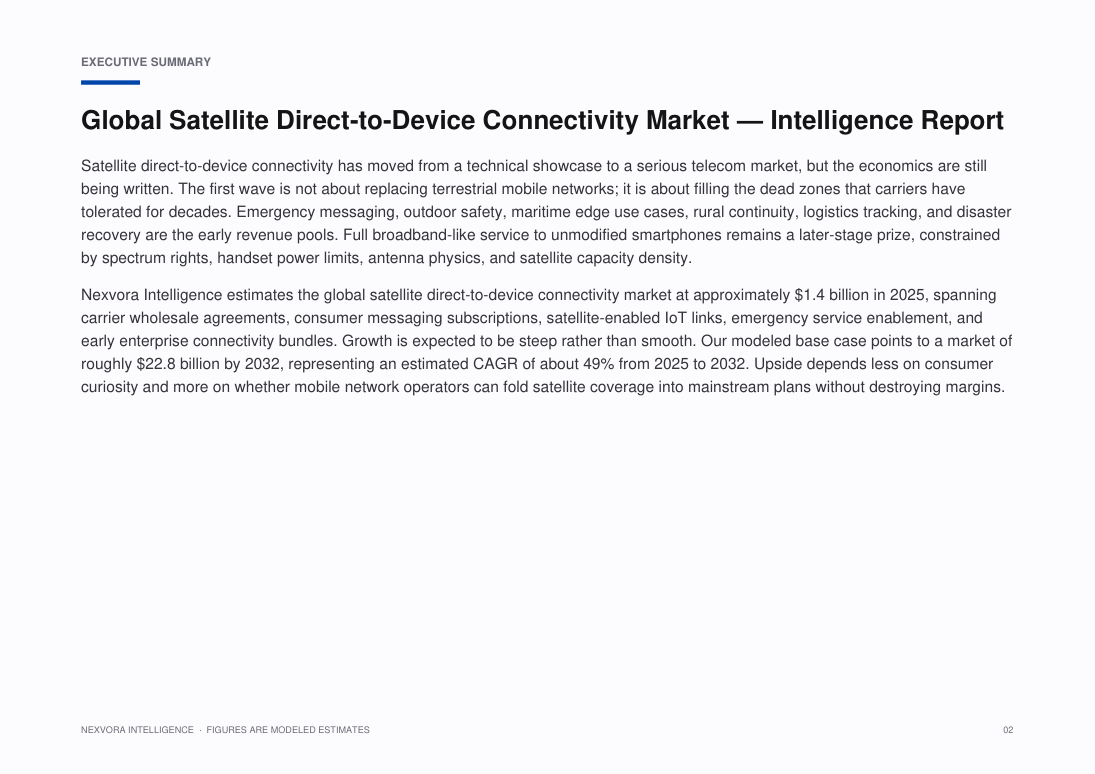
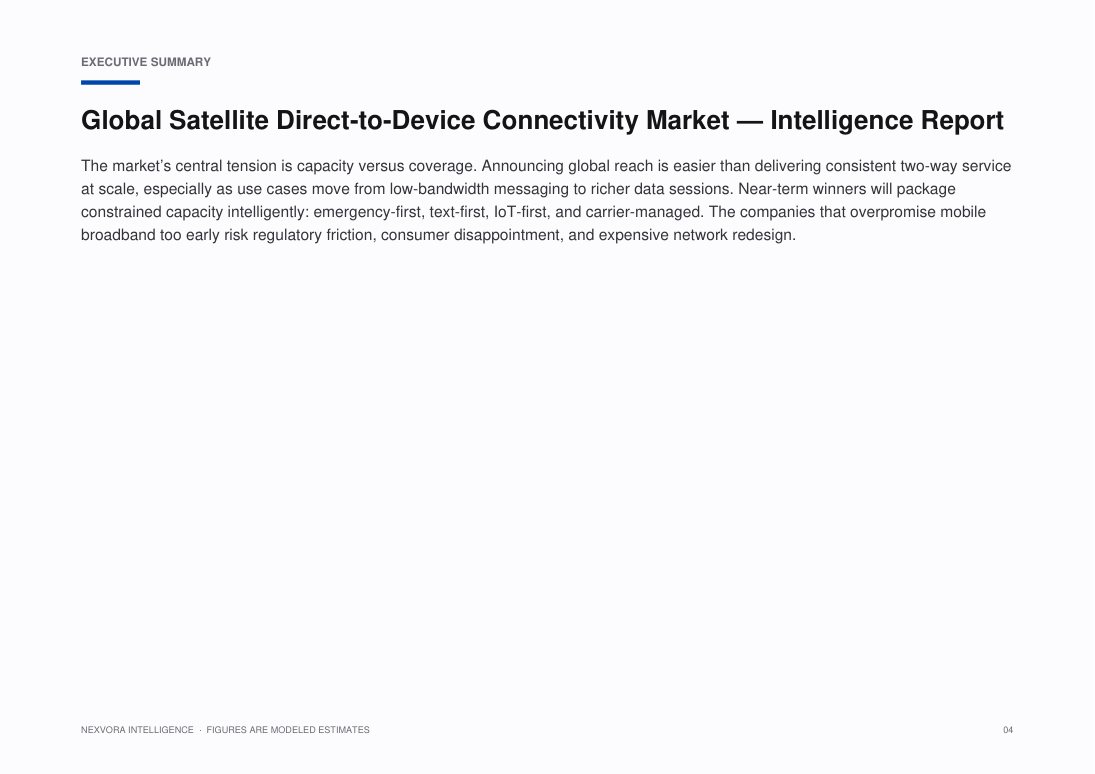
Satellite direct-to-device connectivity has moved from a technical showcase to a serious telecom market, but the economics are still being written. The first wave is not about replacing terrestrial mobile networks; it is about filling the dead zones that carriers have tolerated for decades. Emergency messaging, outdoor safety, maritime edge use cases, rural continuity, logistics tracking, and disaster recovery are the early revenue pools. Full broadband-like service to unmodified smartphones remains a later-stage prize, constrained by spectrum rights, handset power limits, antenna physics, and satellite capacity density.
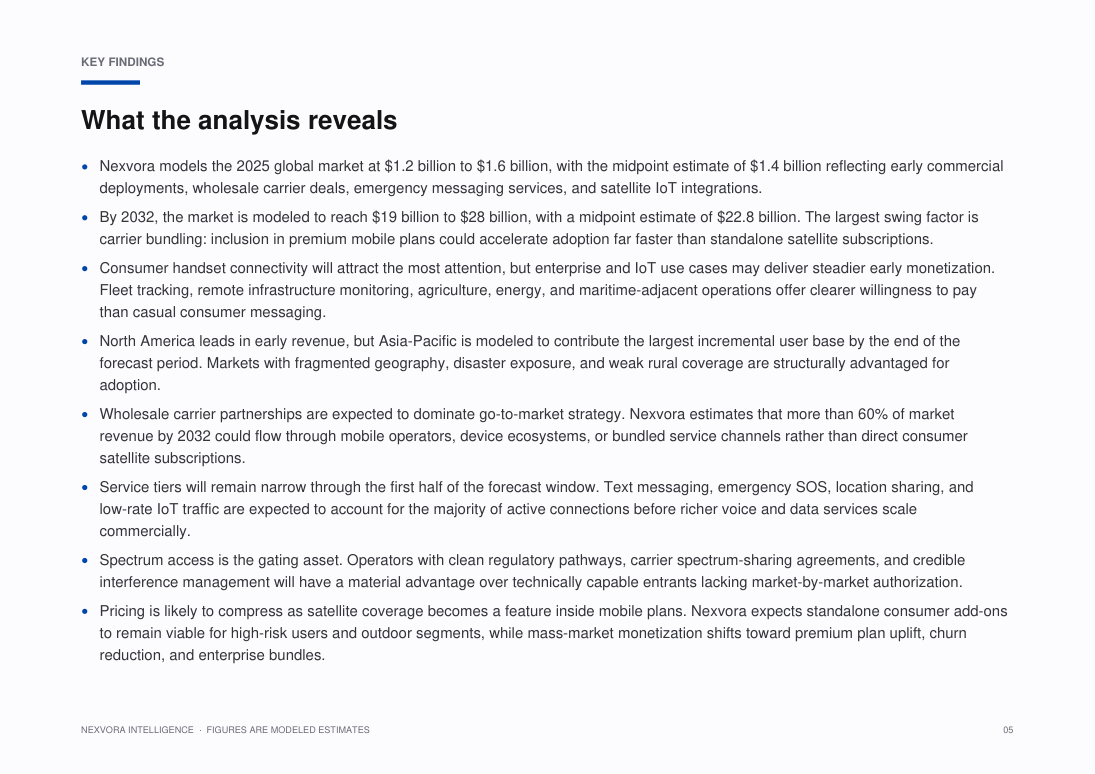
Nexvora Intelligence estimates the global satellite direct-to-device connectivity market at approximately $••• in 2025, spanning carrier wholesale agreements, consumer messaging subscriptions, satellite-enabled IoT links, emergency service enablement, and early enterprise connectivity bundles. Growth is expected to be steep rather than smooth. Our modeled base case points to a market of roughly $••• by 2032, representing an estimated CAGR of about ••% from 2025 to 2032. Upside depends less on consumer curiosity and more on whether mobile network operators can fold satellite coverage into mainstream plans without destroying margins.
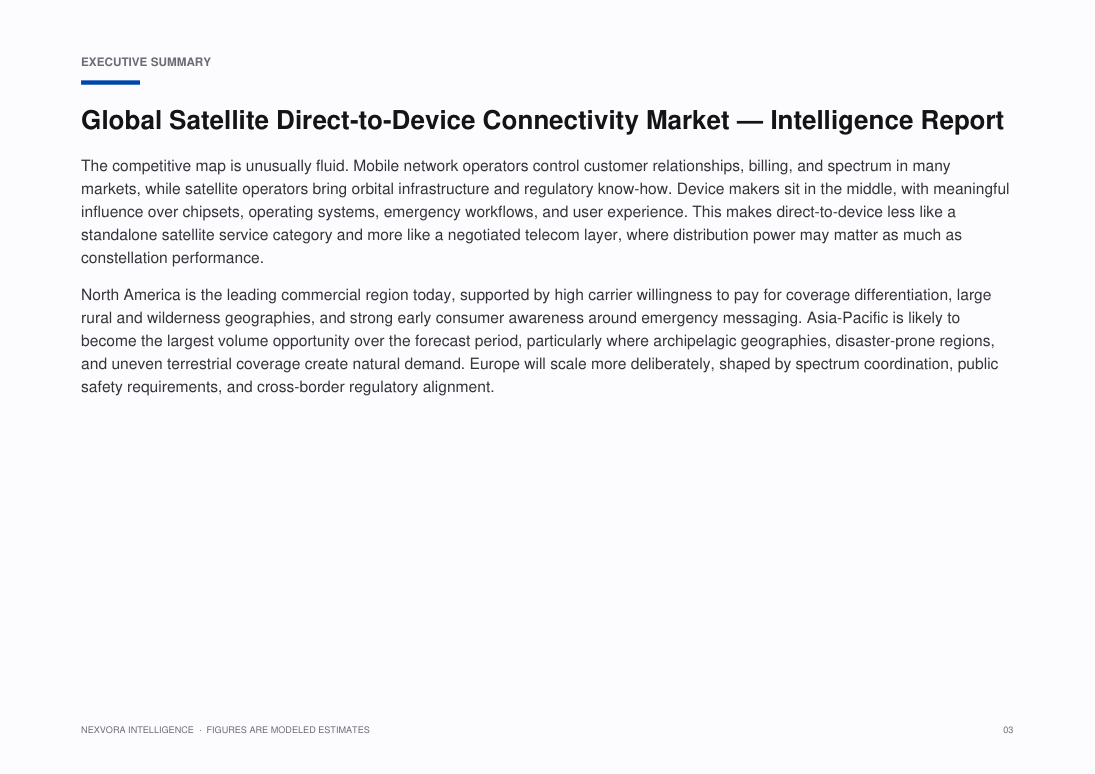
The competitive map is unusually fluid. Mobile network operators control customer relationships, billing, and spectrum in many markets, while satellite operators bring orbital infrastructure and regulatory know-how. Device makers sit in the middle, with meaningful influence over chipsets, operating systems, emergency workflows, and user experience. This makes direct-to-device less like a standalone satellite service category and more like a negotiated telecom layer, where distribution power may matter as much as constellation performance.
North America is the leading commercial region today, supported by high carrier willingness to pay for coverage differentiation, large rural and wilderness geographies, and strong early consumer awareness around emergency messaging. Asia-Pacific is likely to become the largest volume opportunity over the forecast period, particularly where archipelagic geographies, disaster-prone regions, and uneven terrestrial coverage create natural demand. Europe will scale more deliberately, shaped by spectrum coordination, public safety requirements, and cross-border regulatory alignment.
Specific figures are hidden in this free preview. Unlock the report to see all modeled market sizes, forecasts and growth rates.
What this report covers.
Commercial outlook, competitive structure, and adoption trajectory across handset, IoT, emergency, and carrier-integrated services, 2025–2032
Who this report is for.
- Corporate strategy, planning and M&A teams evaluating the market
- Investors, private equity and venture teams sizing the opportunity
- Product, marketing and go-to-market leaders
- Consultants and analysts building the competitive picture
- Executives planning market entry, expansion or investment
How this report is built.
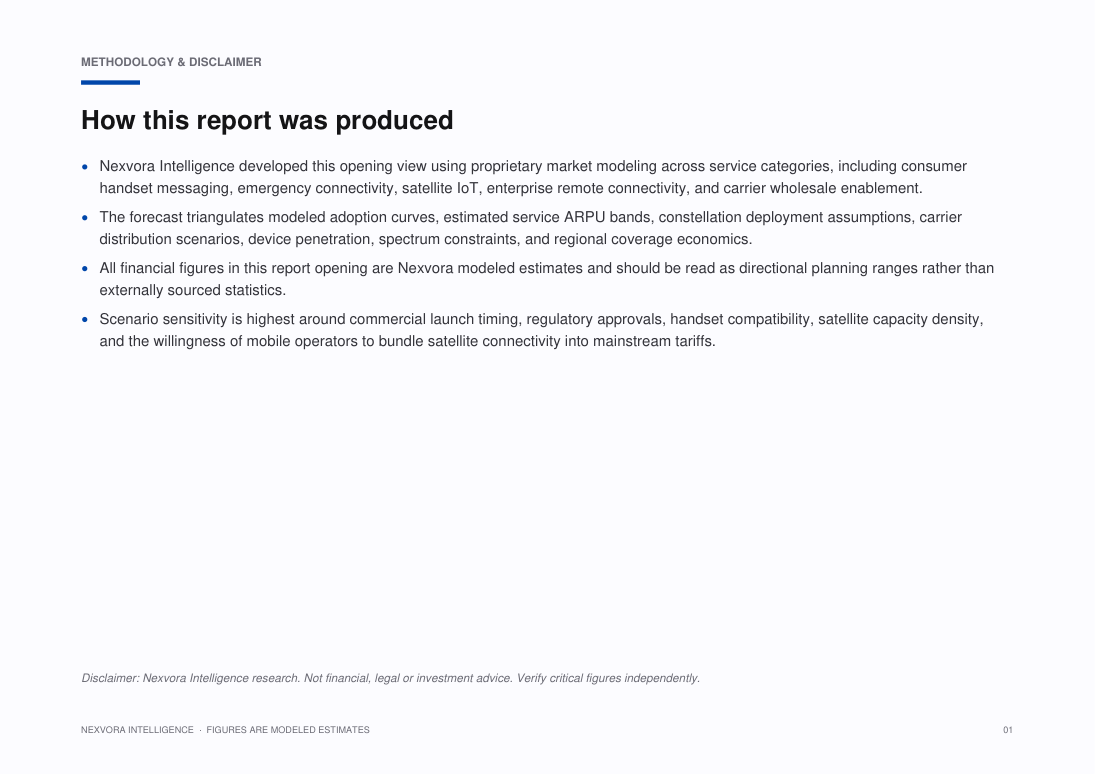
Nexvora Intelligence developed this opening view using proprietary market modeling across service categories, including consumer handset messaging, emergency connectivity, satellite IoT, enterprise remote connectivity, and carrier wholesale enablement.
The forecast triangulates modeled adoption curves, estimated service ARPU bands, constellation deployment assumptions, carrier distribution scenarios, device penetration, spectrum constraints, and regional coverage economics.
All financial figures in this report opening are Nexvora modeled estimates and should be read as directional planning ranges rather than externally sourced statistics.
Scenario sensitivity is highest around commercial launch timing, regulatory approvals, handset compatibility, satellite capacity density, and the willingness of mobile operators to bundle satellite connectivity into mainstream tariffs.
What's inside — a number-free look.
A full outline of the figures and tables you'll get. Specific data, market sizes and forecasts are unlocked with purchase.
List of Figures
- Figure 1: Market Overview and Structure — Satellite Direct-to-Device Connectivity
- Figure 2: Market Size and Forecast Framework — Satellite Direct-to-Device Connectivity
- Figure 3: Value Chain and Ecosystem Analysis — Satellite Direct-to-Device Connectivity
- Figure 4: Market Dynamics — Drivers, Restraints and Opportunities — Satellite Direct-to-Device Connectivity
- Figure 5: Segment Contribution Analysis — Satellite Direct-to-Device Connectivity
- Figure 6: Regional Market Landscape — Satellite Direct-to-Device Connectivity
- Figure 7: Country-level Opportunity Mapping — Satellite Direct-to-Device Connectivity
- Figure 8: Competitive Positioning Matrix — Satellite Direct-to-Device Connectivity
- Figure 9: Market Share of Leading Players — Satellite Direct-to-Device Connectivity
- Figure 10: Adoption and Penetration Trends — Satellite Direct-to-Device Connectivity
- Figure 11: Technology and Innovation Landscape — Satellite Direct-to-Device Connectivity
- Figure 12: Pricing and Business Model Analysis — Satellite Direct-to-Device Connectivity
- Figure 13: Investment, Funding and M&A Landscape — Satellite Direct-to-Device Connectivity
- Figure 14: Regulatory and Policy Framework — Satellite Direct-to-Device Connectivity
- Figure 15: Porter's Five Forces Analysis — Satellite Direct-to-Device Connectivity
- Figure 16: PESTLE Analysis — Satellite Direct-to-Device Connectivity
- Figure 17: Growth Opportunity Heat Map — Satellite Direct-to-Device Connectivity
- Figure 18: Future Outlook and Strategic Roadmap — Satellite Direct-to-Device Connectivity
List of Tables
- Table 1: Market Segmentation Overview — Satellite Direct-to-Device Connectivity
- Table 2: Segment Definitions and Scope — Satellite Direct-to-Device Connectivity
- Table 3: Regional and Country Coverage Summary — Satellite Direct-to-Device Connectivity
- Table 4: Key Company Profiles and Offerings — Satellite Direct-to-Device Connectivity
- Table 5: Competitive Benchmarking Matrix — Satellite Direct-to-Device Connectivity
- Table 6: Product and Service Portfolio Mapping — Satellite Direct-to-Device Connectivity
- Table 7: Market Drivers, Restraints and Trends — Satellite Direct-to-Device Connectivity
- Table 8: Strategic Initiatives and Developments — Satellite Direct-to-Device Connectivity
- Table 9: Partnerships and Collaborations — Satellite Direct-to-Device Connectivity
- Table 10: Research Assumptions and Limitations — Satellite Direct-to-Device Connectivity
- Table 11: Data Sources and References — Satellite Direct-to-Device Connectivity
- Table 12: Report Scope and Coverage Summary — Satellite Direct-to-Device Connectivity
A look at the pages.
108 pages · 20 sections · charts & tables
A genuine peek at the opening pages. Unlock to read every page in full.
6 of 108 pages shown
Turn this market into a plan for your business.
Answer a few quick questions and unlock a personalised operational read — your maturity score, prioritised focus areas and quick wins — mapped to where this market is heading. Result delivered instantly and emailed to you.
- Maturity score & prioritised focus areas
- Practical quick wins and a recommended next step
Questions, answered.
How big is the Global Satellite Direct-to-Device Connectivity Market?
Nexvora models the Global Satellite Direct-to-Device Connectivity Market at approximately $1.4B in 2025. Full market sizing, segmentation and forecasts are inside the report (modeled estimate).
What is the growth rate (CAGR) of the Global Satellite Direct-to-Device Connectivity Market?
The Global Satellite Direct-to-Device Connectivity Market is projected to grow at a CAGR of about 49% from 2025 to 2032 over the forecast period — a Nexvora modeled estimate detailed across the report's 20 sections.
What does this report include?
A complete market intelligence report — market sizing and forecasts, segmentation, regional and industry analysis, competitive landscape, trends, and strategic recommendations across 20 sections.
How do I access it after purchase?
Instantly, in your secure online viewer. Reports are view-only and available on any device from your library.
Are the figures sourced?
Quantitative figures are Nexvora modeled estimates unless explicitly cited to a referenced source within the report.
Can I buy access for my team?
Yes — add user seats at checkout, or subscribe for bulk access across multiple reports.
Nexvora Intelligence research report. All quantitative figures are modeled estimates — not audited data. Not financial or investment advice.
Gallium Nitride Power Devices vs Generative AI Enterprise Software
The right choice depends on the buyer’s priorities because these are different types of offerings. Choose Wolfspeed Gallium Nitride Power Devices if you need gallium nitride power devices in the semiconductors and electronics area. Choose Microsoft Generative AI Enterprise Software if you need enterprise generative AI software in the artificial intelligence category.
Grounded in published specifications — guidance, not an endorsement.
More market reports
Keep exploring intelligence in this and related sectors.

Global Private 5G Networks for Industrial Automation Market — Intelligence Report

Indonesia Digital Entertainment Market — Gaming, Video Streaming, Music, Creator Economy & Digital Advertising

Global Direct-to-Device Satellite Connectivity, 5G NTN and Hybrid Mobile-Satellite Networks Market — Intelligence Report
Global Direct-to-Device Satellite Connectivity, 5G NTN and Satellite Smartphone Services Market — Intelligence Report
AI Analyst
Insights and answers generated live from Global Satellite Direct-to-Device Connectivity Market — Intelligence Report's verified data. Modeled estimates — not investment advice.
- The report covers the Global Satellite Direct-to-Device Connectivity Market within the Telecom, Media & Entertainment sector.
- The study focuses on commercial outlook, competitive structure, and adoption trajectory for the 2025–2032 period.
- The market scope includes handset, IoT, emergency, and carrier-integrated satellite direct-to-device services.
- Notable: The report positions satellite direct-to-device connectivity as a cross-application market spanning consumer devices, IoT use cases, emergency connectivity, and carrier partnerships.