
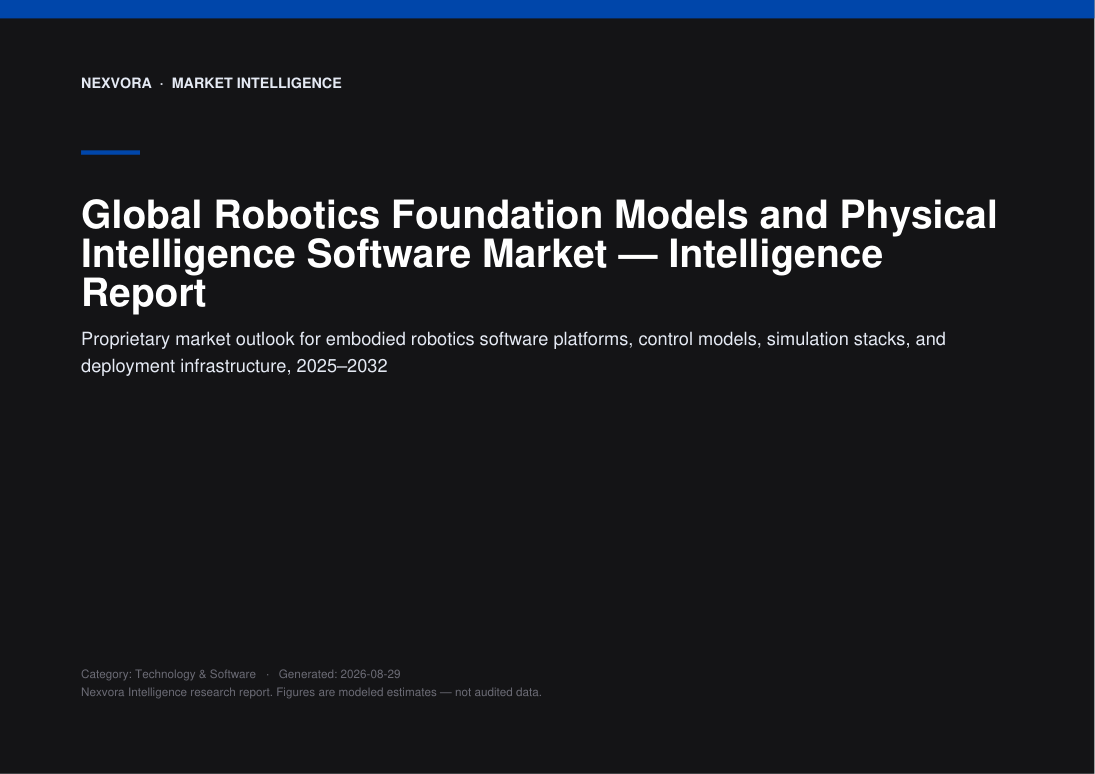
Global Robotics Foundation Models and Physical Intelligence Software Market — Intelligence Report
Proprietary market outlook for embodied robotics software platforms, control models, simulation stacks, and deployment infrastructure, 2025–2032
Nexvora Intelligence market report on Global Robotics Foundation Models and Physical AI Software Market.
per extra user
Instant access after payment. Secure via Razorpay.
The opening view — free.
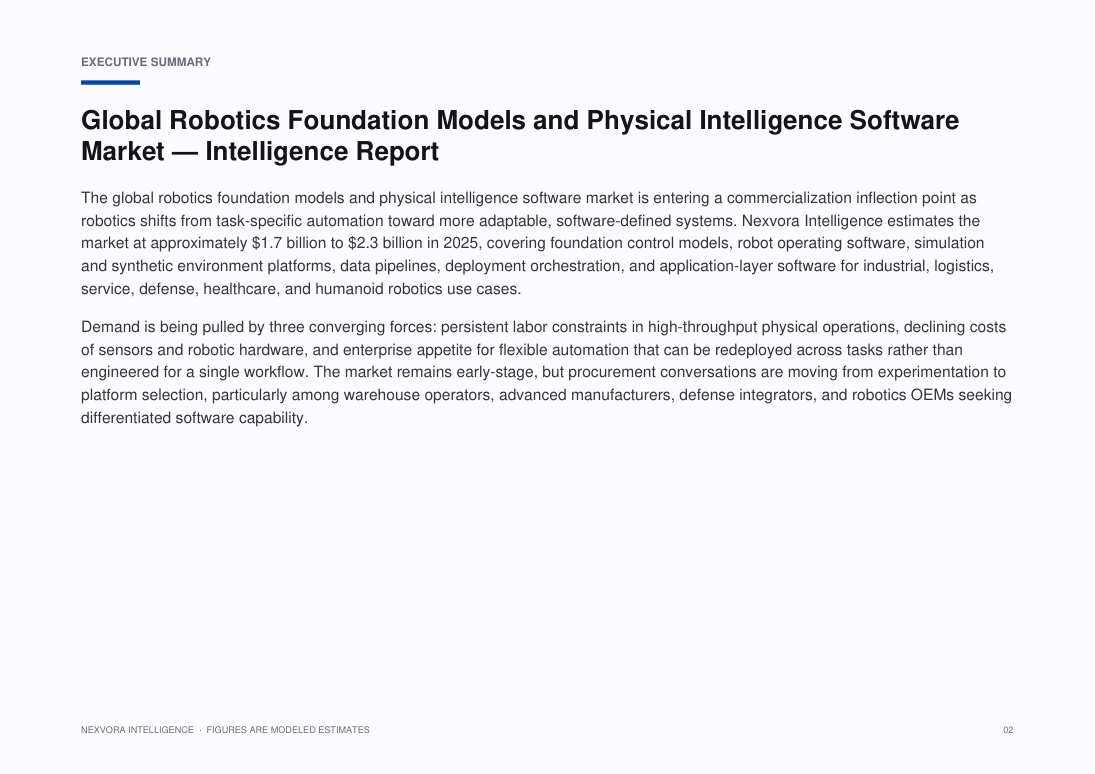
The global robotics foundation models and physical intelligence software market is entering a commercialization inflection point as robotics shifts from task-specific automation toward more adaptable, software-defined systems. Nexvora Intelligence estimates the market at approximately $••• to $••• in 2025, covering foundation control models, robot operating software, simulation and synthetic environment platforms, data pipelines, deployment orchestration, and application-layer software for industrial, logistics, service, defense, healthcare, and humanoid robotics use cases.
Demand is being pulled by three converging forces: persistent labor constraints in high-throughput physical operations, declining costs of sensors and robotic hardware, and enterprise appetite for flexible automation that can be redeployed across tasks rather than engineered for a single workflow. The market remains early-stage, but procurement conversations are moving from experimentation to platform selection, particularly among warehouse operators, advanced manufacturers, defense integrators, and robotics OEMs seeking differentiated software capability.
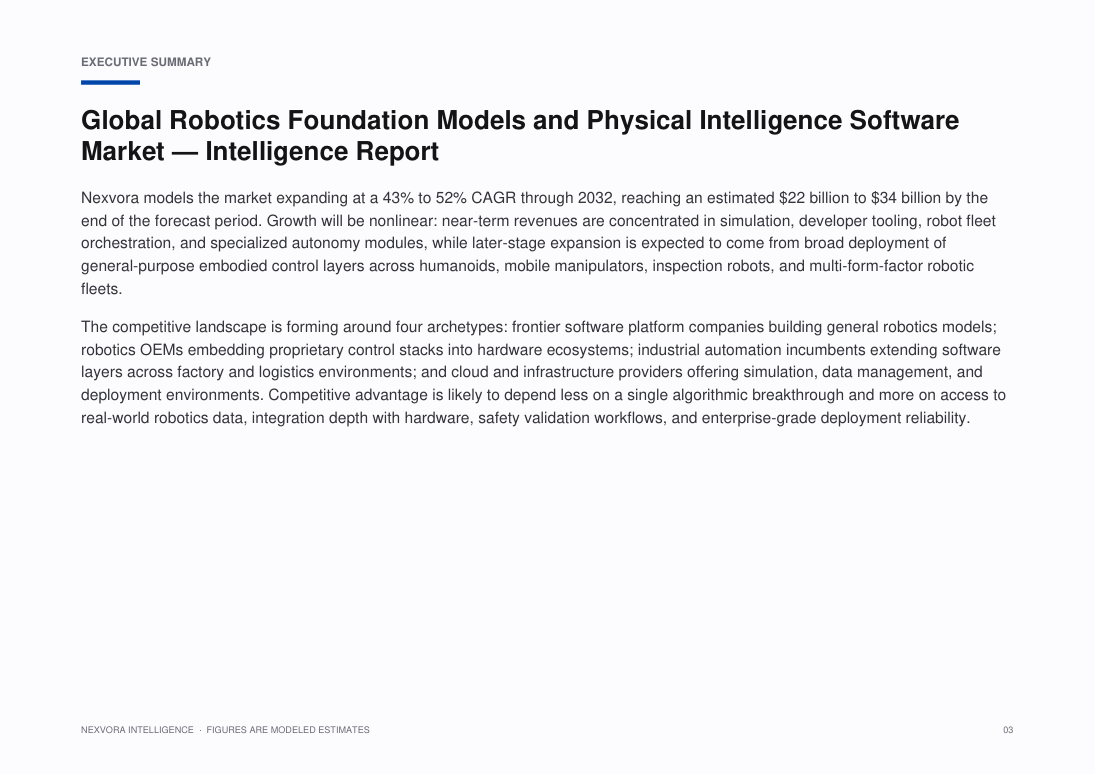
Nexvora models the market expanding at a ••% to ••% CAGR through 2032, reaching an estimated $••• to $••• by the end of the forecast period. Growth will be nonlinear: near-term revenues are concentrated in simulation, developer tooling, robot fleet orchestration, and specialized autonomy modules, while later-stage expansion is expected to come from broad deployment of general-purpose embodied control layers across humanoids, mobile manipulators, inspection robots, and multi-form-factor robotic fleets.
The competitive landscape is forming around four archetypes: frontier software platform companies building general robotics models; robotics OEMs embedding proprietary control stacks into hardware ecosystems; industrial automation incumbents extending software layers across factory and logistics environments; and cloud and infrastructure providers offering simulation, data management, and deployment environments. Competitive advantage is likely to depend less on a single algorithmic breakthrough and more on access to real-world robotics data, integration depth with hardware, safety validation workflows, and enterprise-grade deployment reliability.
Specific figures are hidden in this free preview. Unlock the report to see all modeled market sizes, forecasts and growth rates.
What this report covers.
Proprietary market outlook for embodied robotics software platforms, control models, simulation stacks, and deployment infrastructure, 2025–2032
Who this report is for.
- Corporate strategy, planning and M&A teams evaluating the market
- Investors, private equity and venture teams sizing the opportunity
- Product, marketing and go-to-market leaders
- Consultants and analysts building the competitive picture
- Executives planning market entry, expansion or investment
How this report is built.
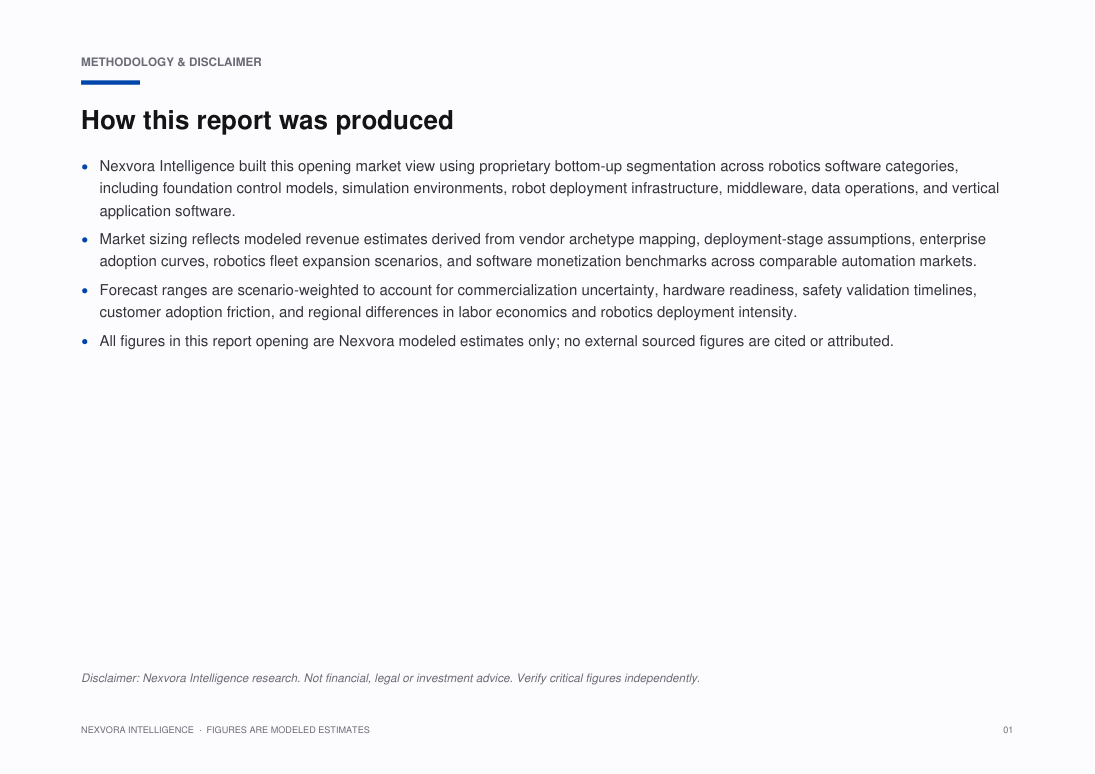
Nexvora Intelligence built this opening market view using proprietary bottom-up segmentation across robotics software categories, including foundation control models, simulation environments, robot deployment infrastructure, middleware, data operations, and vertical application software.
Market sizing reflects modeled revenue estimates derived from vendor archetype mapping, deployment-stage assumptions, enterprise adoption curves, robotics fleet expansion scenarios, and software monetization benchmarks across comparable automation markets.
Forecast ranges are scenario-weighted to account for commercialization uncertainty, hardware readiness, safety validation timelines, customer adoption friction, and regional differences in labor economics and robotics deployment intensity.
All figures in this report opening are Nexvora modeled estimates only; no external sourced figures are cited or attributed.
What's inside — a number-free look.
A full outline of the figures and tables you'll get. Specific data, market sizes and forecasts are unlocked with purchase.
List of Figures
- Figure 1: Market Overview and Structure — Robotics Foundation Models and Physical Intelligence Software
- Figure 2: Market Size and Forecast Framework — Robotics Foundation Models and Physical Intelligence Software
- Figure 3: Value Chain and Ecosystem Analysis — Robotics Foundation Models and Physical Intelligence Software
- Figure 4: Market Dynamics — Drivers, Restraints and Opportunities — Robotics Foundation Models and Physical Intelligence Software
- Figure 5: Segment Contribution Analysis — Robotics Foundation Models and Physical Intelligence Software
- Figure 6: Regional Market Landscape — Robotics Foundation Models and Physical Intelligence Software
- Figure 7: Country-level Opportunity Mapping — Robotics Foundation Models and Physical Intelligence Software
- Figure 8: Competitive Positioning Matrix — Robotics Foundation Models and Physical Intelligence Software
- Figure 9: Market Share of Leading Players — Robotics Foundation Models and Physical Intelligence Software
- Figure 10: Adoption and Penetration Trends — Robotics Foundation Models and Physical Intelligence Software
- Figure 11: Technology and Innovation Landscape — Robotics Foundation Models and Physical Intelligence Software
- Figure 12: Pricing and Business Model Analysis — Robotics Foundation Models and Physical Intelligence Software
- Figure 13: Investment, Funding and M&A Landscape — Robotics Foundation Models and Physical Intelligence Software
- Figure 14: Regulatory and Policy Framework — Robotics Foundation Models and Physical Intelligence Software
- Figure 15: Porter's Five Forces Analysis — Robotics Foundation Models and Physical Intelligence Software
- Figure 16: PESTLE Analysis — Robotics Foundation Models and Physical Intelligence Software
- Figure 17: Growth Opportunity Heat Map — Robotics Foundation Models and Physical Intelligence Software
- Figure 18: Future Outlook and Strategic Roadmap — Robotics Foundation Models and Physical Intelligence Software
List of Tables
- Table 1: Market Segmentation Overview — Robotics Foundation Models and Physical Intelligence Software
- Table 2: Segment Definitions and Scope — Robotics Foundation Models and Physical Intelligence Software
- Table 3: Regional and Country Coverage Summary — Robotics Foundation Models and Physical Intelligence Software
- Table 4: Key Company Profiles and Offerings — Robotics Foundation Models and Physical Intelligence Software
- Table 5: Competitive Benchmarking Matrix — Robotics Foundation Models and Physical Intelligence Software
- Table 6: Product and Service Portfolio Mapping — Robotics Foundation Models and Physical Intelligence Software
- Table 7: Market Drivers, Restraints and Trends — Robotics Foundation Models and Physical Intelligence Software
- Table 8: Strategic Initiatives and Developments — Robotics Foundation Models and Physical Intelligence Software
- Table 9: Partnerships and Collaborations — Robotics Foundation Models and Physical Intelligence Software
- Table 10: Research Assumptions and Limitations — Robotics Foundation Models and Physical Intelligence Software
- Table 11: Data Sources and References — Robotics Foundation Models and Physical Intelligence Software
- Table 12: Report Scope and Coverage Summary — Robotics Foundation Models and Physical Intelligence Software
A look at the pages.
108 pages · 20 sections · charts & tables
A genuine peek at the opening pages. Unlock to read every page in full.
6 of 108 pages shown
Turn this market into a plan for your business.
Answer a few quick questions and unlock a personalised operational read — your maturity score, prioritised focus areas and quick wins — mapped to where this market is heading. Result delivered instantly and emailed to you.
- Maturity score & prioritised focus areas
- Practical quick wins and a recommended next step
Questions, answered.
How big is the Global Robotics Foundation Models and Physical Intelligence Software Market?
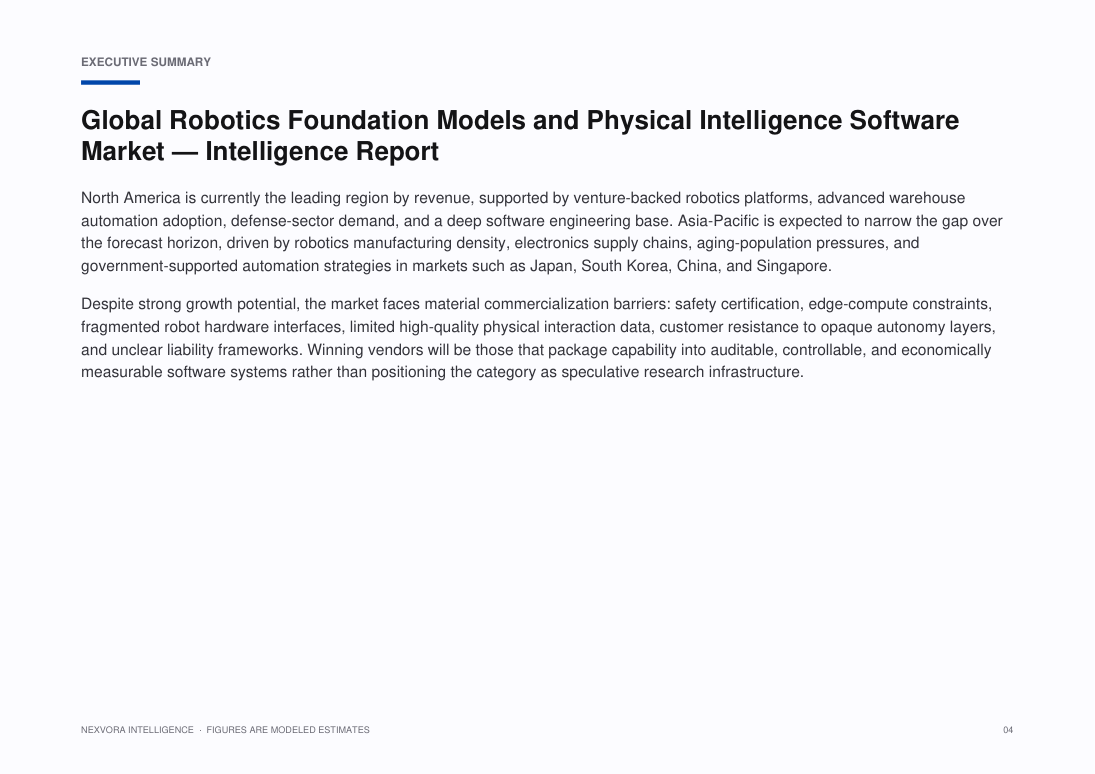
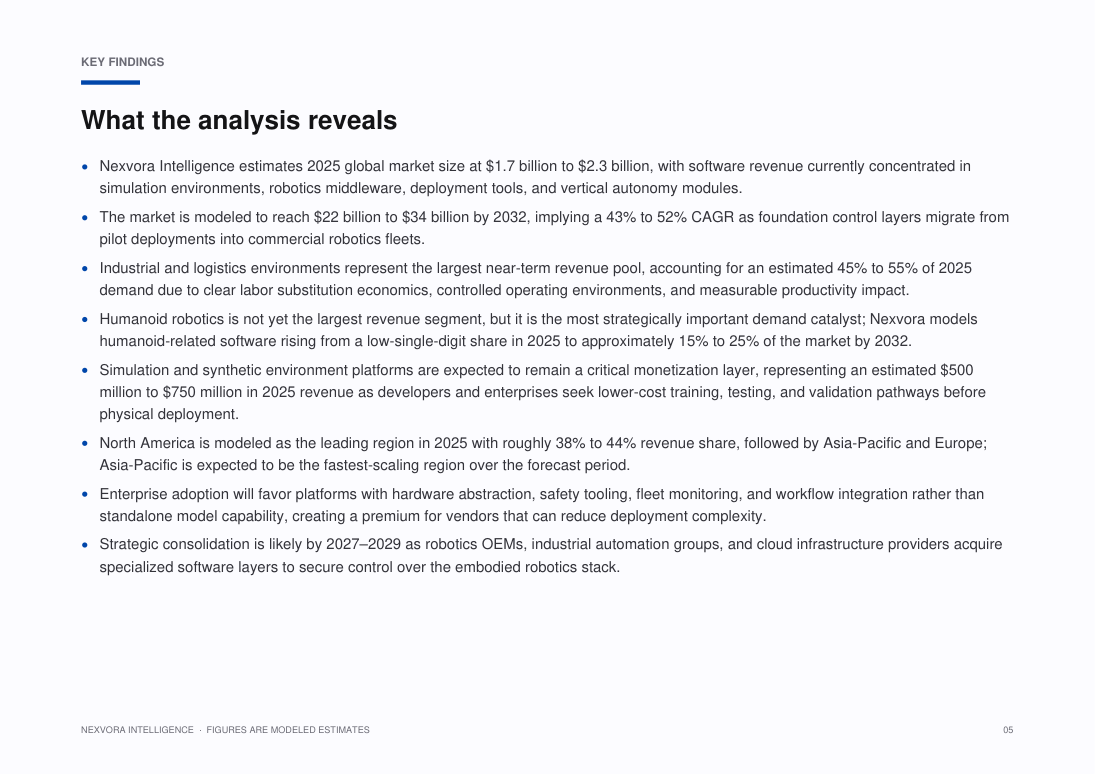
Nexvora models the Global Robotics Foundation Models and Physical Intelligence Software Market at approximately $1.7B–$2.3B. Full market sizing, segmentation and forecasts are inside the report (modeled estimate).
What is the growth rate (CAGR) of the Global Robotics Foundation Models and Physical Intelligence Software Market?
The Global Robotics Foundation Models and Physical Intelligence Software Market is projected to grow at a CAGR of about 43%–52% over the forecast period — a Nexvora modeled estimate detailed across the report's 20 sections.
What does this report include?
A complete market intelligence report — market sizing and forecasts, segmentation, regional and industry analysis, competitive landscape, trends, and strategic recommendations across 20 sections.
How do I access it after purchase?
Instantly, in your secure online viewer. Reports are view-only and available on any device from your library.
Are the figures sourced?
Quantitative figures are Nexvora modeled estimates unless explicitly cited to a referenced source within the report.
Can I buy access for my team?
Yes — add user seats at checkout, or subscribe for bulk access across multiple reports.
Nexvora Intelligence research report. All quantitative figures are modeled estimates — not audited data. Not financial or investment advice.
More market reports
Keep exploring intelligence in this and related sectors.

Global Agentic Enterprise Software Market — Intelligence Report

Nexvora vs. McKinsey: Technology & Software Advisory Market — Competitive Intelligence Report
Global Intelligent PCs, On-Device Generative Computing and NPU Software Ecosystem — Intelligence Report