
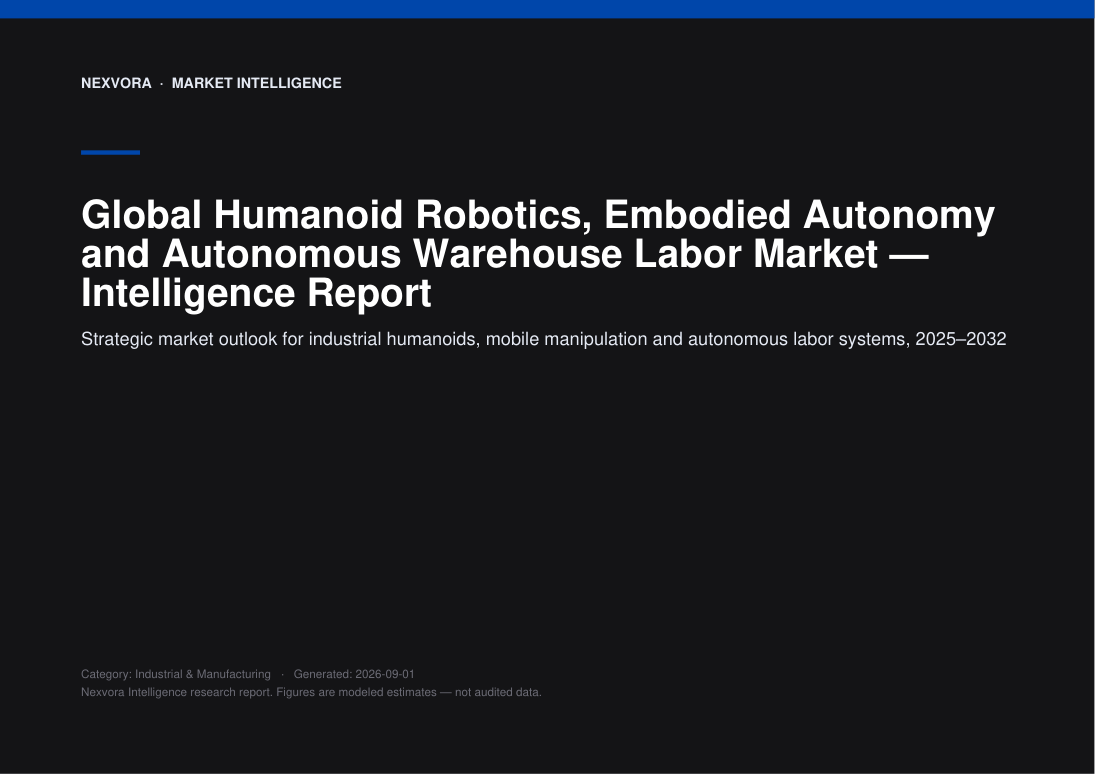
Global Humanoid Robotics, Embodied Autonomy and Autonomous Warehouse Labor Market — Intelligence Report
Strategic market outlook for industrial humanoids, mobile manipulation and autonomous labor systems, 2025–2032
Nexvora Intelligence market report on Global Humanoid Robotics, Physical AI and Autonomous Warehouse Labor Market.
per extra user
Instant access after payment. Secure via Razorpay.
The opening view — free.
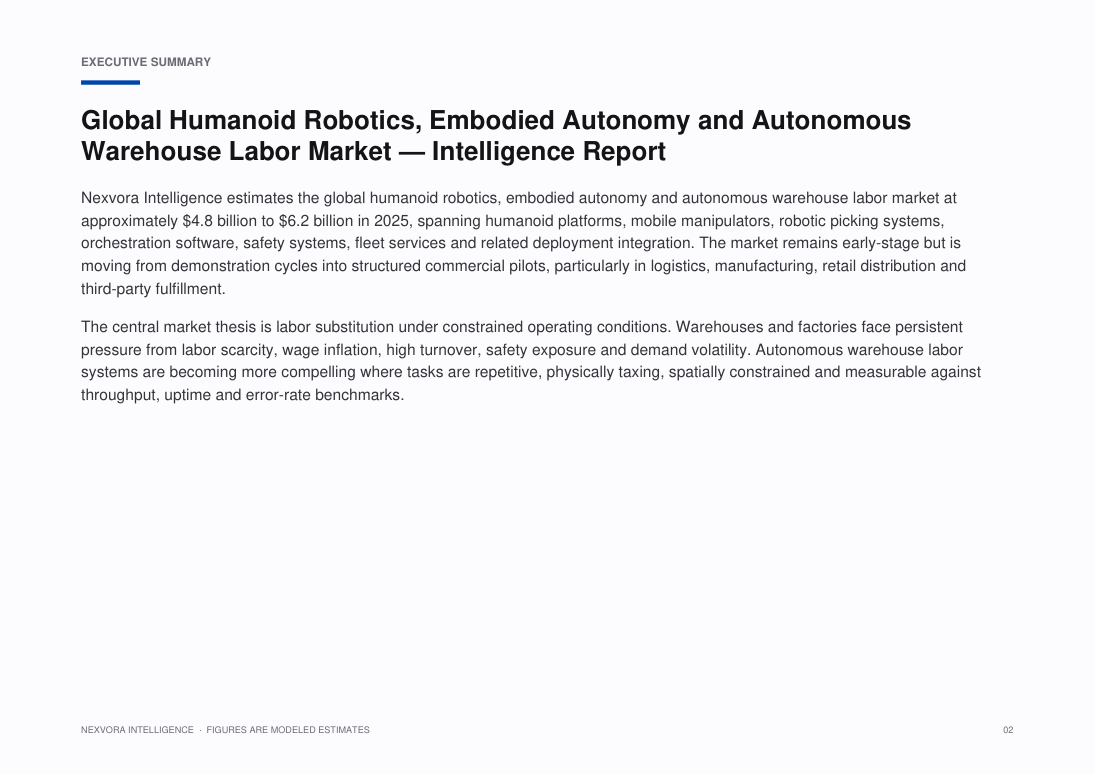
Nexvora Intelligence estimates the global humanoid robotics, embodied autonomy and autonomous warehouse labor market at approximately $••• to $••• in 2025, spanning humanoid platforms, mobile manipulators, robotic picking systems, orchestration software, safety systems, fleet services and related deployment integration. The market remains early-stage but is moving from demonstration cycles into structured commercial pilots, particularly in logistics, manufacturing, retail distribution and third-party fulfillment.
The central market thesis is labor substitution under constrained operating conditions. Warehouses and factories face persistent pressure from labor scarcity, wage inflation, high turnover, safety exposure and demand volatility. Autonomous warehouse labor systems are becoming more compelling where tasks are repetitive, physically taxing, spatially constrained and measurable against throughput, uptime and error-rate benchmarks.
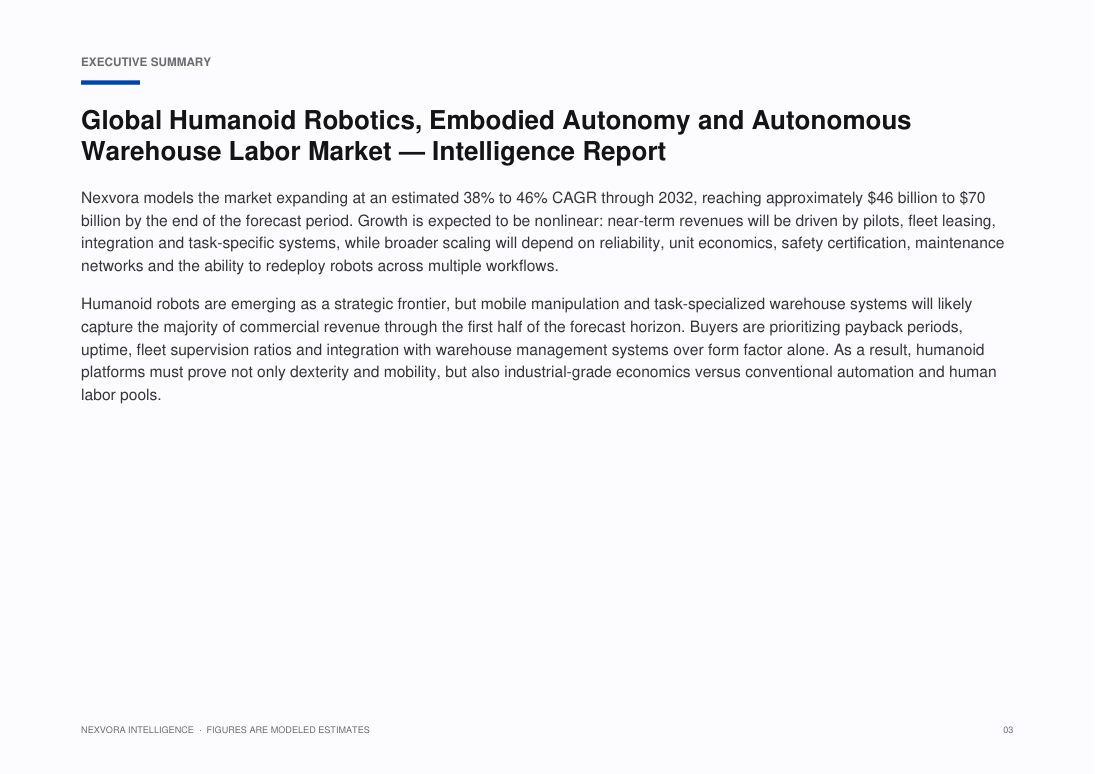
Nexvora models the market expanding at an estimated ••% to ••% CAGR through 2032, reaching approximately $••• to $••• by the end of the forecast period. Growth is expected to be nonlinear: near-term revenues will be driven by pilots, fleet leasing, integration and task-specific systems, while broader scaling will depend on reliability, unit economics, safety certification, maintenance networks and the ability to redeploy robots across multiple workflows.
Humanoid robots are emerging as a strategic frontier, but mobile manipulation and task-specialized warehouse systems will likely capture the majority of commercial revenue through the first half of the forecast horizon. Buyers are prioritizing payback periods, uptime, fleet supervision ratios and integration with warehouse management systems over form factor alone. As a result, humanoid platforms must prove not only dexterity and mobility, but also industrial-grade economics versus conventional automation and human labor pools.
Specific figures are hidden in this free preview. Unlock the report to see all modeled market sizes, forecasts and growth rates.
What this report covers.
Strategic market outlook for industrial humanoids, mobile manipulation and autonomous labor systems, 2025–2032
Who this report is for.
- Corporate strategy, planning and M&A teams evaluating the market
- Investors, private equity and venture teams sizing the opportunity
- Product, marketing and go-to-market leaders
- Consultants and analysts building the competitive picture
- Executives planning market entry, expansion or investment
How this report is built.
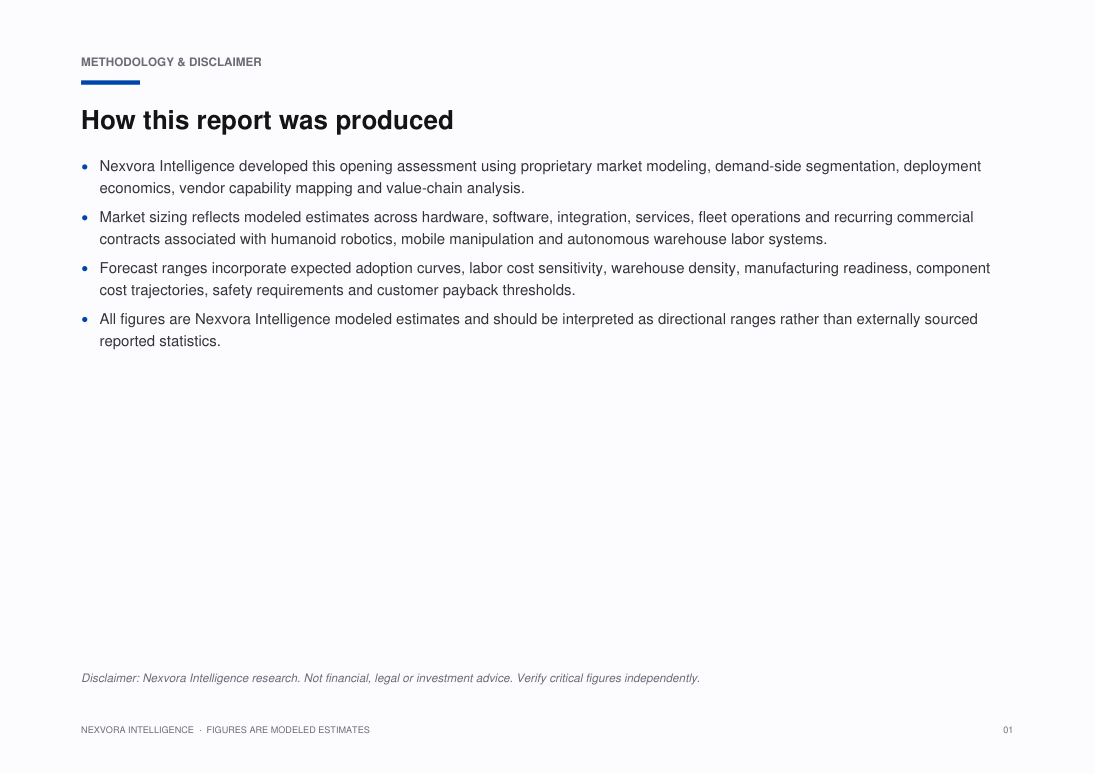
Nexvora Intelligence developed this opening assessment using proprietary market modeling, demand-side segmentation, deployment economics, vendor capability mapping and value-chain analysis.
Market sizing reflects modeled estimates across hardware, software, integration, services, fleet operations and recurring commercial contracts associated with humanoid robotics, mobile manipulation and autonomous warehouse labor systems.
Forecast ranges incorporate expected adoption curves, labor cost sensitivity, warehouse density, manufacturing readiness, component cost trajectories, safety requirements and customer payback thresholds.
All figures are Nexvora Intelligence modeled estimates and should be interpreted as directional ranges rather than externally sourced reported statistics.
What's inside — a number-free look.
A full outline of the figures and tables you'll get. Specific data, market sizes and forecasts are unlocked with purchase.
List of Figures
- Figure 1: Market Overview and Structure — Humanoid Robotics, Embodied Autonomy and Autonomous Warehouse Labor
- Figure 2: Market Size and Forecast Framework — Humanoid Robotics, Embodied Autonomy and Autonomous Warehouse Labor
- Figure 3: Value Chain and Ecosystem Analysis — Humanoid Robotics, Embodied Autonomy and Autonomous Warehouse Labor
- Figure 4: Market Dynamics — Drivers, Restraints and Opportunities — Humanoid Robotics, Embodied Autonomy and Autonomous Warehouse Labor
- Figure 5: Segment Contribution Analysis — Humanoid Robotics, Embodied Autonomy and Autonomous Warehouse Labor
- Figure 6: Regional Market Landscape — Humanoid Robotics, Embodied Autonomy and Autonomous Warehouse Labor
- Figure 7: Country-level Opportunity Mapping — Humanoid Robotics, Embodied Autonomy and Autonomous Warehouse Labor
- Figure 8: Competitive Positioning Matrix — Humanoid Robotics, Embodied Autonomy and Autonomous Warehouse Labor
- Figure 9: Market Share of Leading Players — Humanoid Robotics, Embodied Autonomy and Autonomous Warehouse Labor
- Figure 10: Adoption and Penetration Trends — Humanoid Robotics, Embodied Autonomy and Autonomous Warehouse Labor
- Figure 11: Technology and Innovation Landscape — Humanoid Robotics, Embodied Autonomy and Autonomous Warehouse Labor
- Figure 12: Pricing and Business Model Analysis — Humanoid Robotics, Embodied Autonomy and Autonomous Warehouse Labor
- Figure 13: Investment, Funding and M&A Landscape — Humanoid Robotics, Embodied Autonomy and Autonomous Warehouse Labor
- Figure 14: Regulatory and Policy Framework — Humanoid Robotics, Embodied Autonomy and Autonomous Warehouse Labor
- Figure 15: Porter's Five Forces Analysis — Humanoid Robotics, Embodied Autonomy and Autonomous Warehouse Labor
- Figure 16: PESTLE Analysis — Humanoid Robotics, Embodied Autonomy and Autonomous Warehouse Labor
- Figure 17: Growth Opportunity Heat Map — Humanoid Robotics, Embodied Autonomy and Autonomous Warehouse Labor
- Figure 18: Future Outlook and Strategic Roadmap — Humanoid Robotics, Embodied Autonomy and Autonomous Warehouse Labor
List of Tables
- Table 1: Market Segmentation Overview — Humanoid Robotics, Embodied Autonomy and Autonomous Warehouse Labor
- Table 2: Segment Definitions and Scope — Humanoid Robotics, Embodied Autonomy and Autonomous Warehouse Labor
- Table 3: Regional and Country Coverage Summary — Humanoid Robotics, Embodied Autonomy and Autonomous Warehouse Labor
- Table 4: Key Company Profiles and Offerings — Humanoid Robotics, Embodied Autonomy and Autonomous Warehouse Labor
- Table 5: Competitive Benchmarking Matrix — Humanoid Robotics, Embodied Autonomy and Autonomous Warehouse Labor
- Table 6: Product and Service Portfolio Mapping — Humanoid Robotics, Embodied Autonomy and Autonomous Warehouse Labor
- Table 7: Market Drivers, Restraints and Trends — Humanoid Robotics, Embodied Autonomy and Autonomous Warehouse Labor
- Table 8: Strategic Initiatives and Developments — Humanoid Robotics, Embodied Autonomy and Autonomous Warehouse Labor
- Table 9: Partnerships and Collaborations — Humanoid Robotics, Embodied Autonomy and Autonomous Warehouse Labor
- Table 10: Research Assumptions and Limitations — Humanoid Robotics, Embodied Autonomy and Autonomous Warehouse Labor
- Table 11: Data Sources and References — Humanoid Robotics, Embodied Autonomy and Autonomous Warehouse Labor
- Table 12: Report Scope and Coverage Summary — Humanoid Robotics, Embodied Autonomy and Autonomous Warehouse Labor
A look at the pages.
107 pages · 20 sections · charts & tables
A genuine peek at the opening pages. Unlock to read every page in full.
6 of 107 pages shown
Turn this market into a plan for your business.
Answer a few quick questions and unlock a personalised operational read — your maturity score, prioritised focus areas and quick wins — mapped to where this market is heading. Result delivered instantly and emailed to you.
- Maturity score & prioritised focus areas
- Practical quick wins and a recommended next step
Questions, answered.
What does this report include?
A complete market intelligence report — market sizing and forecasts, segmentation, regional and industry analysis, competitive landscape, trends, and strategic recommendations across 20 sections.
How do I access it after purchase?
Instantly, in your secure online viewer. Reports are view-only and available on any device from your library.
Are the figures sourced?
Quantitative figures are Nexvora modeled estimates unless explicitly cited to a referenced source within the report.
Can I buy access for my team?
Yes — add user seats at checkout, or subscribe for bulk access across multiple reports.
Nexvora Intelligence research report. All quantitative figures are modeled estimates — not audited data. Not financial or investment advice.