
Global Humanoid Robotics Market — Industrial & Service Automation Intelligence Report
Embodied automation, warehouse labor substitution, manufacturing augmentation, and service robotics outlook, 2026–2031
Nexvora Intelligence market report on Global Humanoid Robotics Market — Physical AI, Warehouse Automation, Manufacturing Labor & Service Robotics Outlook, 2026–2031.

per extra user
Instant access after payment. Secure via Razorpay.
The opening view — free.
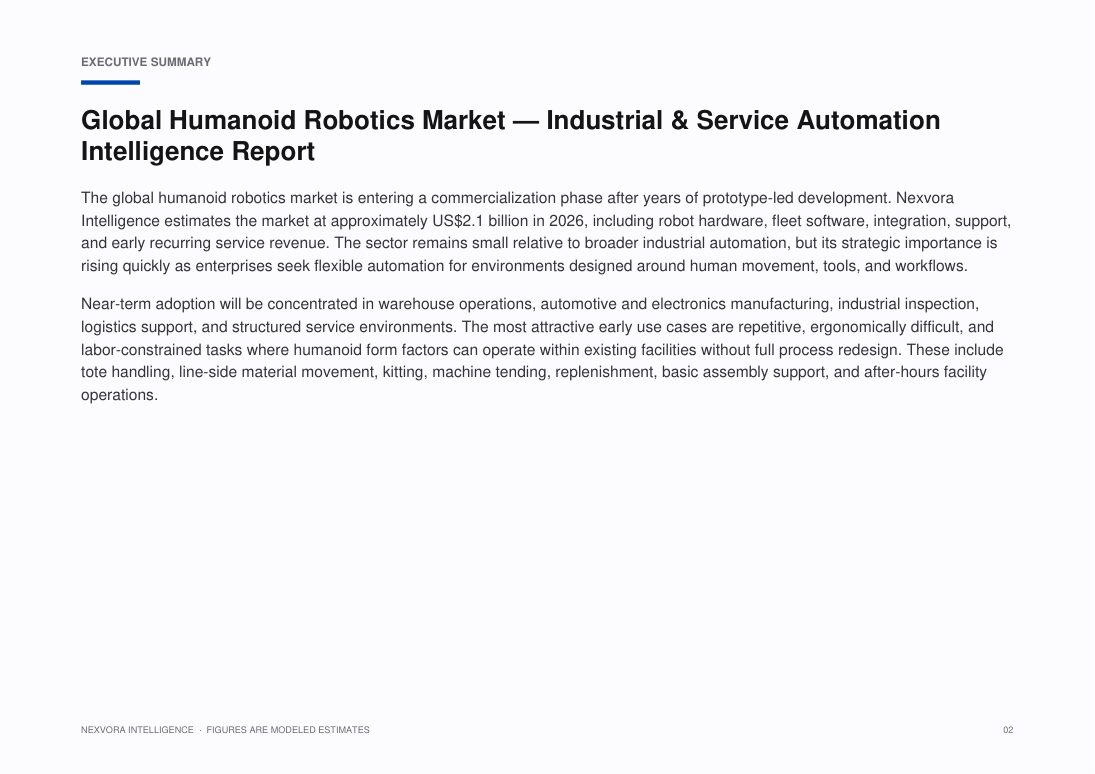
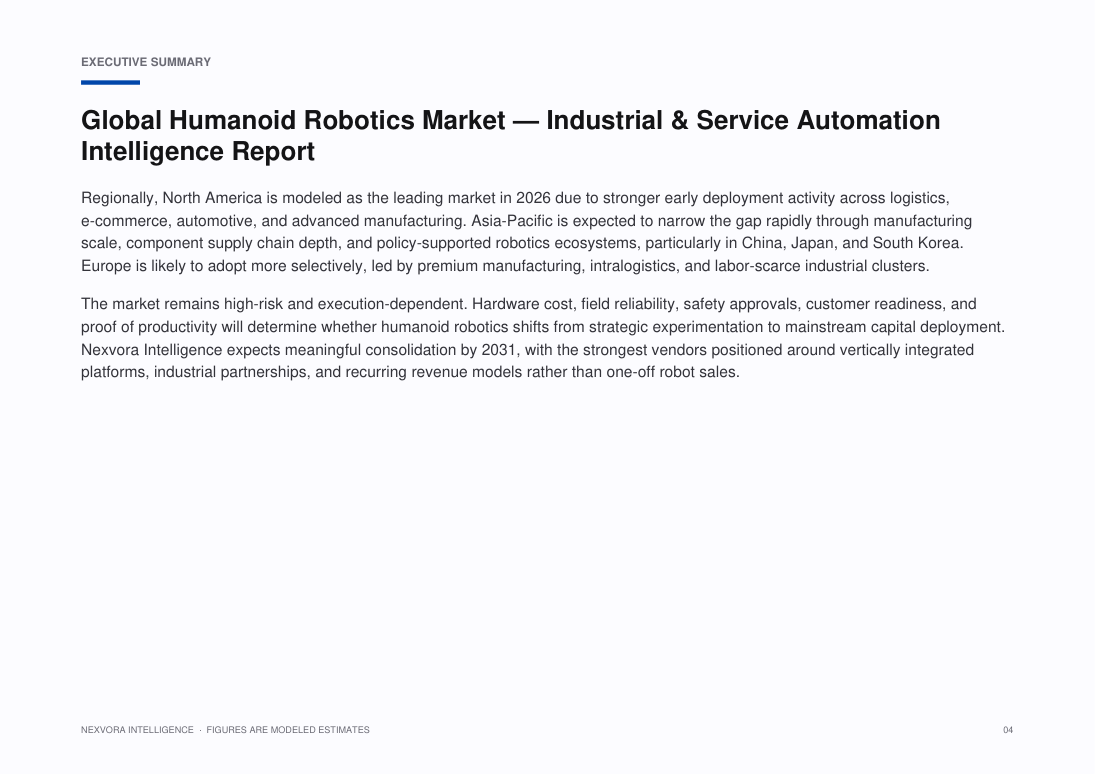
The global humanoid robotics market is entering a commercialization phase after years of prototype-led development. Nexvora Intelligence estimates the market at approximately US$••• in 2026, including robot hardware, fleet software, integration, support, and early recurring service revenue. The sector remains small relative to broader industrial automation, but its strategic importance is rising quickly as enterprises seek flexible automation for environments designed around human movement, tools, and workflows.
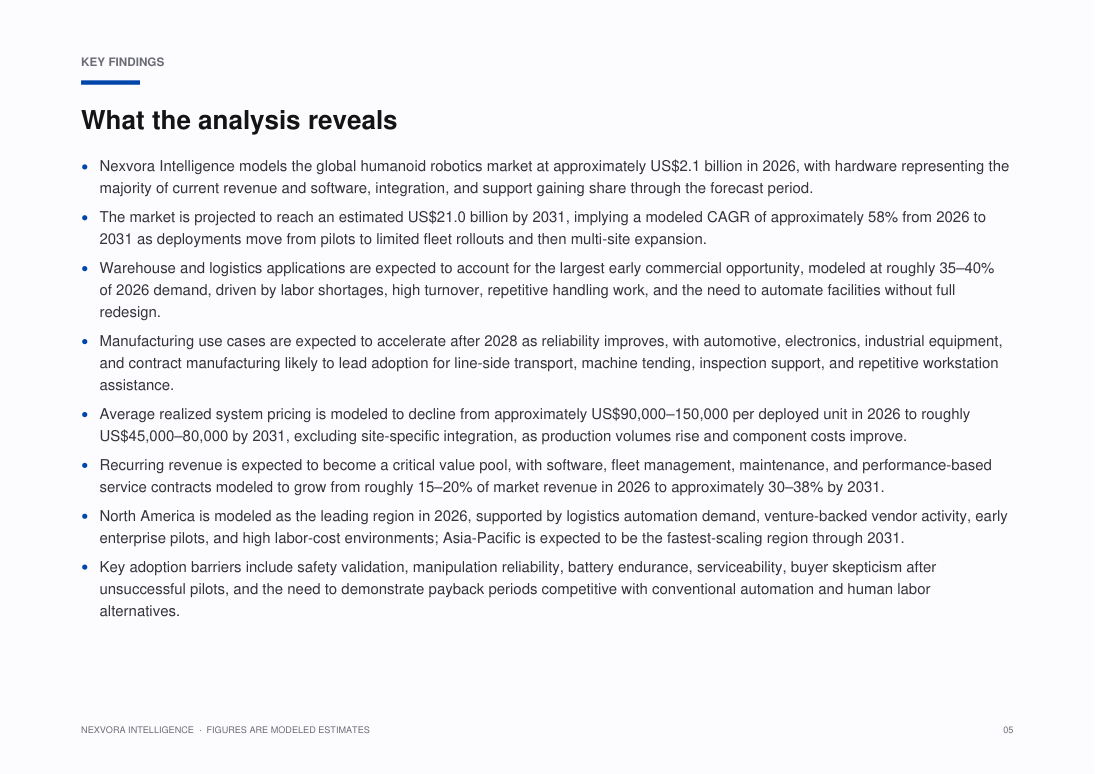
Near-term adoption will be concentrated in warehouse operations, automotive and electronics manufacturing, industrial inspection, logistics support, and structured service environments. The most attractive early use cases are repetitive, ergonomically difficult, and labor-constrained tasks where humanoid form factors can operate within existing facilities without full process redesign. These include tote handling, line-side material movement, kitting, machine tending, replenishment, basic assembly support, and after-hours facility operations.
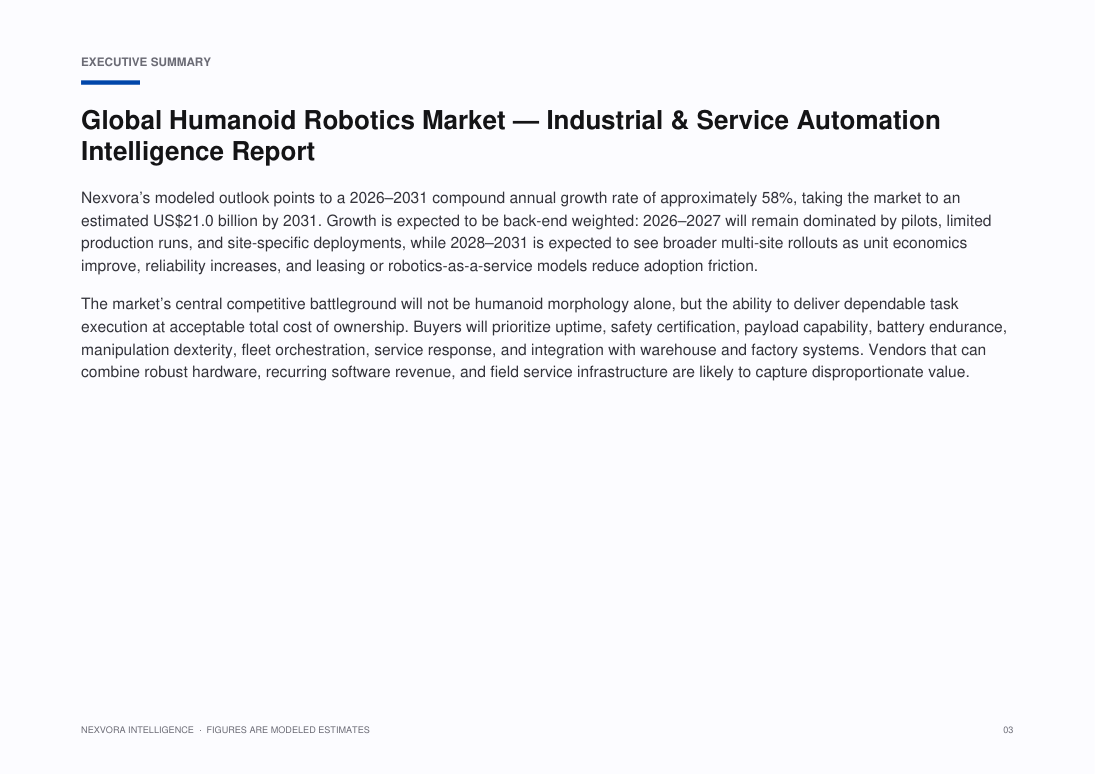
Nexvora’s modeled outlook points to a 2026–2031 compound annual growth rate of approximately ••%, taking the market to an estimated US$••• by 2031. Growth is expected to be back-end weighted: 2026–2027 will remain dominated by pilots, limited production runs, and site-specific deployments, while 2028–2031 is expected to see broader multi-site rollouts as unit economics improve, reliability increases, and leasing or robotics-as-a-service models reduce adoption friction.
The market’s central competitive battleground will not be humanoid morphology alone, but the ability to deliver dependable task execution at acceptable total cost of ownership. Buyers will prioritize uptime, safety certification, payload capability, battery endurance, manipulation dexterity, fleet orchestration, service response, and integration with warehouse and factory systems. Vendors that can combine robust hardware, recurring software revenue, and field service infrastructure are likely to capture disproportionate value.
Specific figures are hidden in this free preview. Unlock the report to see all modeled market sizes, forecasts and growth rates.
What this report covers.
Embodied automation, warehouse labor substitution, manufacturing augmentation, and service robotics outlook, 2026–2031
Who this report is for.
- Corporate strategy, planning and M&A teams evaluating the market
- Investors, private equity and venture teams sizing the opportunity
- Product, marketing and go-to-market leaders
- Consultants and analysts building the competitive picture
- Executives planning market entry, expansion or investment
How this report is built.
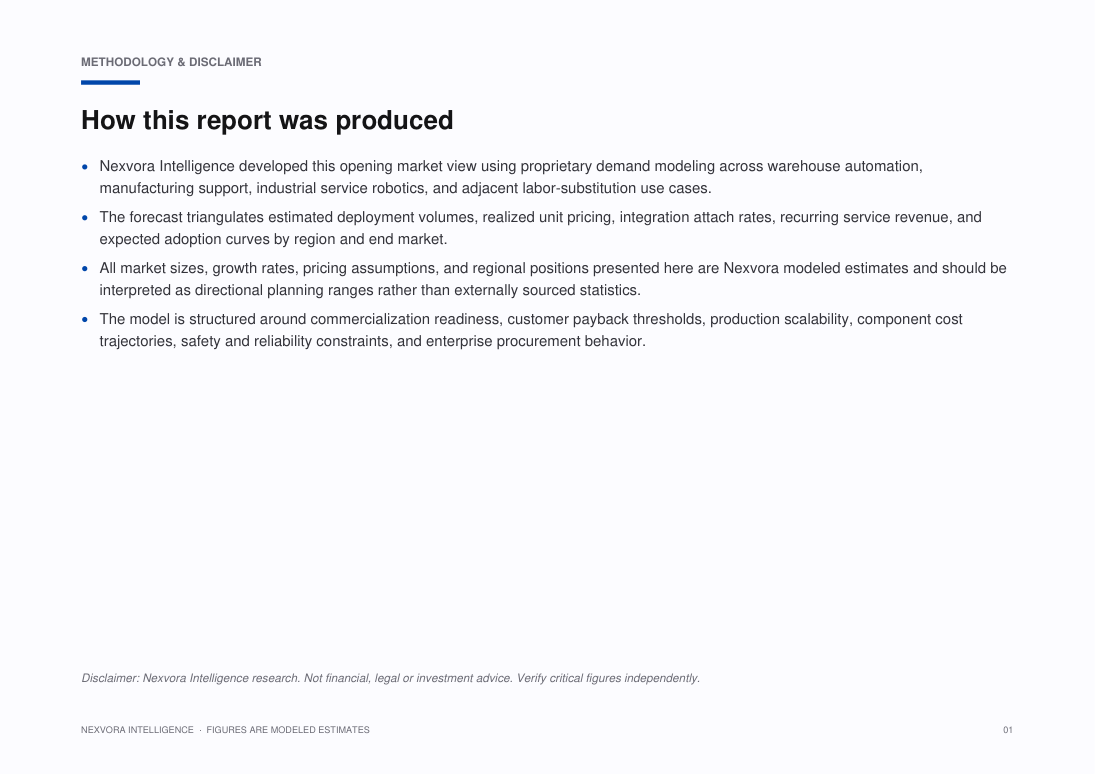
Nexvora Intelligence developed this opening market view using proprietary demand modeling across warehouse automation, manufacturing support, industrial service robotics, and adjacent labor-substitution use cases.
The forecast triangulates estimated deployment volumes, realized unit pricing, integration attach rates, recurring service revenue, and expected adoption curves by region and end market.
All market sizes, growth rates, pricing assumptions, and regional positions presented here are Nexvora modeled estimates and should be interpreted as directional planning ranges rather than externally sourced statistics.
The model is structured around commercialization readiness, customer payback thresholds, production scalability, component cost trajectories, safety and reliability constraints, and enterprise procurement behavior.
What's inside — a number-free look.
A full outline of the figures and tables you'll get. Specific data, market sizes and forecasts are unlocked with purchase.
List of Figures
- Figure 1: Market Overview and Structure — Humanoid Robotics — Industrial & Service Automation
- Figure 2: Market Size and Forecast Framework — Humanoid Robotics — Industrial & Service Automation
- Figure 3: Value Chain and Ecosystem Analysis — Humanoid Robotics — Industrial & Service Automation
- Figure 4: Market Dynamics — Drivers, Restraints and Opportunities — Humanoid Robotics — Industrial & Service Automation
- Figure 5: Segment Contribution Analysis — Humanoid Robotics — Industrial & Service Automation
- Figure 6: Regional Market Landscape — Humanoid Robotics — Industrial & Service Automation
- Figure 7: Country-level Opportunity Mapping — Humanoid Robotics — Industrial & Service Automation
- Figure 8: Competitive Positioning Matrix — Humanoid Robotics — Industrial & Service Automation
- Figure 9: Market Share of Leading Players — Humanoid Robotics — Industrial & Service Automation
- Figure 10: Adoption and Penetration Trends — Humanoid Robotics — Industrial & Service Automation
- Figure 11: Technology and Innovation Landscape — Humanoid Robotics — Industrial & Service Automation
- Figure 12: Pricing and Business Model Analysis — Humanoid Robotics — Industrial & Service Automation
- Figure 13: Investment, Funding and M&A Landscape — Humanoid Robotics — Industrial & Service Automation
- Figure 14: Regulatory and Policy Framework — Humanoid Robotics — Industrial & Service Automation
- Figure 15: Porter's Five Forces Analysis — Humanoid Robotics — Industrial & Service Automation
- Figure 16: PESTLE Analysis — Humanoid Robotics — Industrial & Service Automation
- Figure 17: Growth Opportunity Heat Map — Humanoid Robotics — Industrial & Service Automation
- Figure 18: Future Outlook and Strategic Roadmap — Humanoid Robotics — Industrial & Service Automation
List of Tables
- Table 1: Market Segmentation Overview — Humanoid Robotics — Industrial & Service Automation
- Table 2: Segment Definitions and Scope — Humanoid Robotics — Industrial & Service Automation
- Table 3: Regional and Country Coverage Summary — Humanoid Robotics — Industrial & Service Automation
- Table 4: Key Company Profiles and Offerings — Humanoid Robotics — Industrial & Service Automation
- Table 5: Competitive Benchmarking Matrix — Humanoid Robotics — Industrial & Service Automation
- Table 6: Product and Service Portfolio Mapping — Humanoid Robotics — Industrial & Service Automation
- Table 7: Market Drivers, Restraints and Trends — Humanoid Robotics — Industrial & Service Automation
- Table 8: Strategic Initiatives and Developments — Humanoid Robotics — Industrial & Service Automation
- Table 9: Partnerships and Collaborations — Humanoid Robotics — Industrial & Service Automation
- Table 10: Research Assumptions and Limitations — Humanoid Robotics — Industrial & Service Automation
- Table 11: Data Sources and References — Humanoid Robotics — Industrial & Service Automation
- Table 12: Report Scope and Coverage Summary — Humanoid Robotics — Industrial & Service Automation
A look at the pages.
107 pages · 20 sections · charts & tables
A genuine peek at the opening pages. Unlock to read every page in full.
6 of 107 pages shown
Turn this market into a plan for your business.
Answer a few quick questions and unlock a personalised operational read — your maturity score, prioritised focus areas and quick wins — mapped to where this market is heading. Result delivered instantly and emailed to you.
- Maturity score & prioritised focus areas
- Practical quick wins and a recommended next step
Questions, answered.
How big is the Global Humanoid Robotics Market?
Nexvora models the Global Humanoid Robotics Market at approximately US$2.1B (2026E). Full market sizing, segmentation and forecasts are inside the report (modeled estimate).
What is the growth rate (CAGR) of the Global Humanoid Robotics Market?
The Global Humanoid Robotics Market is projected to grow at a CAGR of about 58% (2026–2031E) over the forecast period — a Nexvora modeled estimate detailed across the report's 20 sections.
What does this report include?
A complete market intelligence report — market sizing and forecasts, segmentation, regional and industry analysis, competitive landscape, trends, and strategic recommendations across 20 sections.
How do I access it after purchase?
Instantly, in your secure online viewer. Reports are view-only and available on any device from your library.
Are the figures sourced?
Quantitative figures are Nexvora modeled estimates unless explicitly cited to a referenced source within the report.
Can I buy access for my team?
Yes — add user seats at checkout, or subscribe for bulk access across multiple reports.
Nexvora Intelligence research report. All quantitative figures are modeled estimates — not audited data. Not financial or investment advice.
More market reports
Keep exploring intelligence in this and related sectors.

Global Counter-Drone Defense, C-UAS Detection and Autonomous Airspace Security Market — Intelligence Report

Global Autonomous Mining, Electrified Haulage and Critical Minerals Digital Operations Market — Intelligence Report

Global Advanced Semiconductor Packaging, Chiplet Integration and 2.5D/3D Interconnect Market — Intelligence Report