
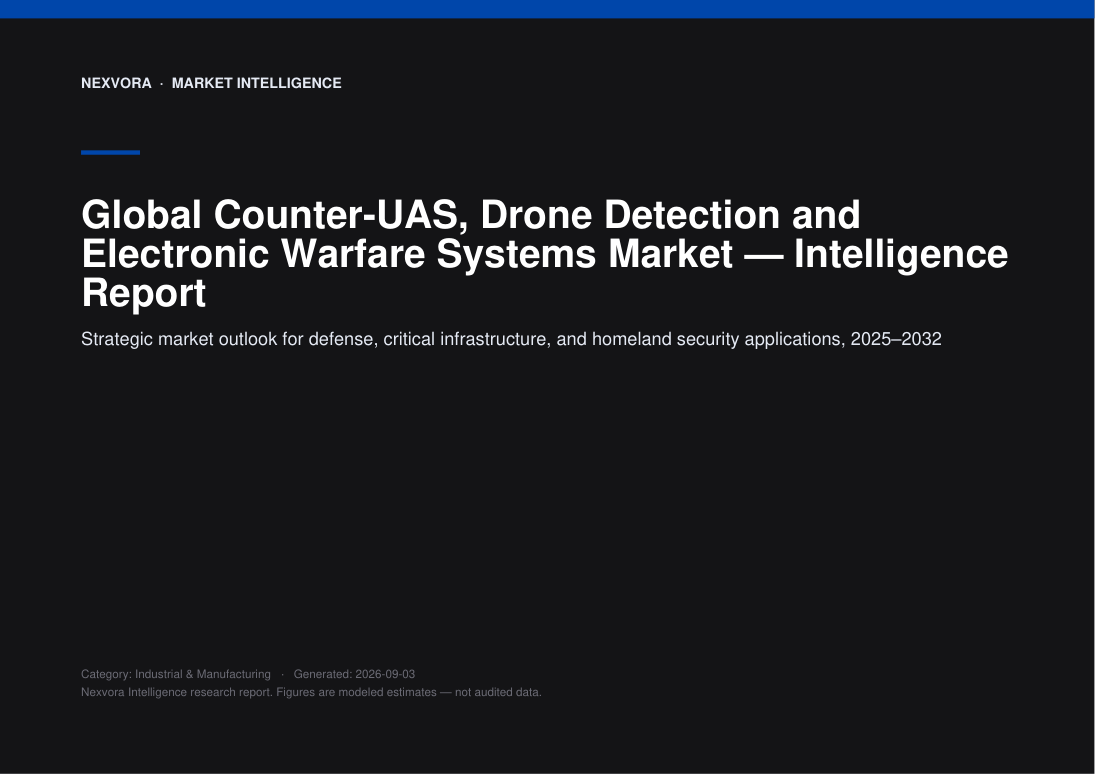
Global Counter-UAS, Drone Detection and Electronic Warfare Systems Market — Intelligence Report
Strategic market outlook for defense, critical infrastructure, and homeland security applications, 2025–2032
Nexvora Intelligence market report on Global Counter-UAS, Drone Detection and Electronic Warfare Systems Market.
per extra user
Instant access after payment. Secure via Razorpay.
The opening view — free.
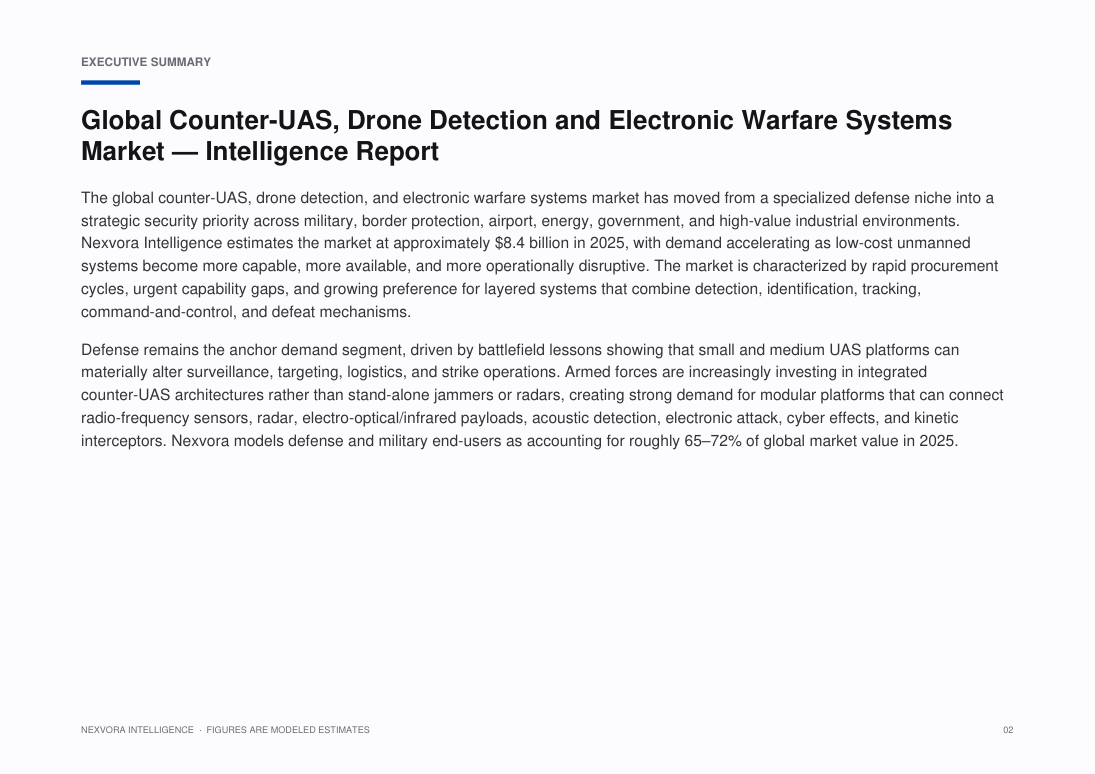
The global counter-UAS, drone detection, and electronic warfare systems market has moved from a specialized defense niche into a strategic security priority across military, border protection, airport, energy, government, and high-value industrial environments. Nexvora Intelligence estimates the market at approximately $••• in 2025, with demand accelerating as low-cost unmanned systems become more capable, more available, and more operationally disruptive. The market is characterized by rapid procurement cycles, urgent capability gaps, and growing preference for layered systems that combine detection, identification, tracking, command-and-control, and defeat mechanisms.
Defense remains the anchor demand segment, driven by battlefield lessons showing that small and medium UAS platforms can materially alter surveillance, targeting, logistics, and strike operations. Armed forces are increasingly investing in integrated counter-UAS architectures rather than stand-alone jammers or radars, creating strong demand for modular platforms that can connect radio-frequency sensors, radar, electro-optical/infrared payloads, acoustic detection, electronic attack, cyber effects, and kinetic interceptors. Nexvora models defense and military end-users as accounting for roughly 65–••% of global market value in 2025.
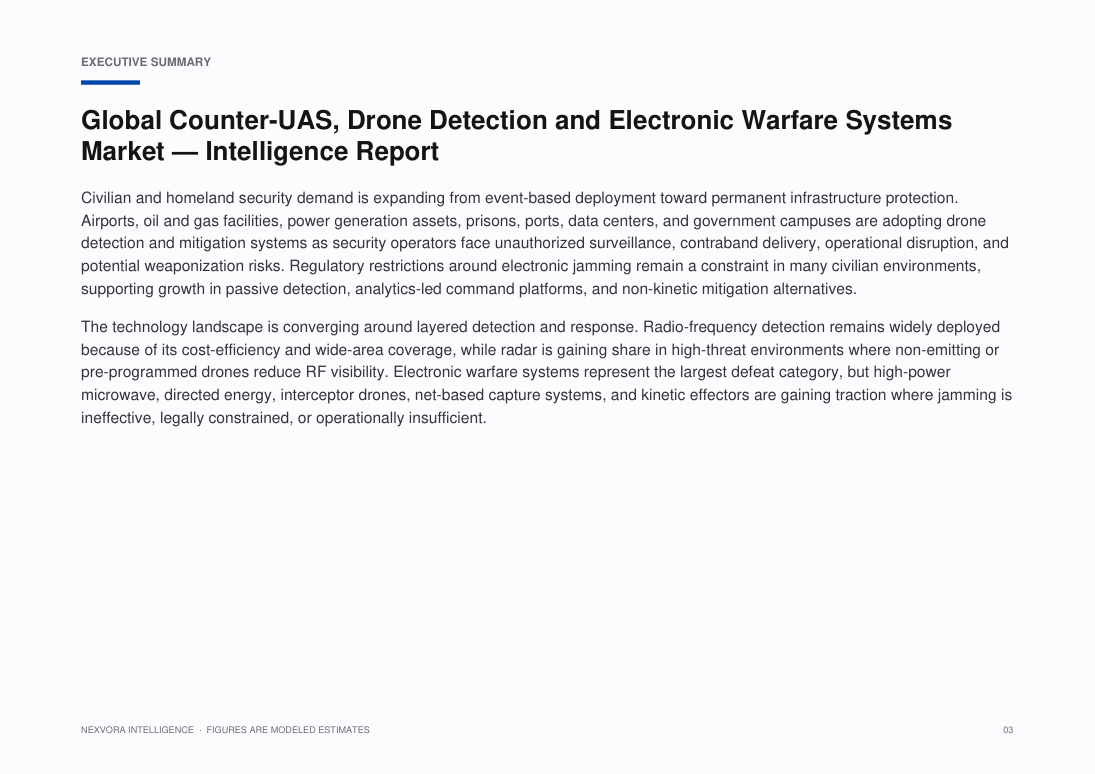
Civilian and homeland security demand is expanding from event-based deployment toward permanent infrastructure protection. Airports, oil and gas facilities, power generation assets, prisons, ports, data centers, and government campuses are adopting drone detection and mitigation systems as security operators face unauthorized surveillance, contraband delivery, operational disruption, and potential weaponization risks. Regulatory restrictions around electronic jamming remain a constraint in many civilian environments, supporting growth in passive detection, analytics-led command platforms, and non-kinetic mitigation alternatives.
The technology landscape is converging around layered detection and response. Radio-frequency detection remains widely deployed because of its cost-efficiency and wide-area coverage, while radar is gaining share in high-threat environments where non-emitting or pre-programmed drones reduce RF visibility. Electronic warfare systems represent the largest defeat category, but high-power microwave, directed energy, interceptor drones, net-based capture systems, and kinetic effectors are gaining traction where jamming is ineffective, legally constrained, or operationally insufficient.
Specific figures are hidden in this free preview. Unlock the report to see all modeled market sizes, forecasts and growth rates.
What this report covers.
Strategic market outlook for defense, critical infrastructure, and homeland security applications, 2025–2032
Who this report is for.
- Corporate strategy, planning and M&A teams evaluating the market
- Investors, private equity and venture teams sizing the opportunity
- Product, marketing and go-to-market leaders
- Consultants and analysts building the competitive picture
- Executives planning market entry, expansion or investment
How this report is built.
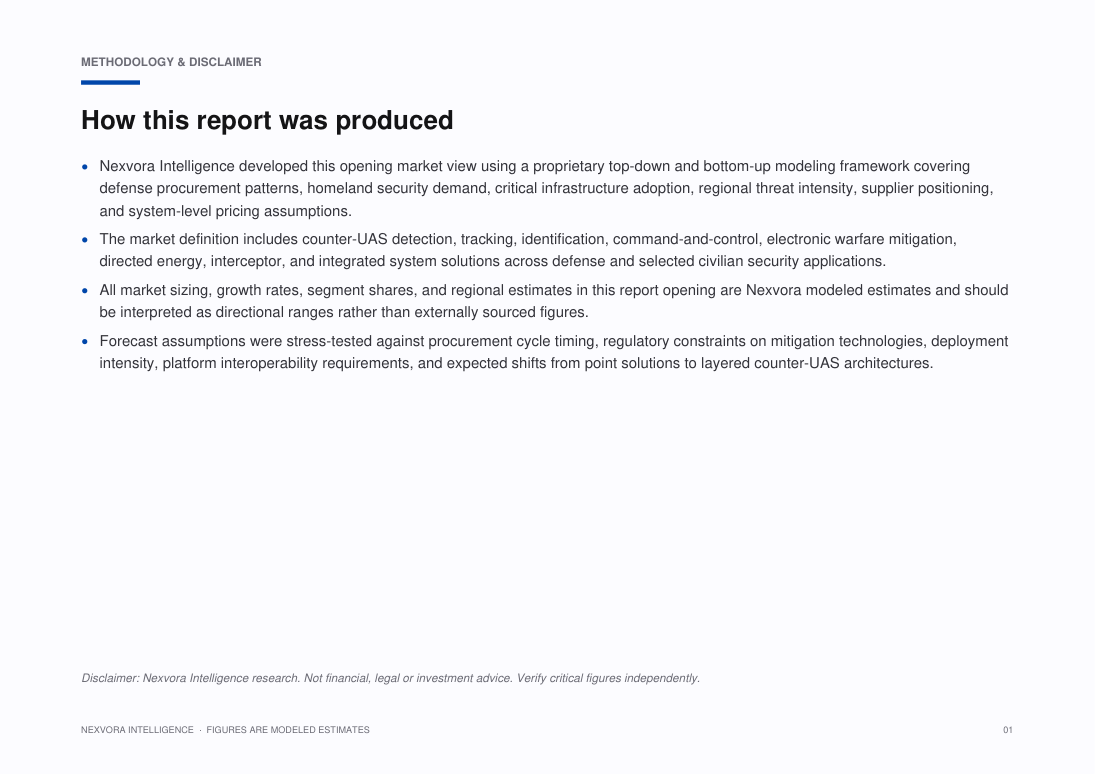
Nexvora Intelligence developed this opening market view using a proprietary top-down and bottom-up modeling framework covering defense procurement patterns, homeland security demand, critical infrastructure adoption, regional threat intensity, supplier positioning, and system-level pricing assumptions.
The market definition includes counter-UAS detection, tracking, identification, command-and-control, electronic warfare mitigation, directed energy, interceptor, and integrated system solutions across defense and selected civilian security applications.
All market sizing, growth rates, segment shares, and regional estimates in this report opening are Nexvora modeled estimates and should be interpreted as directional ranges rather than externally sourced figures.
Forecast assumptions were stress-tested against procurement cycle timing, regulatory constraints on mitigation technologies, deployment intensity, platform interoperability requirements, and expected shifts from point solutions to layered counter-UAS architectures.
What's inside — a number-free look.
A full outline of the figures and tables you'll get. Specific data, market sizes and forecasts are unlocked with purchase.
List of Figures
- Figure 1: Market Overview and Structure — Counter-UAS, Drone Detection and Electronic Warfare Systems
- Figure 2: Market Size and Forecast Framework — Counter-UAS, Drone Detection and Electronic Warfare Systems
- Figure 3: Value Chain and Ecosystem Analysis — Counter-UAS, Drone Detection and Electronic Warfare Systems
- Figure 4: Market Dynamics — Drivers, Restraints and Opportunities — Counter-UAS, Drone Detection and Electronic Warfare Systems
- Figure 5: Segment Contribution Analysis — Counter-UAS, Drone Detection and Electronic Warfare Systems
- Figure 6: Regional Market Landscape — Counter-UAS, Drone Detection and Electronic Warfare Systems
- Figure 7: Country-level Opportunity Mapping — Counter-UAS, Drone Detection and Electronic Warfare Systems
- Figure 8: Competitive Positioning Matrix — Counter-UAS, Drone Detection and Electronic Warfare Systems
- Figure 9: Market Share of Leading Players — Counter-UAS, Drone Detection and Electronic Warfare Systems
- Figure 10: Adoption and Penetration Trends — Counter-UAS, Drone Detection and Electronic Warfare Systems
- Figure 11: Technology and Innovation Landscape — Counter-UAS, Drone Detection and Electronic Warfare Systems
- Figure 12: Pricing and Business Model Analysis — Counter-UAS, Drone Detection and Electronic Warfare Systems
- Figure 13: Investment, Funding and M&A Landscape — Counter-UAS, Drone Detection and Electronic Warfare Systems
- Figure 14: Regulatory and Policy Framework — Counter-UAS, Drone Detection and Electronic Warfare Systems
- Figure 15: Porter's Five Forces Analysis — Counter-UAS, Drone Detection and Electronic Warfare Systems
- Figure 16: PESTLE Analysis — Counter-UAS, Drone Detection and Electronic Warfare Systems
- Figure 17: Growth Opportunity Heat Map — Counter-UAS, Drone Detection and Electronic Warfare Systems
- Figure 18: Future Outlook and Strategic Roadmap — Counter-UAS, Drone Detection and Electronic Warfare Systems
List of Tables
- Table 1: Market Segmentation Overview — Counter-UAS, Drone Detection and Electronic Warfare Systems
- Table 2: Segment Definitions and Scope — Counter-UAS, Drone Detection and Electronic Warfare Systems
- Table 3: Regional and Country Coverage Summary — Counter-UAS, Drone Detection and Electronic Warfare Systems
- Table 4: Key Company Profiles and Offerings — Counter-UAS, Drone Detection and Electronic Warfare Systems
- Table 5: Competitive Benchmarking Matrix — Counter-UAS, Drone Detection and Electronic Warfare Systems
- Table 6: Product and Service Portfolio Mapping — Counter-UAS, Drone Detection and Electronic Warfare Systems
- Table 7: Market Drivers, Restraints and Trends — Counter-UAS, Drone Detection and Electronic Warfare Systems
- Table 8: Strategic Initiatives and Developments — Counter-UAS, Drone Detection and Electronic Warfare Systems
- Table 9: Partnerships and Collaborations — Counter-UAS, Drone Detection and Electronic Warfare Systems
- Table 10: Research Assumptions and Limitations — Counter-UAS, Drone Detection and Electronic Warfare Systems
- Table 11: Data Sources and References — Counter-UAS, Drone Detection and Electronic Warfare Systems
- Table 12: Report Scope and Coverage Summary — Counter-UAS, Drone Detection and Electronic Warfare Systems
A look at the pages.
106 pages · 20 sections · charts & tables
A genuine peek at the opening pages. Unlock to read every page in full.
6 of 106 pages shown
Turn this market into a plan for your business.
Answer a few quick questions and unlock a personalised operational read — your maturity score, prioritised focus areas and quick wins — mapped to where this market is heading. Result delivered instantly and emailed to you.
- Maturity score & prioritised focus areas
- Practical quick wins and a recommended next step
Questions, answered.
How big is the Global Counter-UAS, Drone Detection and Electronic Warfare Systems Market?
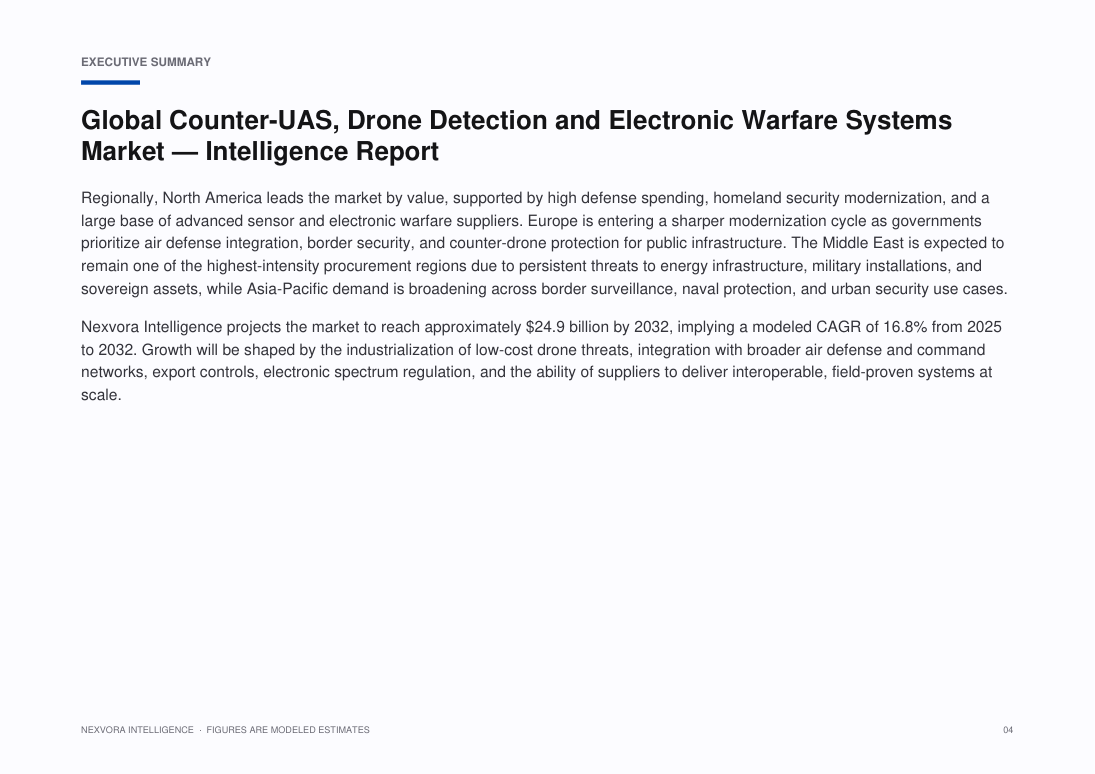
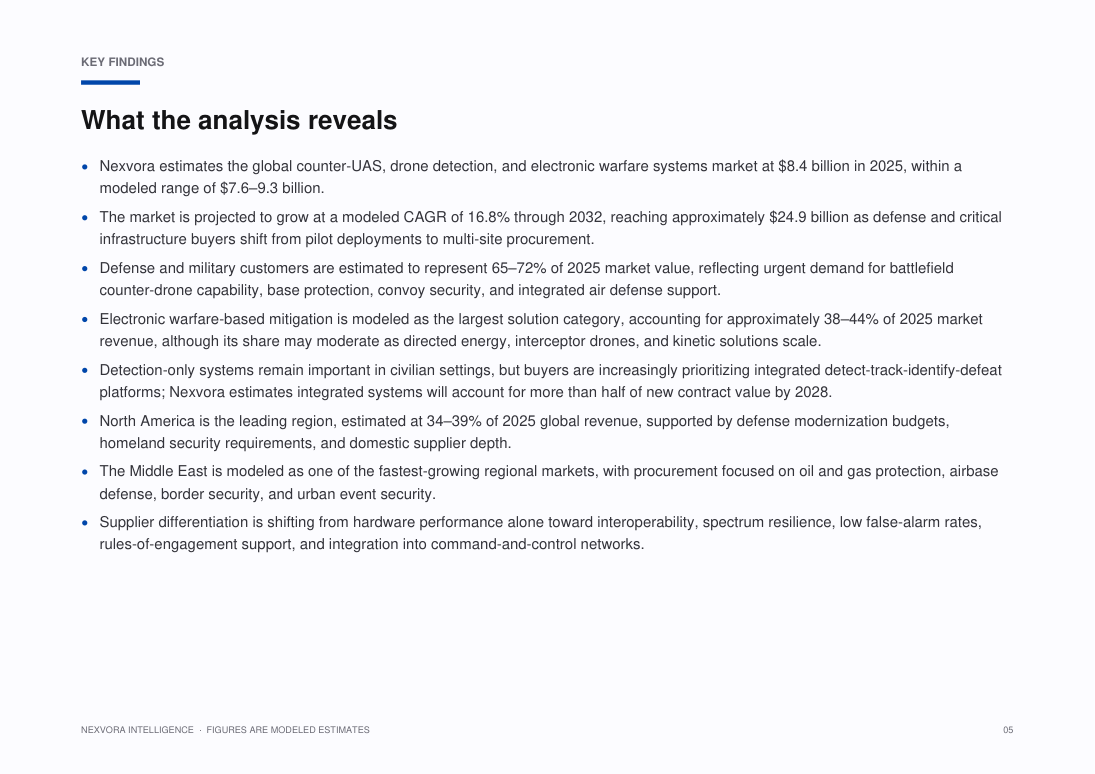
Nexvora models the Global Counter-UAS, Drone Detection and Electronic Warfare Systems Market at approximately $8.4B in 2025. Full market sizing, segmentation and forecasts are inside the report (modeled estimate).
What is the growth rate (CAGR) of the Global Counter-UAS, Drone Detection and Electronic Warfare Systems Market?
The Global Counter-UAS, Drone Detection and Electronic Warfare Systems Market is projected to grow at a CAGR of about 16.8% from 2025–2032 over the forecast period — a Nexvora modeled estimate detailed across the report's 20 sections.
What does this report include?
A complete market intelligence report — market sizing and forecasts, segmentation, regional and industry analysis, competitive landscape, trends, and strategic recommendations across 20 sections.
How do I access it after purchase?
Instantly, in your secure online viewer. Reports are view-only and available on any device from your library.
Are the figures sourced?
Quantitative figures are Nexvora modeled estimates unless explicitly cited to a referenced source within the report.
Can I buy access for my team?
Yes — add user seats at checkout, or subscribe for bulk access across multiple reports.
Nexvora Intelligence research report. All quantitative figures are modeled estimates — not audited data. Not financial or investment advice.
More market reports
Keep exploring intelligence in this and related sectors.

Global Humanoid Robotics Market — Industrial & Service Automation Intelligence Report
Global Counter-Drone Defense, C-UAS Detection and Autonomous Airspace Security Market — Intelligence Report

Global Autonomous Mining, Electrified Haulage and Critical Minerals Digital Operations Market — Intelligence Report