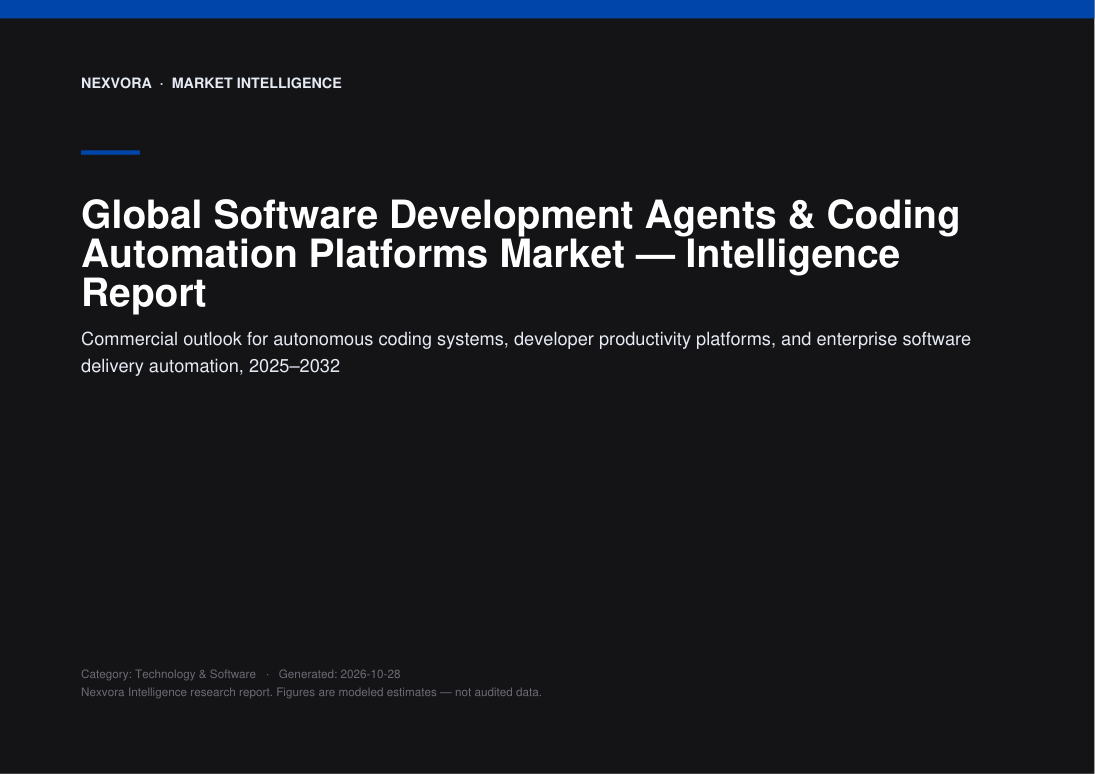
Global Software Development Agents & Coding Automation Platforms Market — Intelligence Report
Commercial outlook for autonomous coding systems, developer productivity platforms, and enterprise software delivery automation, 2025–2032
Nexvora Intelligence market report on Global AI-Native Software Development Agents & Coding Automation Platforms Market — Intelligence Report.
per extra user
Instant access after payment. Secure via Razorpay.
The opening view — free.
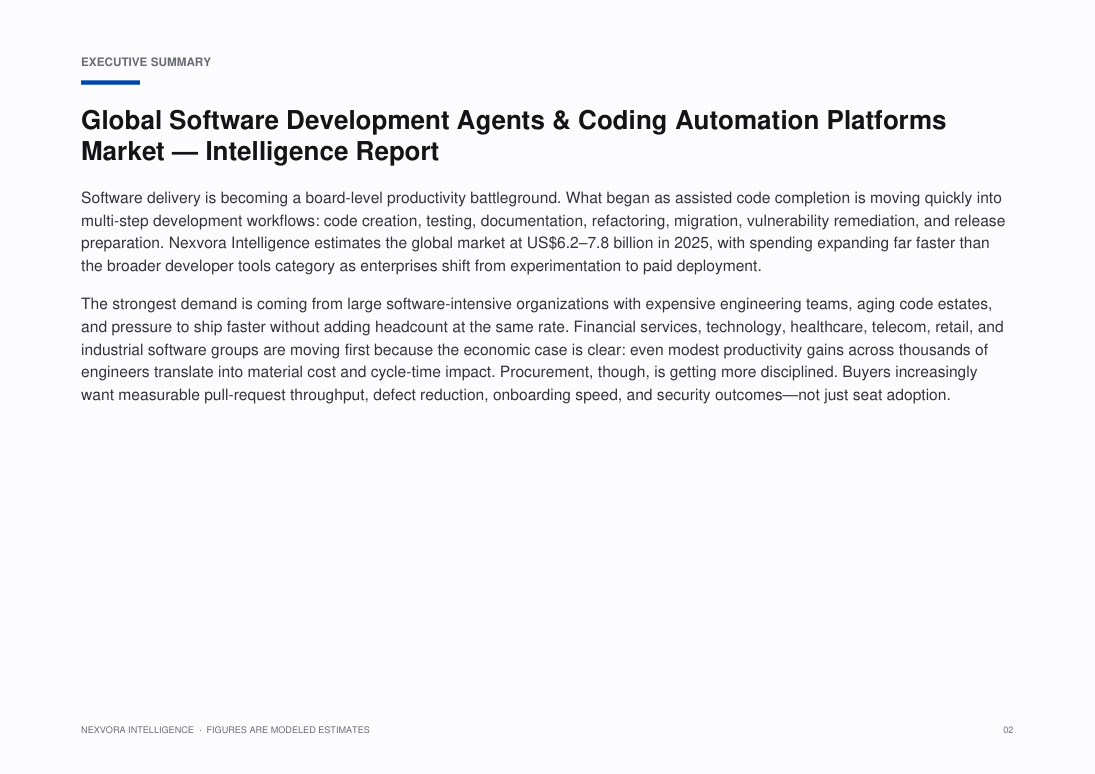
Software delivery is becoming a board-level productivity battleground. What began as assisted code completion is moving quickly into multi-step development workflows: code creation, testing, documentation, refactoring, migration, vulnerability remediation, and release preparation. Nexvora Intelligence estimates the global market at US$•••–••• billion in 2025, with spending expanding far faster than the broader developer tools category as enterprises shift from experimentation to paid deployment.
The strongest demand is coming from large software-intensive organizations with expensive engineering teams, aging code estates, and pressure to ship faster without adding headcount at the same rate. Financial services, technology, healthcare, telecom, retail, and industrial software groups are moving first because the economic case is clear: even modest productivity gains across thousands of engineers translate into material cost and cycle-time impact. Procurement, though, is getting more disciplined. Buyers increasingly want measurable pull-request throughput, defect reduction, onboarding speed, and security outcomes—not just seat adoption.
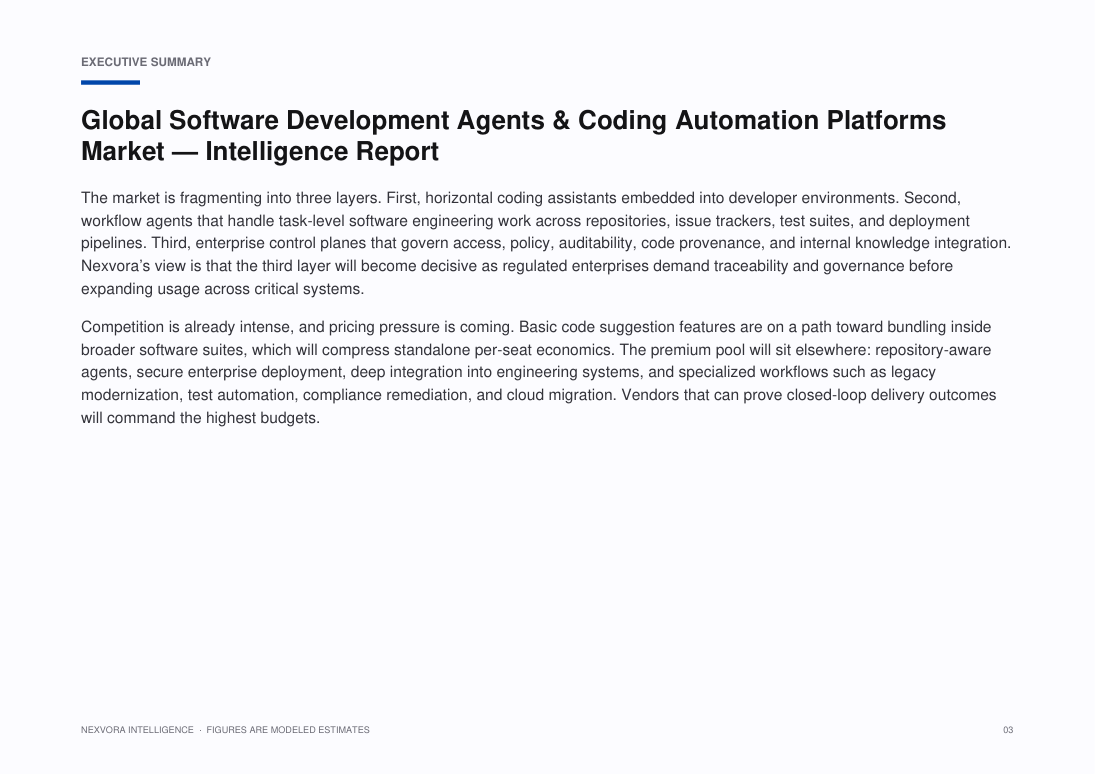
The market is fragmenting into three layers. First, horizontal coding assistants embedded into developer environments. Second, workflow agents that handle task-level software engineering work across repositories, issue trackers, test suites, and deployment pipelines. Third, enterprise control planes that govern access, policy, auditability, code provenance, and internal knowledge integration. Nexvora’s view is that the third layer will become decisive as regulated enterprises demand traceability and governance before expanding usage across critical systems.
Competition is already intense, and pricing pressure is coming. Basic code suggestion features are on a path toward bundling inside broader software suites, which will compress standalone per-seat economics. The premium pool will sit elsewhere: repository-aware agents, secure enterprise deployment, deep integration into engineering systems, and specialized workflows such as legacy modernization, test automation, compliance remediation, and cloud migration. Vendors that can prove closed-loop delivery outcomes will command the highest budgets.
Specific figures are hidden in this free preview. Unlock the report to see all modeled market sizes, forecasts and growth rates.
What this report covers.
Commercial outlook for autonomous coding systems, developer productivity platforms, and enterprise software delivery automation, 2025–2032
Who this report is for.
- Corporate strategy, planning and M&A teams evaluating the market
- Investors, private equity and venture teams sizing the opportunity
- Product, marketing and go-to-market leaders
- Consultants and analysts building the competitive picture
- Executives planning market entry, expansion or investment
How this report is built.
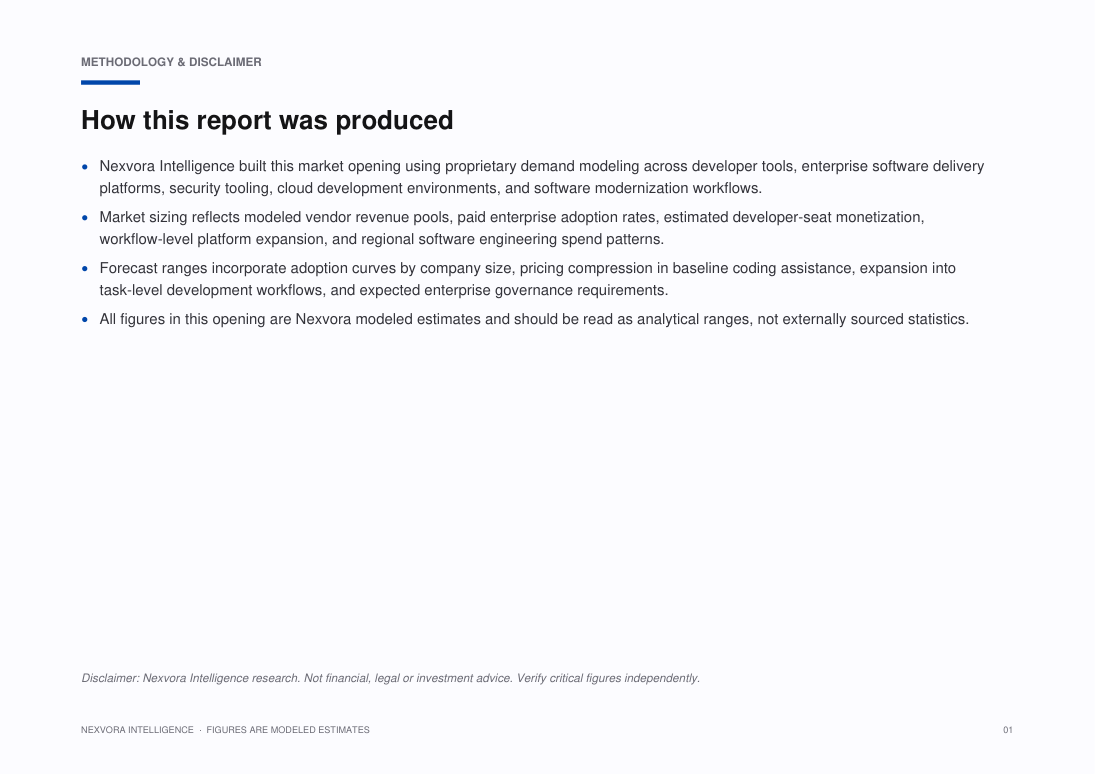
Nexvora Intelligence built this market opening using proprietary demand modeling across developer tools, enterprise software delivery platforms, security tooling, cloud development environments, and software modernization workflows.
Market sizing reflects modeled vendor revenue pools, paid enterprise adoption rates, estimated developer-seat monetization, workflow-level platform expansion, and regional software engineering spend patterns.
Forecast ranges incorporate adoption curves by company size, pricing compression in baseline coding assistance, expansion into task-level development workflows, and expected enterprise governance requirements.
All figures in this opening are Nexvora modeled estimates and should be read as analytical ranges, not externally sourced statistics.
What's inside — a number-free look.
A full outline of the figures and tables you'll get. Specific data, market sizes and forecasts are unlocked with purchase.
List of Figures
- Figure 1: Market Overview and Structure — Software Development Agents & Coding Automation Platforms
- Figure 2: Market Size and Forecast Framework — Software Development Agents & Coding Automation Platforms
- Figure 3: Value Chain and Ecosystem Analysis — Software Development Agents & Coding Automation Platforms
- Figure 4: Market Dynamics — Drivers, Restraints and Opportunities — Software Development Agents & Coding Automation Platforms
- Figure 5: Segment Contribution Analysis — Software Development Agents & Coding Automation Platforms
- Figure 6: Regional Market Landscape — Software Development Agents & Coding Automation Platforms
- Figure 7: Country-level Opportunity Mapping — Software Development Agents & Coding Automation Platforms
- Figure 8: Competitive Positioning Matrix — Software Development Agents & Coding Automation Platforms
- Figure 9: Market Share of Leading Players — Software Development Agents & Coding Automation Platforms
- Figure 10: Adoption and Penetration Trends — Software Development Agents & Coding Automation Platforms
- Figure 11: Technology and Innovation Landscape — Software Development Agents & Coding Automation Platforms
- Figure 12: Pricing and Business Model Analysis — Software Development Agents & Coding Automation Platforms
- Figure 13: Investment, Funding and M&A Landscape — Software Development Agents & Coding Automation Platforms
- Figure 14: Regulatory and Policy Framework — Software Development Agents & Coding Automation Platforms
- Figure 15: Porter's Five Forces Analysis — Software Development Agents & Coding Automation Platforms
- Figure 16: PESTLE Analysis — Software Development Agents & Coding Automation Platforms
- Figure 17: Growth Opportunity Heat Map — Software Development Agents & Coding Automation Platforms
- Figure 18: Future Outlook and Strategic Roadmap — Software Development Agents & Coding Automation Platforms
List of Tables
- Table 1: Market Segmentation Overview — Software Development Agents & Coding Automation Platforms
- Table 2: Segment Definitions and Scope — Software Development Agents & Coding Automation Platforms
- Table 3: Regional and Country Coverage Summary — Software Development Agents & Coding Automation Platforms
- Table 4: Key Company Profiles and Offerings — Software Development Agents & Coding Automation Platforms
- Table 5: Competitive Benchmarking Matrix — Software Development Agents & Coding Automation Platforms
- Table 6: Product and Service Portfolio Mapping — Software Development Agents & Coding Automation Platforms
- Table 7: Market Drivers, Restraints and Trends — Software Development Agents & Coding Automation Platforms
- Table 8: Strategic Initiatives and Developments — Software Development Agents & Coding Automation Platforms
- Table 9: Partnerships and Collaborations — Software Development Agents & Coding Automation Platforms
- Table 10: Research Assumptions and Limitations — Software Development Agents & Coding Automation Platforms
- Table 11: Data Sources and References — Software Development Agents & Coding Automation Platforms
- Table 12: Report Scope and Coverage Summary — Software Development Agents & Coding Automation Platforms
A look at the pages.
107 pages · 20 sections · charts & tables
A genuine peek at the opening pages. Unlock to read every page in full.
6 of 107 pages shown
Turn this market into a plan for your business.
Answer a few quick questions and unlock a personalised operational read — your maturity score, prioritised focus areas and quick wins — mapped to where this market is heading. Result delivered instantly and emailed to you.
- Maturity score & prioritised focus areas
- Practical quick wins and a recommended next step
Questions, answered.
How big is the Global Software Development Agents & Coding Automation Platforms Market?
Nexvora models the Global Software Development Agents & Coding Automation Platforms Market at approximately US$6.2–7.8B (2025E). Full market sizing, segmentation and forecasts are inside the report (modeled estimate).
What is the growth rate (CAGR) of the Global Software Development Agents & Coding Automation Platforms Market?
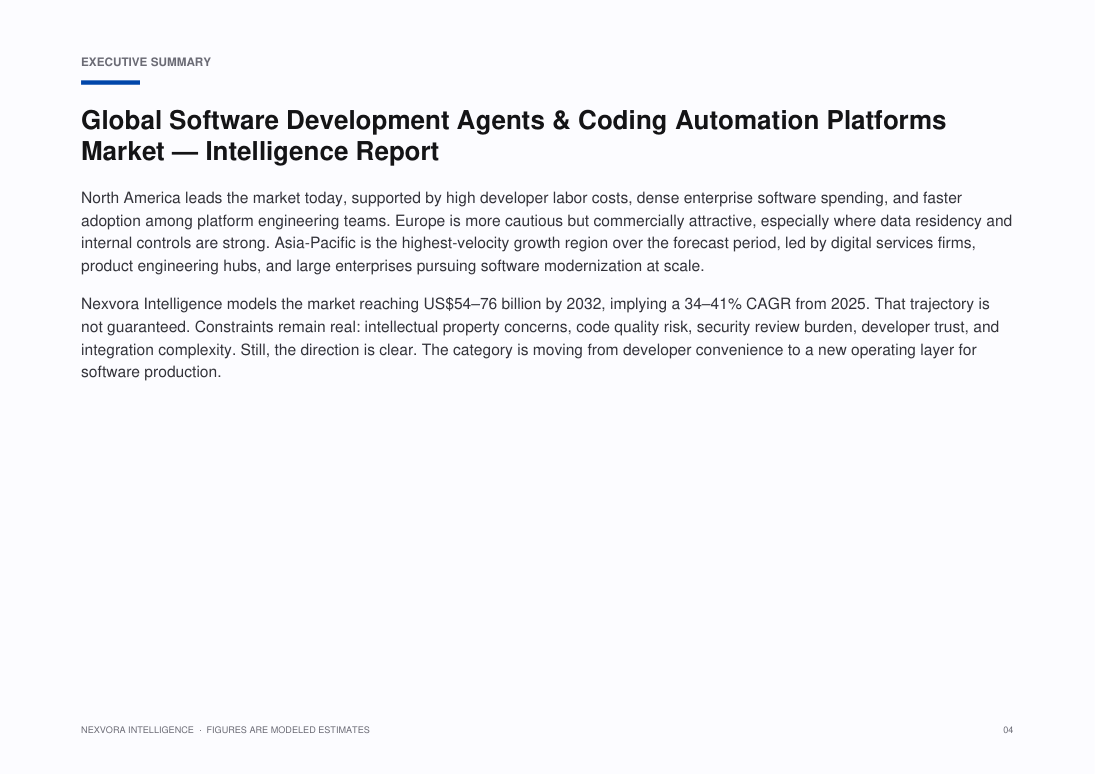
The Global Software Development Agents & Coding Automation Platforms Market is projected to grow at a CAGR of about 34–41% (2025–2032E) over the forecast period — a Nexvora modeled estimate detailed across the report's 20 sections.
What does this report include?
A complete market intelligence report — market sizing and forecasts, segmentation, regional and industry analysis, competitive landscape, trends, and strategic recommendations across 20 sections.
How do I access it after purchase?
Instantly, in your secure online viewer. Reports are view-only and available on any device from your library.
Are the figures sourced?
Quantitative figures are Nexvora modeled estimates unless explicitly cited to a referenced source within the report.
Can I buy access for my team?
Yes — add user seats at checkout, or subscribe for bulk access across multiple reports.
Nexvora Intelligence research report. All quantitative figures are modeled estimates — not audited data. Not financial or investment advice.
Generative AI Enterprise Software vs Robotic Process Automation Software
The right choice depends on the buyer’s priorities because many details are not publicly disclosed. Choose Generative AI Enterprise Software if you need Microsoft enterprise generative AI software in the artificial intelligence category. Choose Robotic Process Automation Software if you need UiPath robotic process automation with Automation Cloud or self-managed Automation Suite, Studio, Robots, Orchestrator, and attended or unattended automation.
Grounded in published specifications — guidance, not an endorsement.
More market reports
Keep exploring intelligence in this and related sectors.

Global Post-Quantum Cryptography Migration Services Market — Intelligence Report
Global Accelerator Memory Chips & High-Bandwidth Memory Supply Chain Market — Intelligence Report

Global Agentic Enterprise Workflow Automation Platforms Market — Intelligence Report

Global Inference ASICs & Edge Accelerator Chips Market — Intelligence Report
AI Analyst
Insights and answers generated live from Global Software Development Agents & Coding Automation Platforms Market — Intelligence Report's verified data. Modeled estimates — not investment advice.
- The report covers the Global Software Development Agents & Coding Automation Platforms Market within the Technology & Software sector.
- The commercial outlook focuses on autonomous coding systems, developer productivity platforms, and enterprise software delivery automation.
- The market report period spans 2025–2032.
- Notable point: Nexvora Intelligence frames the market as AI-native software development agents and coding automation platforms.