Global Computational-Native Drug Discovery, Foundation Models and Robotic Labs — Intelligence Report
Strategic market outlook for model-driven discovery platforms, autonomous experimentation, and robotic laboratory infrastructure, 2025–2032
Nexvora Intelligence market report on Global AI-Native Drug Discovery, Foundation Models and Robotic Labs Market — Intelligence Report.
per extra user
Instant access after payment. Secure via Razorpay.
The opening view — free.
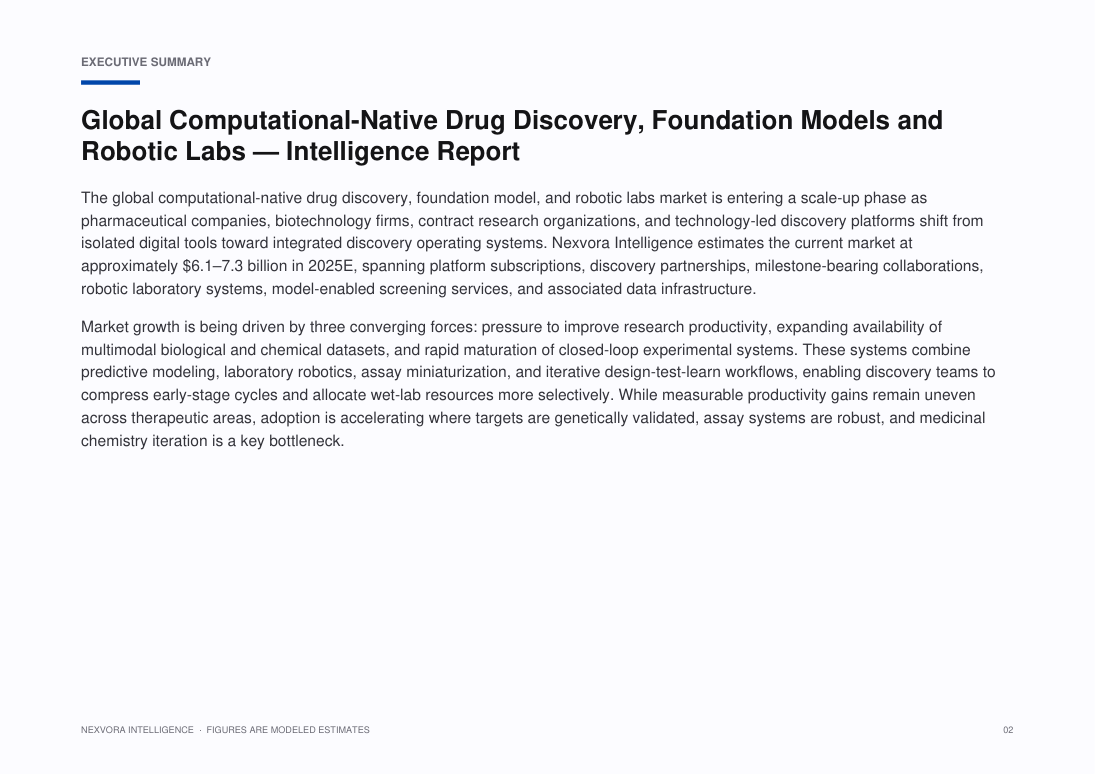
The global computational-native drug discovery, foundation model, and robotic labs market is entering a scale-up phase as pharmaceutical companies, biotechnology firms, contract research organizations, and technology-led discovery platforms shift from isolated digital tools toward integrated discovery operating systems. Nexvora Intelligence estimates the current market at approximately $•••–••• billion in 2025E, spanning platform subscriptions, discovery partnerships, milestone-bearing collaborations, robotic laboratory systems, model-enabled screening services, and associated data infrastructure.
Market growth is being driven by three converging forces: pressure to improve research productivity, expanding availability of multimodal biological and chemical datasets, and rapid maturation of closed-loop experimental systems. These systems combine predictive modeling, laboratory robotics, assay miniaturization, and iterative design-test-learn workflows, enabling discovery teams to compress early-stage cycles and allocate wet-lab resources more selectively. While measurable productivity gains remain uneven across therapeutic areas, adoption is accelerating where targets are genetically validated, assay systems are robust, and medicinal chemistry iteration is a key bottleneck.
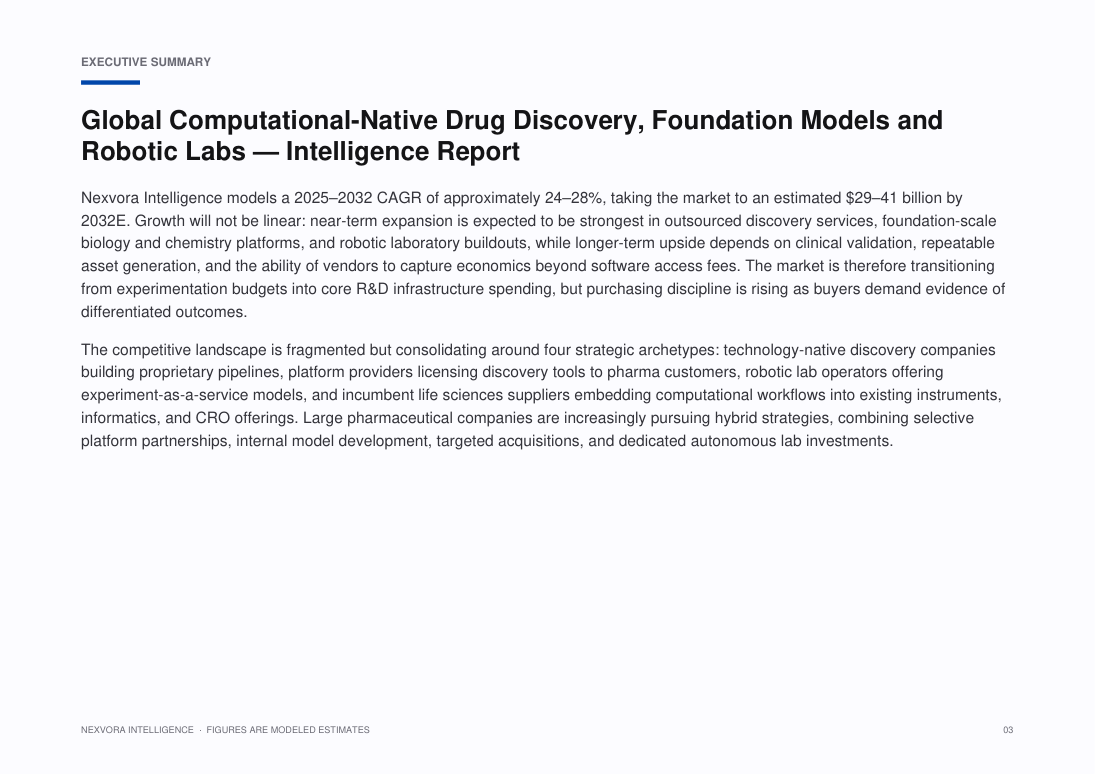
Nexvora Intelligence models a 2025–2032 CAGR of approximately 24–••%, taking the market to an estimated $•••–••• billion by 2032E. Growth will not be linear: near-term expansion is expected to be strongest in outsourced discovery services, foundation-scale biology and chemistry platforms, and robotic laboratory buildouts, while longer-term upside depends on clinical validation, repeatable asset generation, and the ability of vendors to capture economics beyond software access fees. The market is therefore transitioning from experimentation budgets into core R&D infrastructure spending, but purchasing discipline is rising as buyers demand evidence of differentiated outcomes.
The competitive landscape is fragmented but consolidating around four strategic archetypes: technology-native discovery companies building proprietary pipelines, platform providers licensing discovery tools to pharma customers, robotic lab operators offering experiment-as-a-service models, and incumbent life sciences suppliers embedding computational workflows into existing instruments, informatics, and CRO offerings. Large pharmaceutical companies are increasingly pursuing hybrid strategies, combining selective platform partnerships, internal model development, targeted acquisitions, and dedicated autonomous lab investments.
Specific figures are hidden in this free preview. Unlock the report to see all modeled market sizes, forecasts and growth rates.
What this report covers.
Strategic market outlook for model-driven discovery platforms, autonomous experimentation, and robotic laboratory infrastructure, 2025–2032
Who this report is for.
- Corporate strategy, planning and M&A teams evaluating the market
- Investors, private equity and venture teams sizing the opportunity
- Product, marketing and go-to-market leaders
- Consultants and analysts building the competitive picture
- Executives planning market entry, expansion or investment
How this report is built.
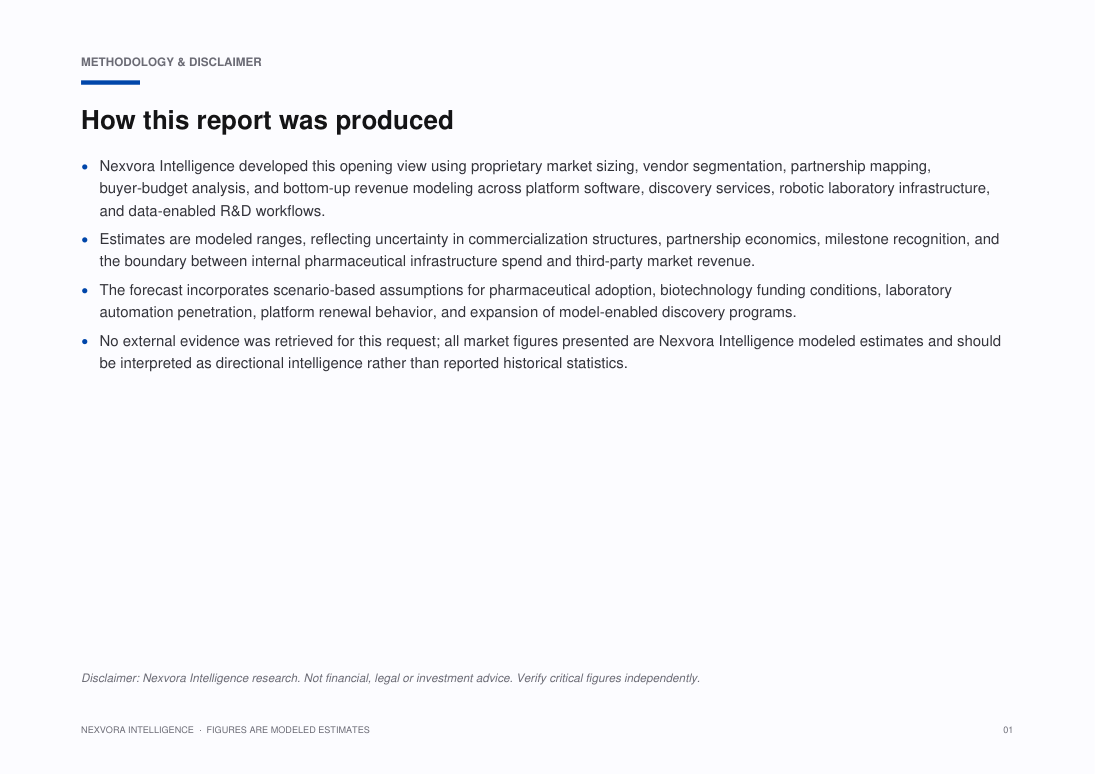
Nexvora Intelligence developed this opening view using proprietary market sizing, vendor segmentation, partnership mapping, buyer-budget analysis, and bottom-up revenue modeling across platform software, discovery services, robotic laboratory infrastructure, and data-enabled R&D workflows.
Estimates are modeled ranges, reflecting uncertainty in commercialization structures, partnership economics, milestone recognition, and the boundary between internal pharmaceutical infrastructure spend and third-party market revenue.
The forecast incorporates scenario-based assumptions for pharmaceutical adoption, biotechnology funding conditions, laboratory automation penetration, platform renewal behavior, and expansion of model-enabled discovery programs.
No external evidence was retrieved for this request; all market figures presented are Nexvora Intelligence modeled estimates and should be interpreted as directional intelligence rather than reported historical statistics.
What's inside — a number-free look.
A full outline of the figures and tables you'll get. Specific data, market sizes and forecasts are unlocked with purchase.
List of Figures
- Figure 1: Market Overview and Structure — Computational-Native Drug Discovery, Foundation Models and Robotic Labs
- Figure 2: Market Size and Forecast Framework — Computational-Native Drug Discovery, Foundation Models and Robotic Labs
- Figure 3: Value Chain and Ecosystem Analysis — Computational-Native Drug Discovery, Foundation Models and Robotic Labs
- Figure 4: Market Dynamics — Drivers, Restraints and Opportunities — Computational-Native Drug Discovery, Foundation Models and Robotic Labs
- Figure 5: Segment Contribution Analysis — Computational-Native Drug Discovery, Foundation Models and Robotic Labs
- Figure 6: Regional Market Landscape — Computational-Native Drug Discovery, Foundation Models and Robotic Labs
- Figure 7: Country-level Opportunity Mapping — Computational-Native Drug Discovery, Foundation Models and Robotic Labs
- Figure 8: Competitive Positioning Matrix — Computational-Native Drug Discovery, Foundation Models and Robotic Labs
- Figure 9: Market Share of Leading Players — Computational-Native Drug Discovery, Foundation Models and Robotic Labs
- Figure 10: Adoption and Penetration Trends — Computational-Native Drug Discovery, Foundation Models and Robotic Labs
- Figure 11: Technology and Innovation Landscape — Computational-Native Drug Discovery, Foundation Models and Robotic Labs
- Figure 12: Pricing and Business Model Analysis — Computational-Native Drug Discovery, Foundation Models and Robotic Labs
- Figure 13: Investment, Funding and M&A Landscape — Computational-Native Drug Discovery, Foundation Models and Robotic Labs
- Figure 14: Regulatory and Policy Framework — Computational-Native Drug Discovery, Foundation Models and Robotic Labs
- Figure 15: Porter's Five Forces Analysis — Computational-Native Drug Discovery, Foundation Models and Robotic Labs
- Figure 16: PESTLE Analysis — Computational-Native Drug Discovery, Foundation Models and Robotic Labs
- Figure 17: Growth Opportunity Heat Map — Computational-Native Drug Discovery, Foundation Models and Robotic Labs
- Figure 18: Future Outlook and Strategic Roadmap — Computational-Native Drug Discovery, Foundation Models and Robotic Labs
List of Tables
- Table 1: Market Segmentation Overview — Computational-Native Drug Discovery, Foundation Models and Robotic Labs
- Table 2: Segment Definitions and Scope — Computational-Native Drug Discovery, Foundation Models and Robotic Labs
- Table 3: Regional and Country Coverage Summary — Computational-Native Drug Discovery, Foundation Models and Robotic Labs
- Table 4: Key Company Profiles and Offerings — Computational-Native Drug Discovery, Foundation Models and Robotic Labs
- Table 5: Competitive Benchmarking Matrix — Computational-Native Drug Discovery, Foundation Models and Robotic Labs
- Table 6: Product and Service Portfolio Mapping — Computational-Native Drug Discovery, Foundation Models and Robotic Labs
- Table 7: Market Drivers, Restraints and Trends — Computational-Native Drug Discovery, Foundation Models and Robotic Labs
- Table 8: Strategic Initiatives and Developments — Computational-Native Drug Discovery, Foundation Models and Robotic Labs
- Table 9: Partnerships and Collaborations — Computational-Native Drug Discovery, Foundation Models and Robotic Labs
- Table 10: Research Assumptions and Limitations — Computational-Native Drug Discovery, Foundation Models and Robotic Labs
- Table 11: Data Sources and References — Computational-Native Drug Discovery, Foundation Models and Robotic Labs
- Table 12: Report Scope and Coverage Summary — Computational-Native Drug Discovery, Foundation Models and Robotic Labs
A look at the pages.
107 pages · 20 sections · charts & tables
A genuine peek at the opening pages. Unlock to read every page in full.
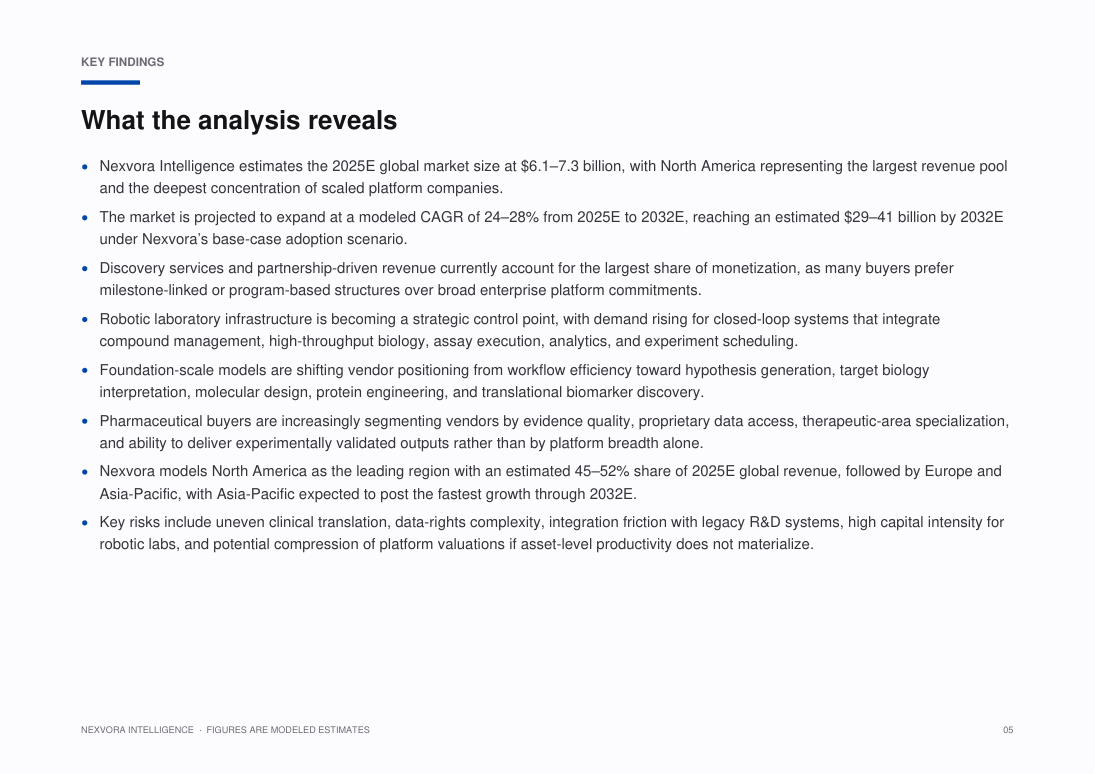
6 of 107 pages shown
Turn this market into a plan for your business.
Answer a few quick questions and unlock a personalised operational read — your maturity score, prioritised focus areas and quick wins — mapped to where this market is heading. Result delivered instantly and emailed to you.
- Maturity score & prioritised focus areas
- Practical quick wins and a recommended next step
Questions, answered.
How big is the Global Computational-Native Drug Discovery, Foundation Models and Robotic Labs?
Nexvora models the Global Computational-Native Drug Discovery, Foundation Models and Robotic Labs at approximately $6.1–7.3B (2025E). Full market sizing, segmentation and forecasts are inside the report (modeled estimate).
What is the growth rate (CAGR) of the Global Computational-Native Drug Discovery, Foundation Models and Robotic Labs?
The Global Computational-Native Drug Discovery, Foundation Models and Robotic Labs is projected to grow at a CAGR of about 24–28% (2025E–2032E) over the forecast period — a Nexvora modeled estimate detailed across the report's 20 sections.
What does this report include?
A complete market intelligence report — market sizing and forecasts, segmentation, regional and industry analysis, competitive landscape, trends, and strategic recommendations across 20 sections.
How do I access it after purchase?
Instantly, in your secure online viewer. Reports are view-only and available on any device from your library.
Are the figures sourced?
Quantitative figures are Nexvora modeled estimates unless explicitly cited to a referenced source within the report.
Can I buy access for my team?
Yes — add user seats at checkout, or subscribe for bulk access across multiple reports.
Nexvora Intelligence research report. All quantitative figures are modeled estimates — not audited data. Not financial or investment advice.
More market reports
Keep exploring intelligence in this and related sectors.

Global GLP-1 Obesity Therapeutics & Metabolic Health Market — Intelligence Report

Global Revenue Cycle Management, Prior Authorization Automation and Clinical Documentation Platforms Market — Intelligence Report
Global Radiopharmaceutical Theranostics, Alpha-Emitter Oncology and Medical Isotope Supply Chain Market — Intelligence Report