
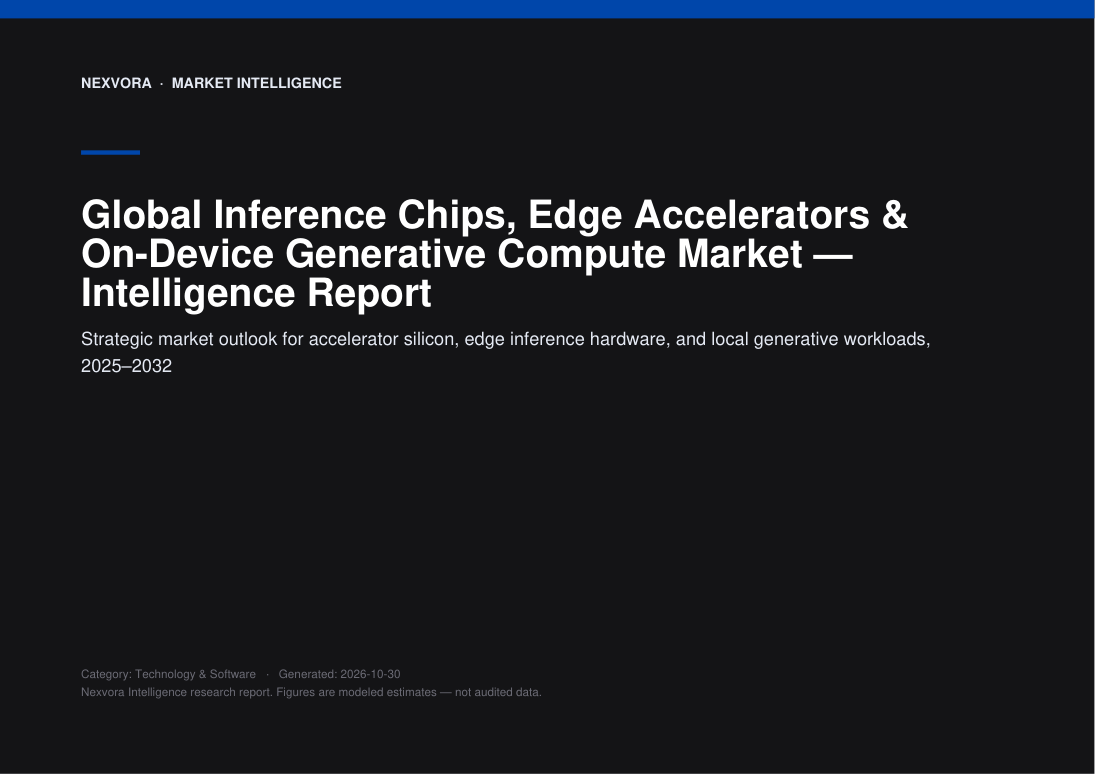
Global Inference Chips, Edge Accelerators & On-Device Generative Compute Market — Intelligence Report
Strategic market outlook for accelerator silicon, edge inference hardware, and local generative workloads, 2025–2032
Nexvora Intelligence market report on Global AI Inference Chips, Edge Accelerators & On-Device Generative AI Market.
per extra user
Instant access after payment. Secure via Razorpay.
The opening view — free.
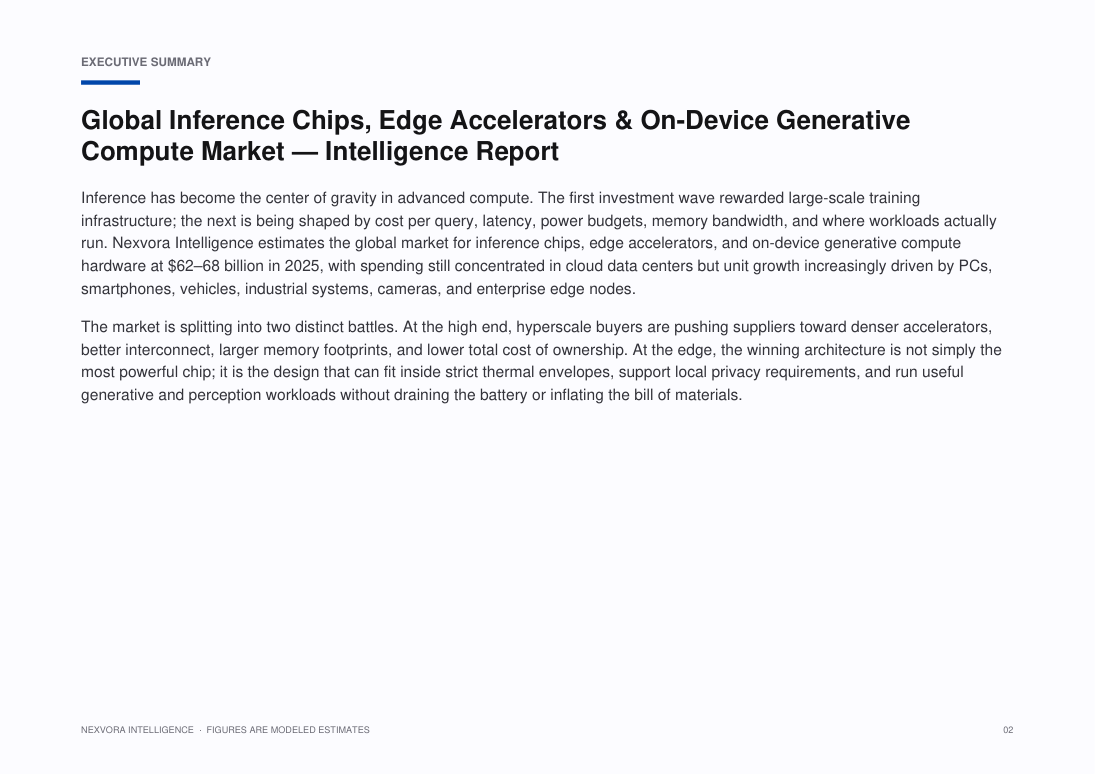
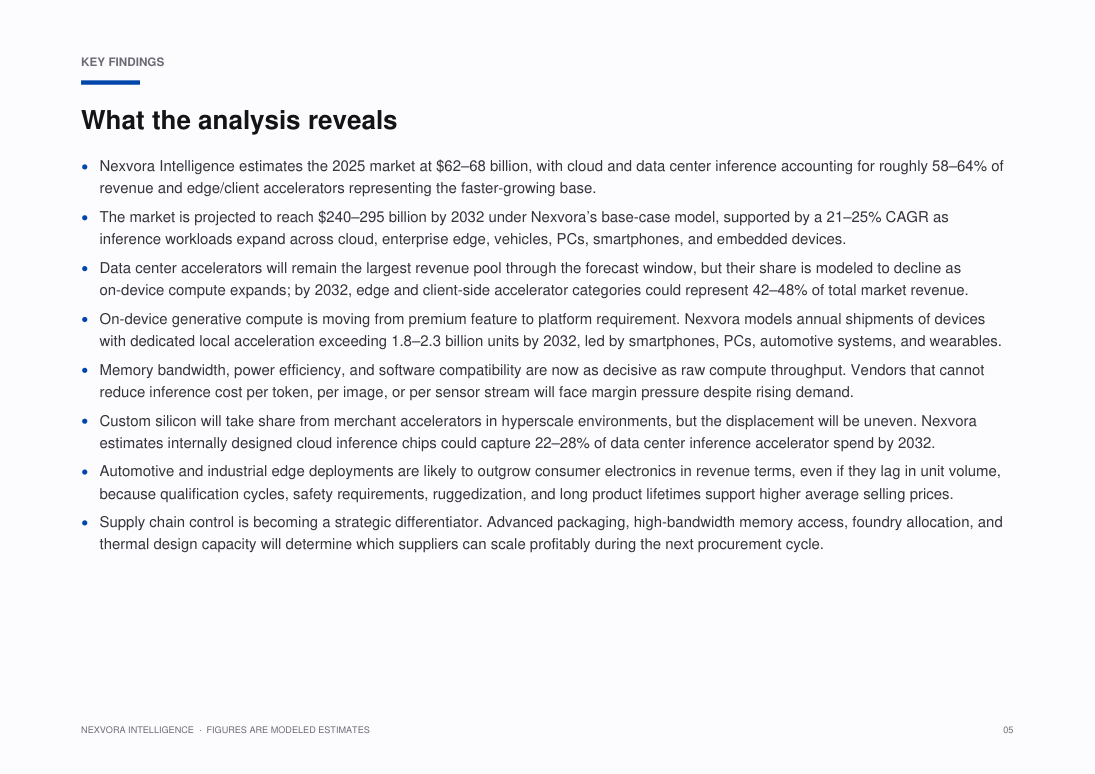
Inference has become the center of gravity in advanced compute. The first investment wave rewarded large-scale training infrastructure; the next is being shaped by cost per query, latency, power budgets, memory bandwidth, and where workloads actually run. Nexvora Intelligence estimates the global market for inference chips, edge accelerators, and on-device generative compute hardware at $•••–••• billion in 2025, with spending still concentrated in cloud data centers but unit growth increasingly driven by PCs, smartphones, vehicles, industrial systems, cameras, and enterprise edge nodes.
The market is splitting into two distinct battles. At the high end, hyperscale buyers are pushing suppliers toward denser accelerators, better interconnect, larger memory footprints, and lower total cost of ownership. At the edge, the winning architecture is not simply the most powerful chip; it is the design that can fit inside strict thermal envelopes, support local privacy requirements, and run useful generative and perception workloads without draining the battery or inflating the bill of materials.
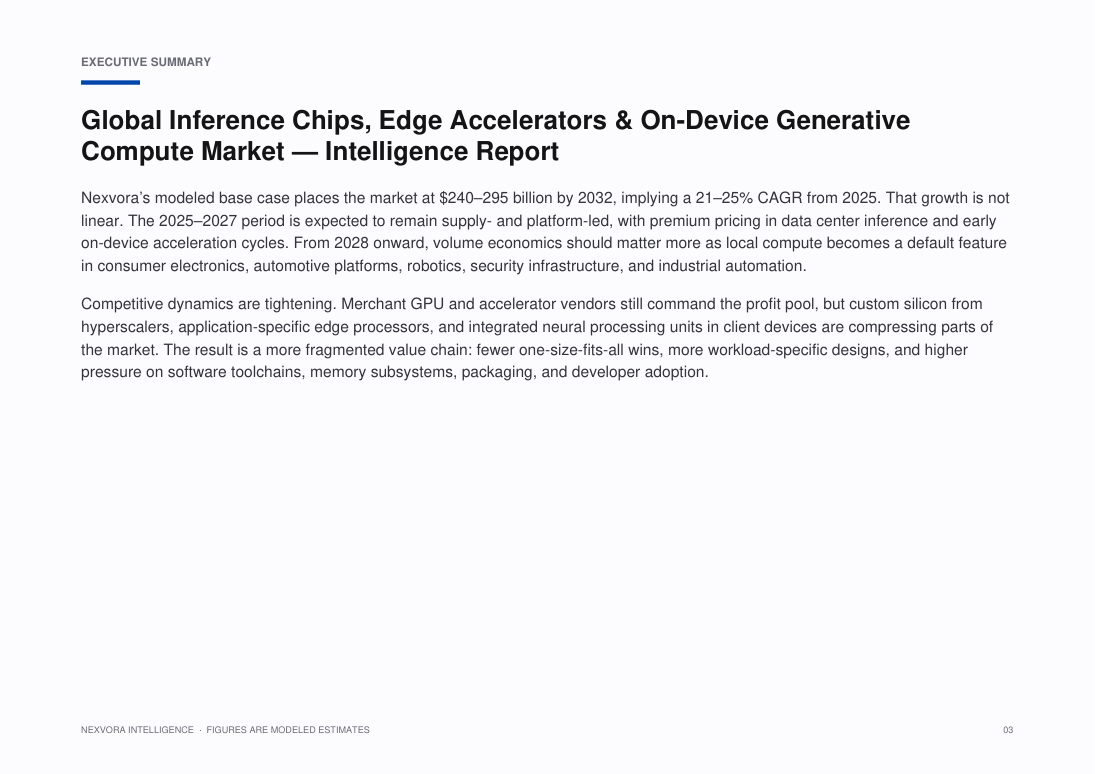
Nexvora’s modeled base case places the market at $•••–••• billion by 2032, implying a 21–••% CAGR from 2025. That growth is not linear. The 2025–2027 period is expected to remain supply- and platform-led, with premium pricing in data center inference and early on-device acceleration cycles. From 2028 onward, volume economics should matter more as local compute becomes a default feature in consumer electronics, automotive platforms, robotics, security infrastructure, and industrial automation.
Competitive dynamics are tightening. Merchant GPU and accelerator vendors still command the profit pool, but custom silicon from hyperscalers, application-specific edge processors, and integrated neural processing units in client devices are compressing parts of the market. The result is a more fragmented value chain: fewer one-size-fits-all wins, more workload-specific designs, and higher pressure on software toolchains, memory subsystems, packaging, and developer adoption.
Specific figures are hidden in this free preview. Unlock the report to see all modeled market sizes, forecasts and growth rates.
What this report covers.
Strategic market outlook for accelerator silicon, edge inference hardware, and local generative workloads, 2025–2032
Who this report is for.
- Corporate strategy, planning and M&A teams evaluating the market
- Investors, private equity and venture teams sizing the opportunity
- Product, marketing and go-to-market leaders
- Consultants and analysts building the competitive picture
- Executives planning market entry, expansion or investment
How this report is built.
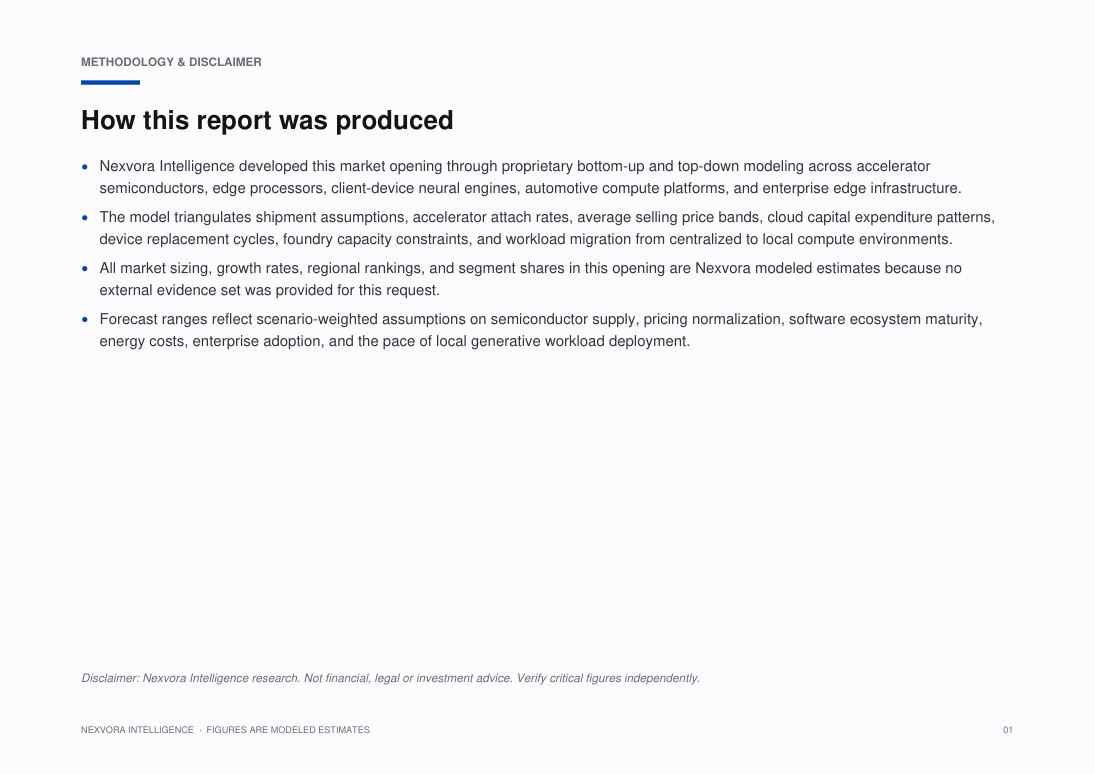
Nexvora Intelligence developed this market opening through proprietary bottom-up and top-down modeling across accelerator semiconductors, edge processors, client-device neural engines, automotive compute platforms, and enterprise edge infrastructure.
The model triangulates shipment assumptions, accelerator attach rates, average selling price bands, cloud capital expenditure patterns, device replacement cycles, foundry capacity constraints, and workload migration from centralized to local compute environments.
All market sizing, growth rates, regional rankings, and segment shares in this opening are Nexvora modeled estimates because no external evidence set was provided for this request.
Forecast ranges reflect scenario-weighted assumptions on semiconductor supply, pricing normalization, software ecosystem maturity, energy costs, enterprise adoption, and the pace of local generative workload deployment.
What's inside — a number-free look.
A full outline of the figures and tables you'll get. Specific data, market sizes and forecasts are unlocked with purchase.
List of Figures
- Figure 1: Market Overview and Structure — Inference Chips, Edge Accelerators & On-Device Generative Compute
- Figure 2: Market Size and Forecast Framework — Inference Chips, Edge Accelerators & On-Device Generative Compute
- Figure 3: Value Chain and Ecosystem Analysis — Inference Chips, Edge Accelerators & On-Device Generative Compute
- Figure 4: Market Dynamics — Drivers, Restraints and Opportunities — Inference Chips, Edge Accelerators & On-Device Generative Compute
- Figure 5: Segment Contribution Analysis — Inference Chips, Edge Accelerators & On-Device Generative Compute
- Figure 6: Regional Market Landscape — Inference Chips, Edge Accelerators & On-Device Generative Compute
- Figure 7: Country-level Opportunity Mapping — Inference Chips, Edge Accelerators & On-Device Generative Compute
- Figure 8: Competitive Positioning Matrix — Inference Chips, Edge Accelerators & On-Device Generative Compute
- Figure 9: Market Share of Leading Players — Inference Chips, Edge Accelerators & On-Device Generative Compute
- Figure 10: Adoption and Penetration Trends — Inference Chips, Edge Accelerators & On-Device Generative Compute
- Figure 11: Technology and Innovation Landscape — Inference Chips, Edge Accelerators & On-Device Generative Compute
- Figure 12: Pricing and Business Model Analysis — Inference Chips, Edge Accelerators & On-Device Generative Compute
- Figure 13: Investment, Funding and M&A Landscape — Inference Chips, Edge Accelerators & On-Device Generative Compute
- Figure 14: Regulatory and Policy Framework — Inference Chips, Edge Accelerators & On-Device Generative Compute
- Figure 15: Porter's Five Forces Analysis — Inference Chips, Edge Accelerators & On-Device Generative Compute
- Figure 16: PESTLE Analysis — Inference Chips, Edge Accelerators & On-Device Generative Compute
- Figure 17: Growth Opportunity Heat Map — Inference Chips, Edge Accelerators & On-Device Generative Compute
- Figure 18: Future Outlook and Strategic Roadmap — Inference Chips, Edge Accelerators & On-Device Generative Compute
List of Tables
- Table 1: Market Segmentation Overview — Inference Chips, Edge Accelerators & On-Device Generative Compute
- Table 2: Segment Definitions and Scope — Inference Chips, Edge Accelerators & On-Device Generative Compute
- Table 3: Regional and Country Coverage Summary — Inference Chips, Edge Accelerators & On-Device Generative Compute
- Table 4: Key Company Profiles and Offerings — Inference Chips, Edge Accelerators & On-Device Generative Compute
- Table 5: Competitive Benchmarking Matrix — Inference Chips, Edge Accelerators & On-Device Generative Compute
- Table 6: Product and Service Portfolio Mapping — Inference Chips, Edge Accelerators & On-Device Generative Compute
- Table 7: Market Drivers, Restraints and Trends — Inference Chips, Edge Accelerators & On-Device Generative Compute
- Table 8: Strategic Initiatives and Developments — Inference Chips, Edge Accelerators & On-Device Generative Compute
- Table 9: Partnerships and Collaborations — Inference Chips, Edge Accelerators & On-Device Generative Compute
- Table 10: Research Assumptions and Limitations — Inference Chips, Edge Accelerators & On-Device Generative Compute
- Table 11: Data Sources and References — Inference Chips, Edge Accelerators & On-Device Generative Compute
- Table 12: Report Scope and Coverage Summary — Inference Chips, Edge Accelerators & On-Device Generative Compute
A look at the pages.
104 pages · 20 sections · charts & tables
A genuine peek at the opening pages. Unlock to read every page in full.
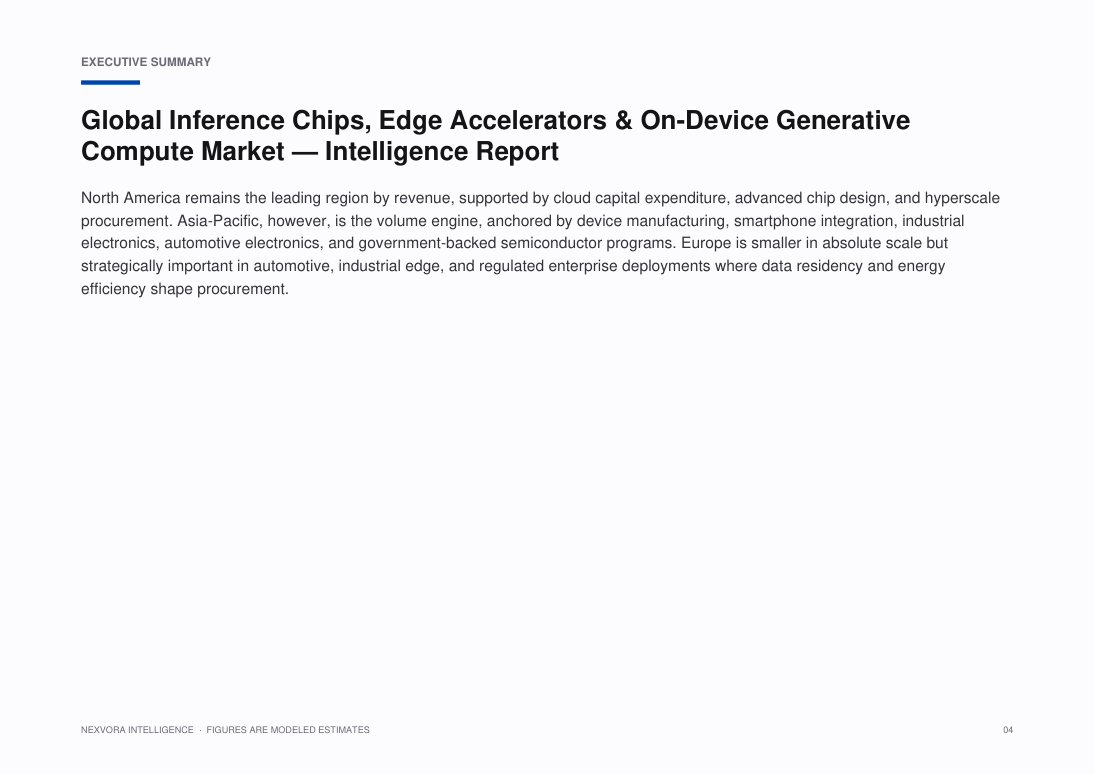
6 of 104 pages shown
Turn this market into a plan for your business.
Answer a few quick questions and unlock a personalised operational read — your maturity score, prioritised focus areas and quick wins — mapped to where this market is heading. Result delivered instantly and emailed to you.
- Maturity score & prioritised focus areas
- Practical quick wins and a recommended next step
Questions, answered.
How big is the Global Inference Chips, Edge Accelerators & On-Device Generative Compute Market?
Nexvora models the Global Inference Chips, Edge Accelerators & On-Device Generative Compute Market at approximately $62–68B (2025E). Full market sizing, segmentation and forecasts are inside the report (modeled estimate).
What is the growth rate (CAGR) of the Global Inference Chips, Edge Accelerators & On-Device Generative Compute Market?
The Global Inference Chips, Edge Accelerators & On-Device Generative Compute Market is projected to grow at a CAGR of about 21–25% (2025–2032E) over the forecast period — a Nexvora modeled estimate detailed across the report's 20 sections.
What does this report include?
A complete market intelligence report — market sizing and forecasts, segmentation, regional and industry analysis, competitive landscape, trends, and strategic recommendations across 20 sections.
How do I access it after purchase?
Instantly, in your secure online viewer. Reports are view-only and available on any device from your library.
Are the figures sourced?
Quantitative figures are Nexvora modeled estimates unless explicitly cited to a referenced source within the report.
Can I buy access for my team?
Yes — add user seats at checkout, or subscribe for bulk access across multiple reports.
Nexvora Intelligence research report. All quantitative figures are modeled estimates — not audited data. Not financial or investment advice.
Generative AI Enterprise Software vs NVIDIA H200
The right choice depends on whether you are buying AI hardware or enterprise generative AI software. Choose NVIDIA H200 if you need an NVIDIA Hopper-based AI chip with HBM3e, 141 GB GPU memory, up to 4.8 TB/s memory bandwidth, and 4th-generation Tensor Cores. Choose Microsoft Generative AI Enterprise Software if you need an enterprise generative AI software product from Microsoft rather than disclosed chip specifications.
Grounded in published specifications — guidance, not an endorsement.
More market reports
Keep exploring intelligence in this and related sectors.
Global Inference Accelerators, Custom ASICs & Edge Compute Chipsets Market — Intelligence Report
Global Autonomous Security Operations & SOC Platforms Market — Intelligence Report
Global Co-Packaged Optics, 1.6T Transceivers & Optical Interconnects for Accelerated Data Centers — Intelligence Report
Global Sovereign Accelerated Cloud & GPU-as-a-Service Platforms Market — Intelligence Report
AI Analyst
Insights and answers generated live from Global Inference Chips, Edge Accelerators & On-Device Generative Compute Market — Intelligence Report's verified data. Modeled estimates — not investment advice.
Not enough data yet to generate insights.