
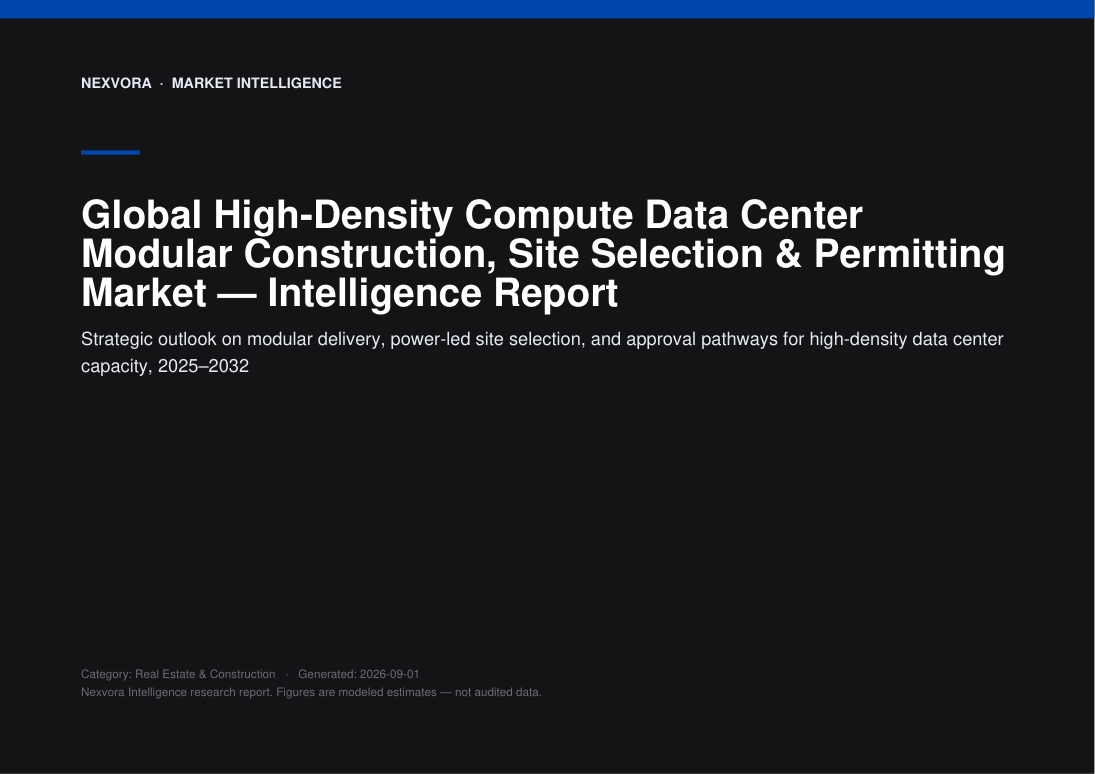
Global High-Density Compute Data Center Modular Construction, Site Selection & Permitting Market — Intelligence Report
Strategic outlook on modular delivery, power-led site selection, and approval pathways for high-density data center capacity, 2025–2032
Nexvora Intelligence market report on Global AI Data Center Modular Construction, Site Selection and Permitting Market.
per extra user
Instant access after payment. Secure via Razorpay.
The opening view — free.
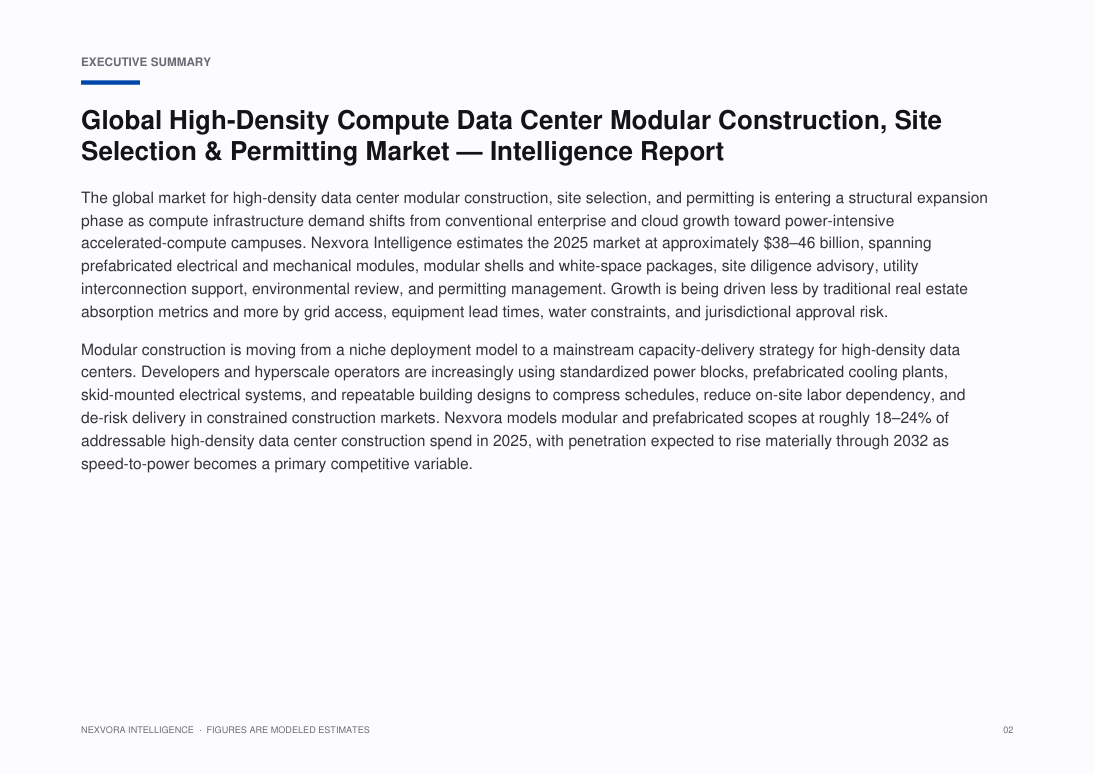
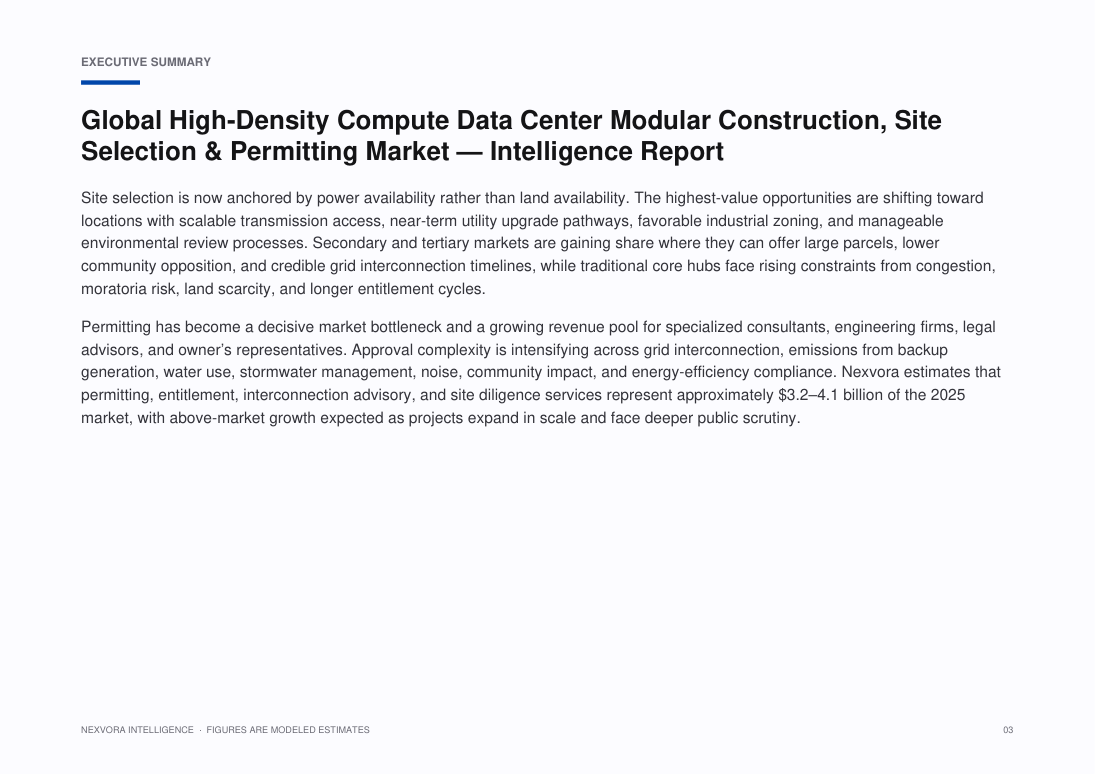
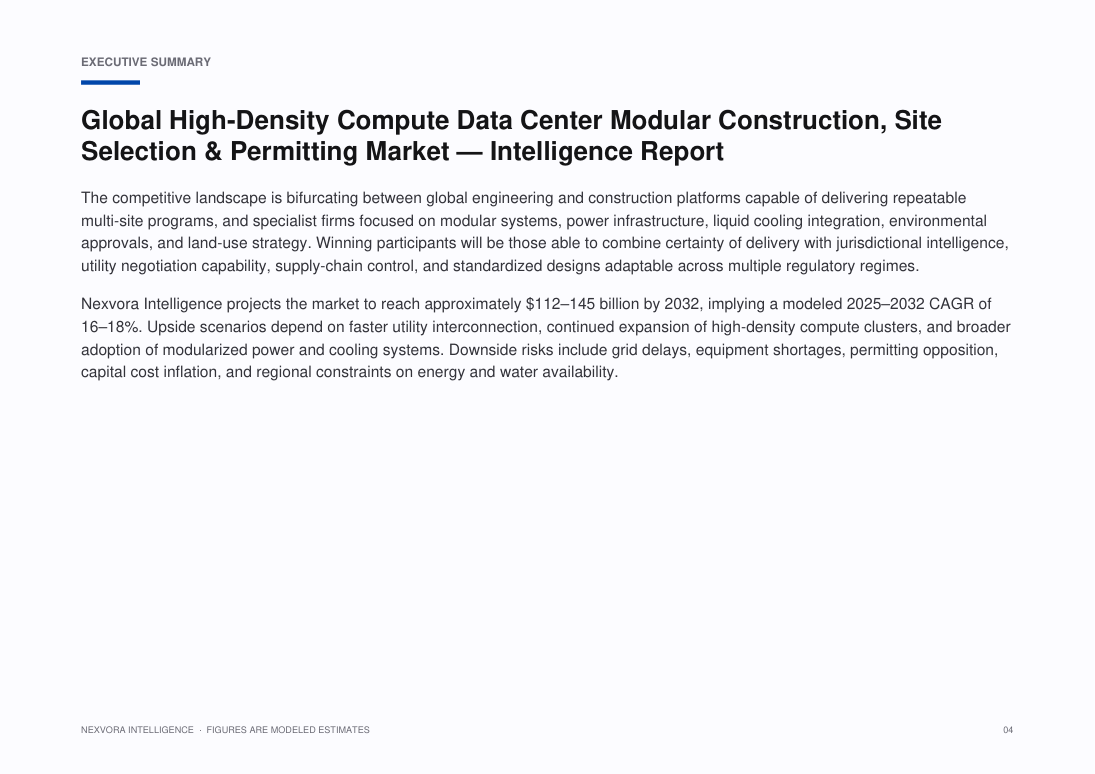
The global market for high-density data center modular construction, site selection, and permitting is entering a structural expansion phase as compute infrastructure demand shifts from conventional enterprise and cloud growth toward power-intensive accelerated-compute campuses. Nexvora Intelligence estimates the 2025 market at approximately $•••–••• billion, spanning prefabricated electrical and mechanical modules, modular shells and white-space packages, site diligence advisory, utility interconnection support, environmental review, and permitting management. Growth is being driven less by traditional real estate absorption metrics and more by grid access, equipment lead times, water constraints, and jurisdictional approval risk.
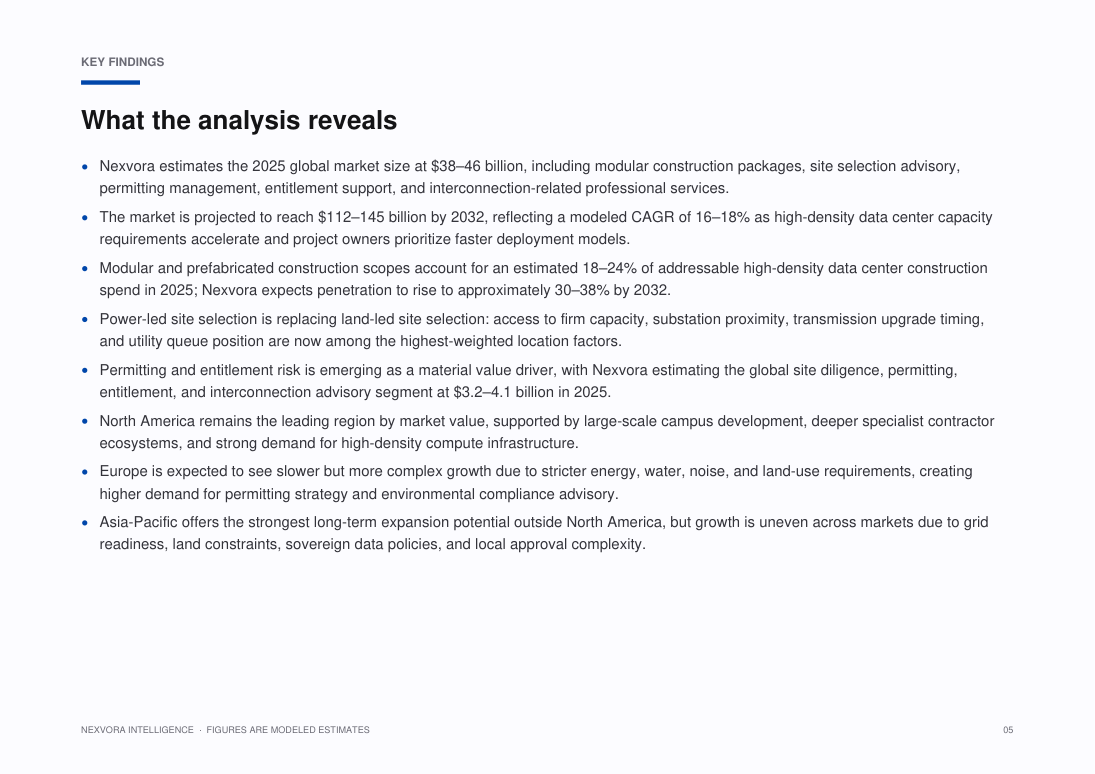
Modular construction is moving from a niche deployment model to a mainstream capacity-delivery strategy for high-density data centers. Developers and hyperscale operators are increasingly using standardized power blocks, prefabricated cooling plants, skid-mounted electrical systems, and repeatable building designs to compress schedules, reduce on-site labor dependency, and de-risk delivery in constrained construction markets. Nexvora models modular and prefabricated scopes at roughly 18–••% of addressable high-density data center construction spend in 2025, with penetration expected to rise materially through 2032 as speed-to-power becomes a primary competitive variable.
Site selection is now anchored by power availability rather than land availability. The highest-value opportunities are shifting toward locations with scalable transmission access, near-term utility upgrade pathways, favorable industrial zoning, and manageable environmental review processes. Secondary and tertiary markets are gaining share where they can offer large parcels, lower community opposition, and credible grid interconnection timelines, while traditional core hubs face rising constraints from congestion, moratoria risk, land scarcity, and longer entitlement cycles.
Permitting has become a decisive market bottleneck and a growing revenue pool for specialized consultants, engineering firms, legal advisors, and owner’s representatives. Approval complexity is intensifying across grid interconnection, emissions from backup generation, water use, stormwater management, noise, community impact, and energy-efficiency compliance. Nexvora estimates that permitting, entitlement, interconnection advisory, and site diligence services represent approximately $•••–••• billion of the 2025 market, with above-market growth expected as projects expand in scale and face deeper public scrutiny.
Specific figures are hidden in this free preview. Unlock the report to see all modeled market sizes, forecasts and growth rates.
What this report covers.
Strategic outlook on modular delivery, power-led site selection, and approval pathways for high-density data center capacity, 2025–2032
Who this report is for.
- Corporate strategy, planning and M&A teams evaluating the market
- Investors, private equity and venture teams sizing the opportunity
- Product, marketing and go-to-market leaders
- Consultants and analysts building the competitive picture
- Executives planning market entry, expansion or investment
How this report is built.
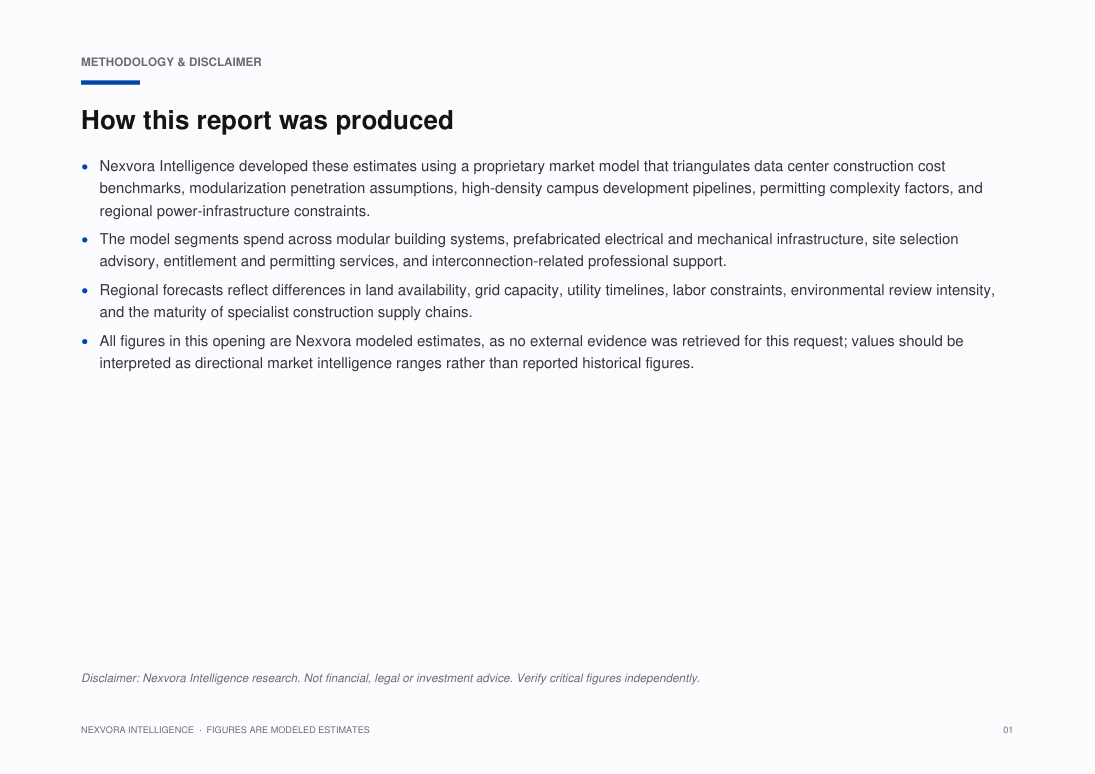
Nexvora Intelligence developed these estimates using a proprietary market model that triangulates data center construction cost benchmarks, modularization penetration assumptions, high-density campus development pipelines, permitting complexity factors, and regional power-infrastructure constraints.
The model segments spend across modular building systems, prefabricated electrical and mechanical infrastructure, site selection advisory, entitlement and permitting services, and interconnection-related professional support.
Regional forecasts reflect differences in land availability, grid capacity, utility timelines, labor constraints, environmental review intensity, and the maturity of specialist construction supply chains.
All figures in this opening are Nexvora modeled estimates, as no external evidence was retrieved for this request; values should be interpreted as directional market intelligence ranges rather than reported historical figures.
What's inside — a number-free look.
A full outline of the figures and tables you'll get. Specific data, market sizes and forecasts are unlocked with purchase.
List of Figures
- Figure 1: Market Overview and Structure — High-Density Compute Data Center Modular Construction, Site Selection & Permitting
- Figure 2: Market Size and Forecast Framework — High-Density Compute Data Center Modular Construction, Site Selection & Permitting
- Figure 3: Value Chain and Ecosystem Analysis — High-Density Compute Data Center Modular Construction, Site Selection & Permitting
- Figure 4: Market Dynamics — Drivers, Restraints and Opportunities — High-Density Compute Data Center Modular Construction, Site Selection & Permitting
- Figure 5: Segment Contribution Analysis — High-Density Compute Data Center Modular Construction, Site Selection & Permitting
- Figure 6: Regional Market Landscape — High-Density Compute Data Center Modular Construction, Site Selection & Permitting
- Figure 7: Country-level Opportunity Mapping — High-Density Compute Data Center Modular Construction, Site Selection & Permitting
- Figure 8: Competitive Positioning Matrix — High-Density Compute Data Center Modular Construction, Site Selection & Permitting
- Figure 9: Market Share of Leading Players — High-Density Compute Data Center Modular Construction, Site Selection & Permitting
- Figure 10: Adoption and Penetration Trends — High-Density Compute Data Center Modular Construction, Site Selection & Permitting
- Figure 11: Technology and Innovation Landscape — High-Density Compute Data Center Modular Construction, Site Selection & Permitting
- Figure 12: Pricing and Business Model Analysis — High-Density Compute Data Center Modular Construction, Site Selection & Permitting
- Figure 13: Investment, Funding and M&A Landscape — High-Density Compute Data Center Modular Construction, Site Selection & Permitting
- Figure 14: Regulatory and Policy Framework — High-Density Compute Data Center Modular Construction, Site Selection & Permitting
- Figure 15: Porter's Five Forces Analysis — High-Density Compute Data Center Modular Construction, Site Selection & Permitting
- Figure 16: PESTLE Analysis — High-Density Compute Data Center Modular Construction, Site Selection & Permitting
- Figure 17: Growth Opportunity Heat Map — High-Density Compute Data Center Modular Construction, Site Selection & Permitting
- Figure 18: Future Outlook and Strategic Roadmap — High-Density Compute Data Center Modular Construction, Site Selection & Permitting
List of Tables
- Table 1: Market Segmentation Overview — High-Density Compute Data Center Modular Construction, Site Selection & Permitting
- Table 2: Segment Definitions and Scope — High-Density Compute Data Center Modular Construction, Site Selection & Permitting
- Table 3: Regional and Country Coverage Summary — High-Density Compute Data Center Modular Construction, Site Selection & Permitting
- Table 4: Key Company Profiles and Offerings — High-Density Compute Data Center Modular Construction, Site Selection & Permitting
- Table 5: Competitive Benchmarking Matrix — High-Density Compute Data Center Modular Construction, Site Selection & Permitting
- Table 6: Product and Service Portfolio Mapping — High-Density Compute Data Center Modular Construction, Site Selection & Permitting
- Table 7: Market Drivers, Restraints and Trends — High-Density Compute Data Center Modular Construction, Site Selection & Permitting
- Table 8: Strategic Initiatives and Developments — High-Density Compute Data Center Modular Construction, Site Selection & Permitting
- Table 9: Partnerships and Collaborations — High-Density Compute Data Center Modular Construction, Site Selection & Permitting
- Table 10: Research Assumptions and Limitations — High-Density Compute Data Center Modular Construction, Site Selection & Permitting
- Table 11: Data Sources and References — High-Density Compute Data Center Modular Construction, Site Selection & Permitting
- Table 12: Report Scope and Coverage Summary — High-Density Compute Data Center Modular Construction, Site Selection & Permitting
A look at the pages.
107 pages · 20 sections · charts & tables
A genuine peek at the opening pages. Unlock to read every page in full.
6 of 107 pages shown
Turn this market into a plan for your business.
Answer a few quick questions and unlock a personalised operational read — your maturity score, prioritised focus areas and quick wins — mapped to where this market is heading. Result delivered instantly and emailed to you.
- Maturity score & prioritised focus areas
- Practical quick wins and a recommended next step
Questions, answered.
How big is the Global High-Density Compute Data Center Modular Construction, Site Selection & Permitting Market?
Nexvora models the Global High-Density Compute Data Center Modular Construction, Site Selection & Permitting Market at approximately $38–46 billion, 2025. Full market sizing, segmentation and forecasts are inside the report (modeled estimate).
What is the growth rate (CAGR) of the Global High-Density Compute Data Center Modular Construction, Site Selection & Permitting Market?
The Global High-Density Compute Data Center Modular Construction, Site Selection & Permitting Market is projected to grow at a CAGR of about 16–18%, 2025–2032 over the forecast period — a Nexvora modeled estimate detailed across the report's 20 sections.
What does this report include?
A complete market intelligence report — market sizing and forecasts, segmentation, regional and industry analysis, competitive landscape, trends, and strategic recommendations across 20 sections.
How do I access it after purchase?
Instantly, in your secure online viewer. Reports are view-only and available on any device from your library.
Are the figures sourced?
Quantitative figures are Nexvora modeled estimates unless explicitly cited to a referenced source within the report.
Can I buy access for my team?
Yes — add user seats at checkout, or subscribe for bulk access across multiple reports.
Nexvora Intelligence research report. All quantitative figures are modeled estimates — not audited data. Not financial or investment advice.
More market reports
Keep exploring intelligence in this and related sectors.
Philippines Facility Management Market — Intelligence Report
Global Proptech & Smart Buildings Market — Intelligence Report

Global Humanoid Robotics Market — Industrial & Service Automation Intelligence Report
