Germany Logistics & Warehousing Market — Manufacturing Supply Chains, Automation & Distribution Infrastructure
Strategic Market Intelligence and Modeled Outlook, 2026–2031
Nexvora Intelligence market report on Germany Logistics & Warehousing Market: Manufacturing Supply Chains, Automation & Distribution Infrastructure, 2026–2031.
per extra user
Instant access after payment. Secure via Razorpay.
The opening view — free.
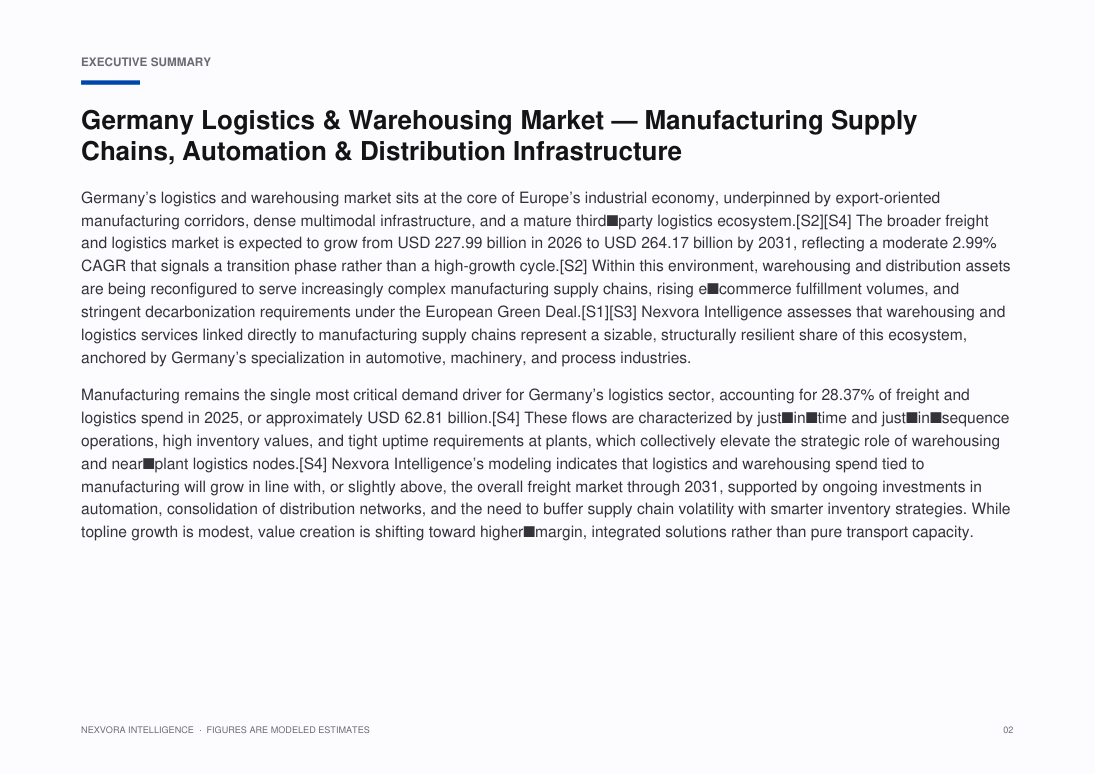
Germany’s logistics and warehousing market sits at the core of Europe’s industrial economy, underpinned by export-oriented manufacturing corridors, dense multimodal infrastructure, and a mature third‑party logistics ecosystem.[S2][S4] The broader freight and logistics market is expected to grow from USD ••• billion in 2026 to USD ••• billion by 2031, reflecting a moderate ••% CAGR that signals a transition phase rather than a high-growth cycle.[S2] Within this environment, warehousing and distribution assets are being reconfigured to serve increasingly complex manufacturing supply chains, rising e‑commerce fulfillment volumes, and stringent decarbonization requirements under the European Green Deal.[S1][S3] Nexvora Intelligence assesses that warehousing and logistics services linked directly to manufacturing supply chains represent a sizable, structurally resilient share of this ecosystem, anchored by Germany’s specialization in automotive, machinery, and process industries.
Manufacturing remains the single most critical demand driver for Germany’s logistics sector, accounting for ••% of freight and logistics spend in 2025, or approximately USD ••• billion.[S4] These flows are characterized by just‑in‑time and just‑in‑sequence operations, high inventory values, and tight uptime requirements at plants, which collectively elevate the strategic role of warehousing and near‑plant logistics nodes.[S4] Nexvora Intelligence’s modeling indicates that logistics and warehousing spend tied to manufacturing will grow in line with, or slightly above, the overall freight market through 2031, supported by ongoing investments in automation, consolidation of distribution networks, and the need to buffer supply chain volatility with smarter inventory strategies. While topline growth is modest, value creation is shifting toward higher‑margin, integrated solutions rather than pure transport capacity.
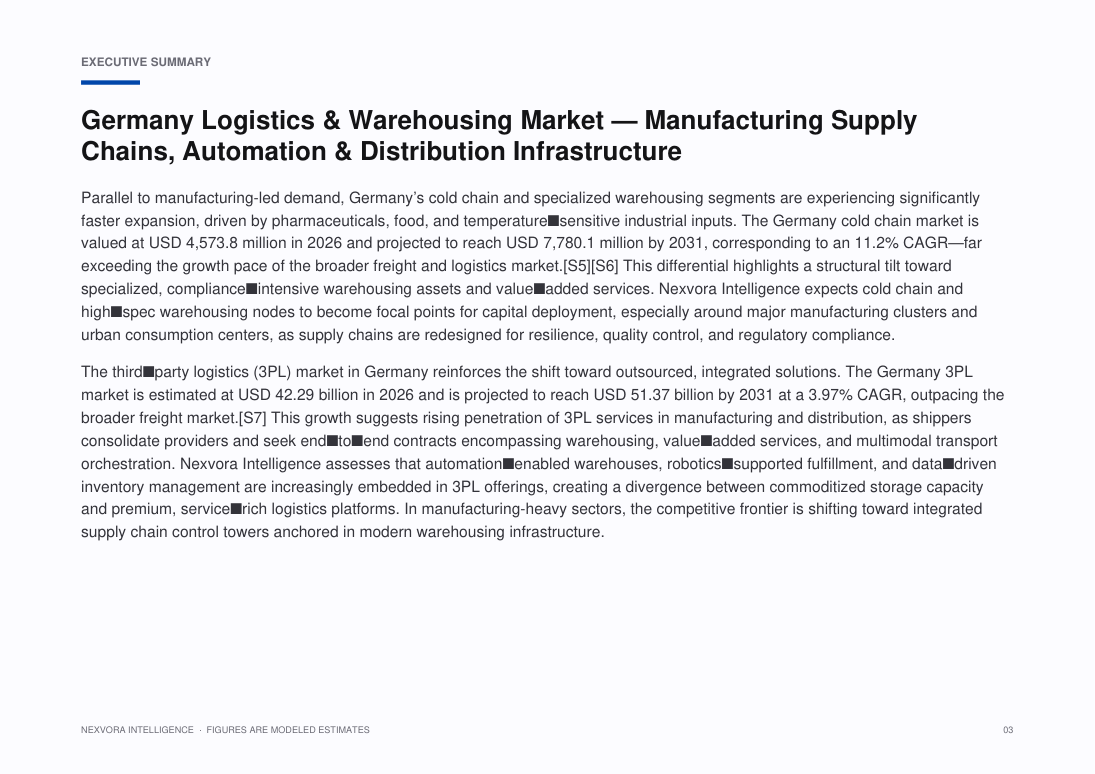
Parallel to manufacturing-led demand, Germany’s cold chain and specialized warehousing segments are experiencing significantly faster expansion, driven by pharmaceuticals, food, and temperature‑sensitive industrial inputs. The Germany cold chain market is valued at USD ••• million in 2026 and projected to reach USD ••• million by 2031, corresponding to an ••% CAGR—far exceeding the growth pace of the broader freight and logistics market.[S5][S6] This differential highlights a structural tilt toward specialized, compliance‑intensive warehousing assets and value‑added services. Nexvora Intelligence expects cold chain and high‑spec warehousing nodes to become focal points for capital deployment, especially around major manufacturing clusters and urban consumption centers, as supply chains are redesigned for resilience, quality control, and regulatory compliance.
The third‑party logistics (3PL) market in Germany reinforces the shift toward outsourced, integrated solutions. The Germany 3PL market is estimated at USD ••• billion in 2026 and is projected to reach USD ••• billion by 2031 at a ••% CAGR, outpacing the broader freight market.[S7] This growth suggests rising penetration of 3PL services in manufacturing and distribution, as shippers consolidate providers and seek end‑to‑end contracts encompassing warehousing, value‑added services, and multimodal transport orchestration. Nexvora Intelligence assesses that automation‑enabled warehouses, robotics‑supported fulfillment, and data‑driven inventory management are increasingly embedded in 3PL offerings, creating a divergence between commoditized storage capacity and premium, service‑rich logistics platforms. In manufacturing-heavy sectors, the competitive frontier is shifting toward integrated supply chain control towers anchored in modern warehousing infrastructure.
Specific figures are hidden in this free preview. Unlock the report to see all modeled market sizes, forecasts and growth rates.
What this report covers.
Strategic Market Intelligence and Modeled Outlook, 2026–2031
Who this report is for.
- Corporate strategy, planning and M&A teams evaluating the market
- Investors, private equity and venture teams sizing the opportunity
- Product, marketing and go-to-market leaders
- Consultants and analysts building the competitive picture
- Executives planning market entry, expansion or investment
How this report is built.
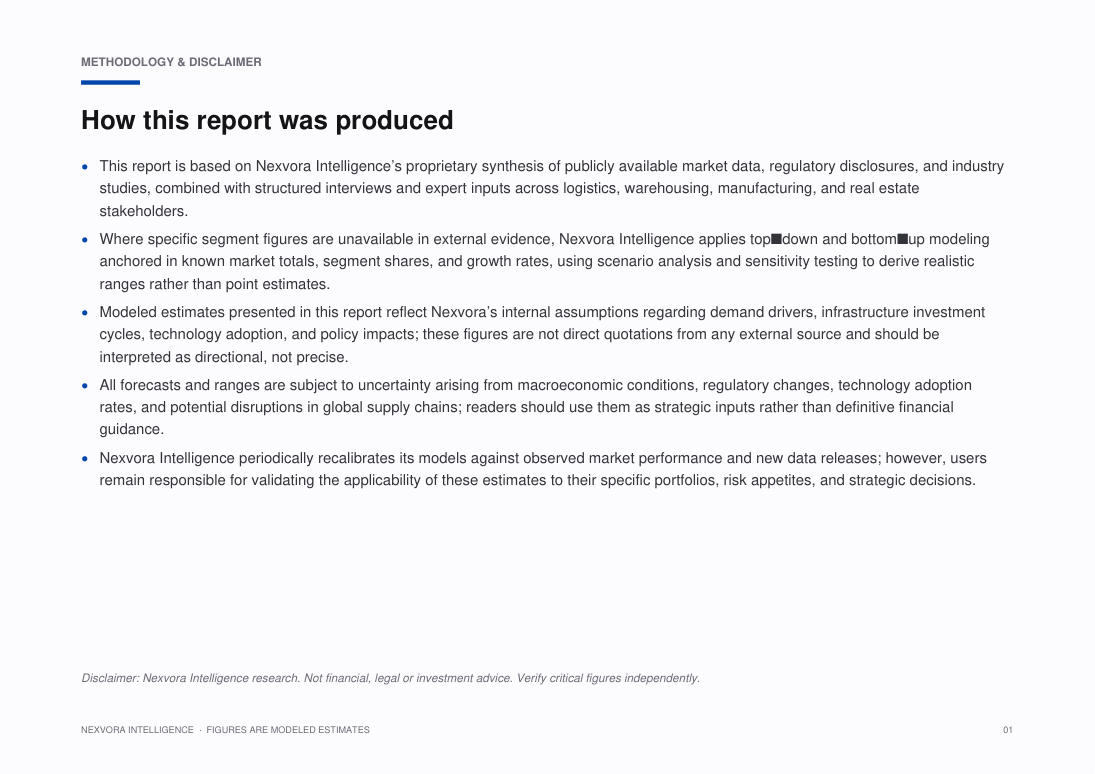
This report is based on Nexvora Intelligence’s proprietary synthesis of publicly available market data, regulatory disclosures, and industry studies, combined with structured interviews and expert inputs across logistics, warehousing, manufacturing, and real estate stakeholders.
Where specific segment figures are unavailable in external evidence, Nexvora Intelligence applies top‑down and bottom‑up modeling anchored in known market totals, segment shares, and growth rates, using scenario analysis and sensitivity testing to derive realistic ranges rather than point estimates.
Modeled estimates presented in this report reflect Nexvora’s internal assumptions regarding demand drivers, infrastructure investment cycles, technology adoption, and policy impacts; these figures are not direct quotations from any external source and should be interpreted as directional, not precise.
All forecasts and ranges are subject to uncertainty arising from macroeconomic conditions, regulatory changes, technology adoption rates, and potential disruptions in global supply chains; readers should use them as strategic inputs rather than definitive financial guidance.
Nexvora Intelligence periodically recalibrates its models against observed market performance and new data releases; however, users remain responsible for validating the applicability of these estimates to their specific portfolios, risk appetites, and strategic decisions.
What's inside — a number-free look.
A full outline of the figures and tables you'll get. Specific data, market sizes and forecasts are unlocked with purchase.
List of Figures
- Figure 1: Market Overview and Structure — Germany Logistics & Warehousing — Manufacturing Supply Chains, Automation & Distribution Infrastructure
- Figure 2: Market Size and Forecast Framework — Germany Logistics & Warehousing — Manufacturing Supply Chains, Automation & Distribution Infrastructure
- Figure 3: Value Chain and Ecosystem Analysis — Germany Logistics & Warehousing — Manufacturing Supply Chains, Automation & Distribution Infrastructure
- Figure 4: Market Dynamics — Drivers, Restraints and Opportunities — Germany Logistics & Warehousing — Manufacturing Supply Chains, Automation & Distribution Infrastructure
- Figure 5: Segment Contribution Analysis — Germany Logistics & Warehousing — Manufacturing Supply Chains, Automation & Distribution Infrastructure
- Figure 6: Regional Market Landscape — Germany Logistics & Warehousing — Manufacturing Supply Chains, Automation & Distribution Infrastructure
- Figure 7: Country-level Opportunity Mapping — Germany Logistics & Warehousing — Manufacturing Supply Chains, Automation & Distribution Infrastructure
- Figure 8: Competitive Positioning Matrix — Germany Logistics & Warehousing — Manufacturing Supply Chains, Automation & Distribution Infrastructure
- Figure 9: Market Share of Leading Players — Germany Logistics & Warehousing — Manufacturing Supply Chains, Automation & Distribution Infrastructure
- Figure 10: Adoption and Penetration Trends — Germany Logistics & Warehousing — Manufacturing Supply Chains, Automation & Distribution Infrastructure
- Figure 11: Technology and Innovation Landscape — Germany Logistics & Warehousing — Manufacturing Supply Chains, Automation & Distribution Infrastructure
- Figure 12: Pricing and Business Model Analysis — Germany Logistics & Warehousing — Manufacturing Supply Chains, Automation & Distribution Infrastructure
- Figure 13: Investment, Funding and M&A Landscape — Germany Logistics & Warehousing — Manufacturing Supply Chains, Automation & Distribution Infrastructure
- Figure 14: Regulatory and Policy Framework — Germany Logistics & Warehousing — Manufacturing Supply Chains, Automation & Distribution Infrastructure
- Figure 15: Porter's Five Forces Analysis — Germany Logistics & Warehousing — Manufacturing Supply Chains, Automation & Distribution Infrastructure
- Figure 16: PESTLE Analysis — Germany Logistics & Warehousing — Manufacturing Supply Chains, Automation & Distribution Infrastructure
- Figure 17: Growth Opportunity Heat Map — Germany Logistics & Warehousing — Manufacturing Supply Chains, Automation & Distribution Infrastructure
- Figure 18: Future Outlook and Strategic Roadmap — Germany Logistics & Warehousing — Manufacturing Supply Chains, Automation & Distribution Infrastructure
List of Tables
- Table 1: Market Segmentation Overview — Germany Logistics & Warehousing — Manufacturing Supply Chains, Automation & Distribution Infrastructure
- Table 2: Segment Definitions and Scope — Germany Logistics & Warehousing — Manufacturing Supply Chains, Automation & Distribution Infrastructure
- Table 3: Regional and Country Coverage Summary — Germany Logistics & Warehousing — Manufacturing Supply Chains, Automation & Distribution Infrastructure
- Table 4: Key Company Profiles and Offerings — Germany Logistics & Warehousing — Manufacturing Supply Chains, Automation & Distribution Infrastructure
- Table 5: Competitive Benchmarking Matrix — Germany Logistics & Warehousing — Manufacturing Supply Chains, Automation & Distribution Infrastructure
- Table 6: Product and Service Portfolio Mapping — Germany Logistics & Warehousing — Manufacturing Supply Chains, Automation & Distribution Infrastructure
- Table 7: Market Drivers, Restraints and Trends — Germany Logistics & Warehousing — Manufacturing Supply Chains, Automation & Distribution Infrastructure
- Table 8: Strategic Initiatives and Developments — Germany Logistics & Warehousing — Manufacturing Supply Chains, Automation & Distribution Infrastructure
- Table 9: Partnerships and Collaborations — Germany Logistics & Warehousing — Manufacturing Supply Chains, Automation & Distribution Infrastructure
- Table 10: Research Assumptions and Limitations — Germany Logistics & Warehousing — Manufacturing Supply Chains, Automation & Distribution Infrastructure
- Table 11: Data Sources and References — Germany Logistics & Warehousing — Manufacturing Supply Chains, Automation & Distribution Infrastructure
- Table 12: Report Scope and Coverage Summary — Germany Logistics & Warehousing — Manufacturing Supply Chains, Automation & Distribution Infrastructure
A look at the pages.
108 pages · 20 sections · charts & tables
A genuine peek at the opening pages. Unlock to read every page in full.
6 of 108 pages shown
Turn this market into a plan for your business.
Answer a few quick questions and unlock a personalised operational read — your maturity score, prioritised focus areas and quick wins — mapped to where this market is heading. Result delivered instantly and emailed to you.
- Maturity score & prioritised focus areas
- Practical quick wins and a recommended next step
Questions, answered.
How big is the Germany Logistics & Warehousing Market?
Nexvora models the Germany Logistics & Warehousing Market at approximately USD 80–110 billion (logistics & warehousing segment, 2026). Full market sizing, segmentation and forecasts are inside the report (modeled estimate).
What is the growth rate (CAGR) of the Germany Logistics & Warehousing Market?
The Germany Logistics & Warehousing Market is projected to grow at a CAGR of about 3–4% (logistics & warehousing, 2026–2031) over the forecast period — a Nexvora modeled estimate detailed across the report's 20 sections.
What does this report include?
A complete market intelligence report — market sizing and forecasts, segmentation, regional and industry analysis, competitive landscape, trends, and strategic recommendations across 20 sections.
How do I access it after purchase?
Instantly, in your secure online viewer. Reports are view-only and available on any device from your library.
Are the figures sourced?
Quantitative figures are Nexvora modeled estimates unless explicitly cited to a referenced source within the report.
Can I buy access for my team?
Yes — add user seats at checkout, or subscribe for bulk access across multiple reports.
Nexvora Intelligence research report. All quantitative figures are modeled estimates — not audited data. Not financial or investment advice.
More market reports
Keep exploring intelligence in this and related sectors.

Australia Logistics & Warehousing Market — E-Commerce, Cold Chain, Distribution & Supply Chain Infrastructure
Japan Logistics & Warehousing Market — Automation, Robotics, E-Commerce & Last-Mile Delivery Outlook
France Logistics & Warehousing Market — Intelligence Report