India's Protein Market: From Niche Nutrition to a $50 Billion Mainstream Opportunity by 2032
Nexvora Intelligence maps India's rapidly evolving protein market, projecting a USD 38–50B opportunity by 2032 driven by supplements, plant protein, and digital-first consumers.
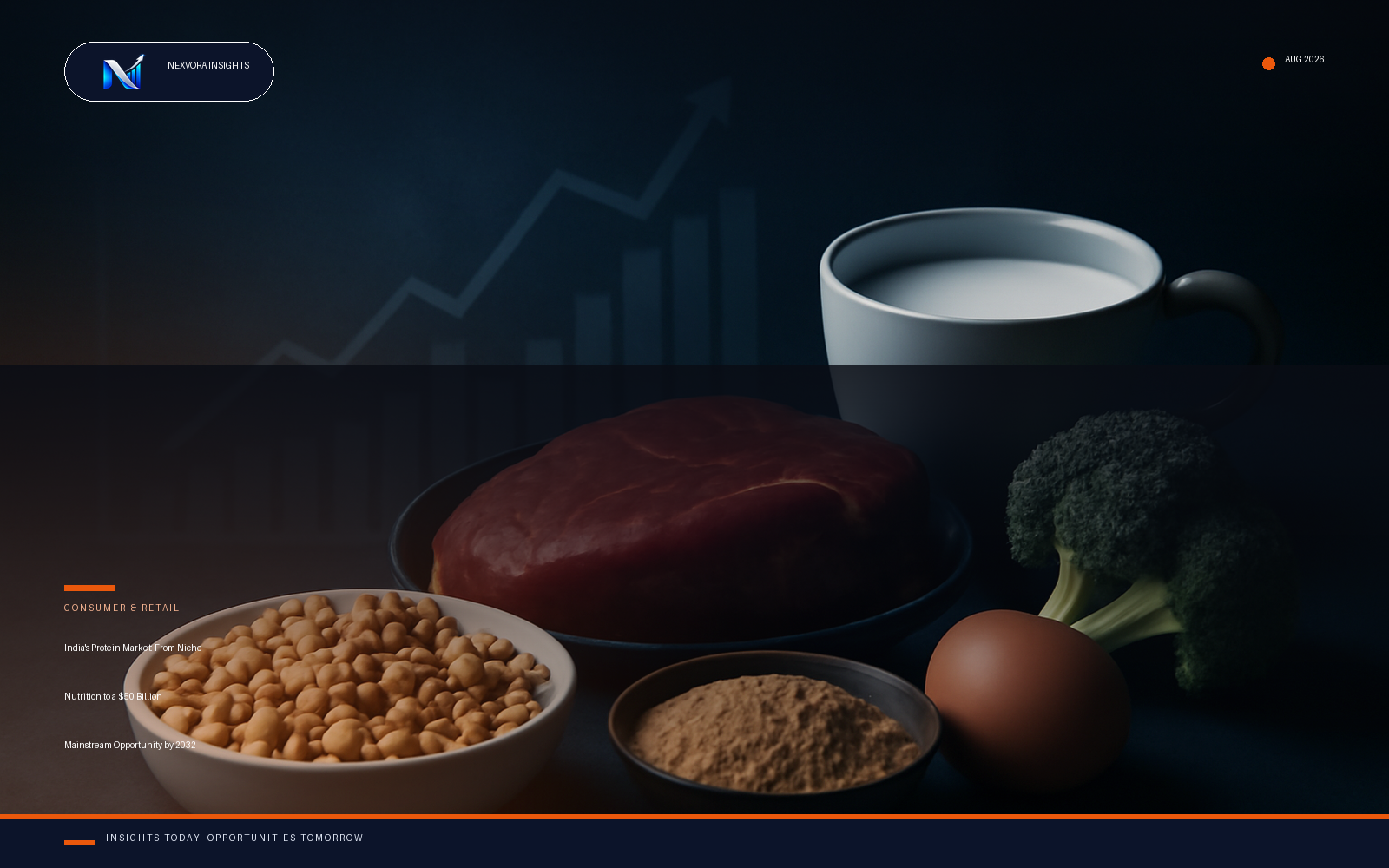
- India's protein market is modeled at USD 18–22B in 2025 and projected to reach USD 38–50B by 2032 at a 9–12% CAGR — one of the largest nutrition sector expansion opportunities globally.
- Sports nutrition and supplements are the fastest-growing sub-segment at an estimated 14–17% CAGR, fuelled by gym penetration, e-commerce access, and Gen-Z wellness awareness.
- An estimated 35–45% of premium whey ingredient volumes are imported, creating structural margin pressure and supply chain risk for domestic formulators that will persist without deliberate capacity investment.
- Plant protein is a high-conviction growth segment at 11–15% CAGR, with India's vegetarian dietary culture providing a unique structural tailwind absent in most comparable global markets.
- Price-point architecture is the critical variable for Tier-2 and Tier-3 market penetration — products above INR 800–1,000 per kg equivalent face significant adoption friction outside metros.
- E-commerce and D2C channels now account for an estimated 30–38% of protein supplement sales by value, making digital capability buildout a strategic imperative for all category participants.
A Market at an Inflection Point
India's protein market is undergoing one of the most significant structural transformations in its history. What was once a category anchored almost entirely in traditional dietary staples — dals, paneer, legumes — has evolved into a sophisticated, multi-segment industry spanning functional food ingredients, clinical nutrition, sports supplements, fortified fast-moving consumer goods, and emerging alternative protein formats. Nexvora's assessment places the total addressable protein market — encompassing food ingredients, protein supplements, fortified foods, and protein-rich FMCG — at an estimated USD 18–22 billion in 2025, with a modeled compound annual growth rate of 9–12%, projecting a market value of USD 38–50 billion by 2032. That trajectory places India among the most compelling protein investment destinations globally, and business leaders would be wise to treat it as such.
The forces behind this expansion are structural, not cyclical. A growing middle class increasingly literate in nutrition science, a youthful demographic cohort actively managing health outcomes, the explosion of fitness infrastructure across urban India, and a digital commerce ecosystem that has radically democratised access to premium nutrition products — these are durable tailwinds, not passing trends. Understanding where within this broad market the value pools are concentrating, where execution risk is greatest, and which segments are structurally underserved is the analytical work that separates strategic winners from reactive participants. Nexvora's India Protein Industry Outlook — Intelligence Report provides that granular intelligence framework.
Sports Nutrition and Supplements: The Fastest Engine of Growth
Among all sub-segments within the Indian protein market, sports nutrition and protein supplements are running at the fastest pace. Nexvora models this category compounding at an estimated 14–17% CAGR through 2032 — a rate that significantly outpaces the broader market average. Three structural factors are powering this growth. First, gym and organised fitness centre penetration is expanding beyond the top eight metropolitan markets into Tier-1 and select Tier-2 cities, creating a new and rapidly growing base of protein supplement consumers who are exercising regularly and seeking performance nutrition. Second, the rise of e-commerce — including platforms such as Amazon, Flipkart, and increasingly dedicated health and wellness marketplaces — has dismantled the traditional geographic constraints on supplement distribution. A consumer in Nagpur or Coimbatore now has the same product access as one in Mumbai, at comparable price points. Third, Gen-Z consumers in India exhibit markedly different nutritional awareness compared to prior generations. This digitally native cohort is actively researching macronutrient intake, engaging with fitness content creators, and making considered, informed purchases in the supplement category.
Implication for market participants: the sports nutrition and supplements segment rewards brands that invest in digital storytelling, community engagement, and transparent product formulation. In Nexvora's view, the brands that will dominate this category through 2032 are not necessarily those with the deepest distribution networks — though that remains important — but those with the most credible, science-backed positioning and the most effective digital acquisition engines. The category is also bifurcating rapidly between premium performance formulations targeting serious fitness enthusiasts and accessible, everyday protein products designed for the mainstream wellness consumer who wants convenient nutrition without the gym-centric branding. Both segments represent significant opportunity, but they require entirely distinct go-to-market strategies.
Get the full market report — data, forecasts & competitive analysis.
Dairy-Derived Proteins: Dominant but Structurally Constrained
Whey and casein, both derived from dairy processing, continue to anchor the organised protein ingredient segment in India. Whey protein concentrate in particular has achieved strong consumer recognition as the benchmark supplement ingredient, and its dominance in the sports nutrition aisle is unlikely to be displaced in the near term. However, beneath this market-leading position lies a structural vulnerability that Nexvora's analysis has identified as a persistent risk for domestic formulators and brands alike: India's own whey protein concentrate production capacity is materially insufficient to meet demand. Nexvora modeled estimates indicate that between 35–45% of premium whey ingredient volumes consumed by Indian manufacturers and supplement brands are sourced through imports, exposing the value chain to currency fluctuation, international supply disruptions, and elevated landed costs that compress margins throughout the system.
This supply constraint is not simply a near-term bottleneck. India produces enormous volumes of milk, yet the conversion of dairy processing by-products into high-value whey protein concentrate has not scaled at a pace commensurate with downstream consumption demand. This reflects both capital investment gaps in dairy processing infrastructure and historical under-prioritisation of the ingredient export opportunity. Nexvora's assessment is that this constraint will persist through the medium term absent deliberate policy support and private capital mobilisation into whey processing capacity. For brands and formulators, the practical implication is a need for robust import sourcing strategies, supplier diversification, and active engagement with domestic dairy processors to support capacity investment. Those who secure preferential supply arrangements for domestic whey as capacity does gradually expand will gain a meaningful and durable cost advantage.
Plant-Based Proteins: A High-Conviction Emerging Segment
India's deep-rooted vegetarian dietary tradition creates a structural cultural tailwind for plant-based protein adoption that is largely unique among large global markets. Unlike Western markets where plant protein has been positioned primarily as a sustainability or ethical choice, in India it aligns naturally with established consumer values and food culture. Pulses, soy, and increasingly pea protein isolates are gaining significant traction in both B2B food manufacturing — where they are used to fortify staple food products — and in the B2C product launch pipeline driven by food-tech and direct-to-consumer brands. Nexvora models plant protein ingredient growth at an estimated 11–15% CAGR through 2032, making it one of the fastest-growing sub-categories within the broader ingredient market.
What is particularly notable in Nexvora's analysis is that D2C and food-tech brands are driving a disproportionate share of new product development activity in plant protein, while established FMCG incumbents have been comparatively slower to move. This is creating a window of opportunity for agile challenger brands to build strong category positions before the larger players fully commit their innovation pipelines and marketing weight. The B2B ingredient opportunity is also substantial: as food manufacturers across biscuits, bakery, snacks, and ready-to-cook categories seek to make protein content a label claim, demand for reliable, food-grade plant protein ingredients will compound significantly. India's domestic pulse production capacity provides a meaningful raw material advantage for pea and lentil-derived protein development — an advantage that domestic ingredient companies should be actively commercialising.
The Tier-2 and Tier-3 Frontier: Unlocking Volume Requires a New Playbook
The protein category's growth story to date has been disproportionately metro-centric. Delhi-NCR, Mumbai, Bengaluru, Hyderabad, and Pune account for the majority of current supplement and premium protein FMCG consumption. However, Nexvora's assessment is unequivocal: the next major growth frontier lies in Tier-2 and Tier-3 city markets, where rising incomes, increasing fitness awareness, and growing digital access are creating latent demand that is not yet being effectively captured by incumbent brands. The challenge is execution, not opportunity — and the execution gap is primarily one of price architecture.
Nexvora analysis consistently identifies INR 800–1,000 per kilogram equivalent as a material adoption friction threshold in non-metro geographies. Products priced above this level face significant resistance from consumers who are nutrition-interested but price-sensitive in ways distinct from their metro counterparts. This requires manufacturers and brands to fundamentally rethink their SKU architecture for Tier-2 and Tier-3 markets — developing smaller pack sizes, sachet formats, and formulations optimised for accessible price points rather than simply rolling out metro-market products at standard pricing. General trade and regional distributor networks remain critical in these geographies, even as e-commerce penetrates deeper. Brands that develop genuinely differentiated, price-calibrated offerings for non-metro India, rather than treating them as secondary markets, will unlock a volume pool that could rival the metro segment in aggregate scale within the forecast period.
Channel Bifurcation: E-Commerce Rewrites the Rules of Brand Building
The distribution landscape for protein products in India is being reshaped at a pace that is outrunning many incumbents' ability to respond. Nexvora modeled estimates indicate that e-commerce and D2C platforms now account for approximately 30–38% of protein supplement sales by value — a share that has grown dramatically over the past three to four years and continues to expand. This channel shift is not merely a logistical rebalancing; it is a fundamental restructuring of where brand equity is built, how consumer relationships are formed, and which metrics define commercial success in the category.
Traditional pharmacy channels and general trade — which historically controlled protein supplement distribution — are losing share at a measurable pace. This creates both a strategic threat for brands that have built their commercial model around these channels and an entry opportunity for digital-first challengers with leaner cost structures and native competency in performance marketing and online community building. Implication: incumbent players must urgently accelerate their digital capability buildout — not as a supplementary channel strategy, but as a primary growth engine. Investment in first-party data infrastructure, digital shelf optimisation, and influencer and content marketing are no longer optional capabilities. They are table stakes for category relevance through 2032.
Regulatory Landscape: Navigating FSSAI's Evolving Protein Standards
The Food Safety and Standards Authority of India (FSSAI) remains the central regulatory body governing the protein supplement and functional food category, and its evolving standard-setting activity represents one of the most material execution risks identified in Nexvora's analysis. Ongoing regulatory developments around proprietary blends, permissible label claims, quality and purity standards for novel protein sources, and testing methodologies for adulteration create a compliance environment characterised by meaningful uncertainty — particularly for smaller D2C entrants and alternative protein innovators who lack the regulatory affairs resources that larger incumbents possess.
Nexvora's assessment is that regulatory risk in this category should be treated as a first-order strategic variable rather than a compliance afterthought. Brands that proactively engage with the regulatory process — including participating in public consultation mechanisms, investing in rigorous third-party testing and certification, and building transparent labelling practices that exceed minimum requirements — will be structurally advantaged as standards crystallise. Conversely, those that take a minimalist compliance posture risk being caught exposed when new standards are formally notified. For international brands and ingredient suppliers seeking to enter or scale in the Indian market, a clear-eyed understanding of FSSAI's regulatory trajectory is an essential prerequisite to market entry planning.
Get the full market report — data, forecasts & competitive analysis.
Alternative Proteins: Watching the Long Game
Precision fermentation, insect protein, and cultivated meat occupy the frontier of the Indian protein narrative, but Nexvora's base case analysis is deliberately measured on their near-to-medium-term commercial significance. Under our base case scenario, these alternative protein formats are modeled as contributing less than 2% of total Indian protein market value by 2032. The constraints are real and multi-layered: regulatory frameworks for novel food categories remain nascent and unpredictable; consumer acceptance in a market shaped by strong cultural and dietary norms around food purity and familiarity is a genuine commercial barrier that goes beyond simple awareness building; and domestic manufacturing infrastructure for these technologies is at an early stage that will require sustained capital investment to scale.
This measured view should not be read as dismissiveness. The upside scenario — accelerated regulatory clarity, successful early consumer education campaigns, and sustained venture and strategic capital commitment — could meaningfully shift this trajectory, and Nexvora will continue to monitor the category's development closely. For investors and strategists with longer time horizons and higher risk tolerance, selective positioning in the Indian alternative protein ecosystem today — particularly in enabling infrastructure, ingredient technology, and distribution partnerships — may prove prescient. However, business case assumptions that depend on material alternative protein market share within the 2032 forecast window should be stress-tested rigorously against structural adoption barriers.
Frequently asked questions
How large is the protein market in India in 2025?
Nexvora models India's total addressable protein market — spanning food ingredients, supplements, fortified foods, and protein-rich FMCG — at USD 18–22 billion in 2025, with strong growth momentum projected through 2032.
Which protein segment is growing fastest in India?
The protein supplements and sports nutrition segment is modeled as the fastest-growing category, with a projected CAGR of 14–17% through 2032, driven by e-commerce expansion, urban gym penetration, and digitally native Gen-Z consumers.
Is plant-based protein a viable market opportunity in India?
Yes. Nexvora models plant protein ingredients growing at 11–15% CAGR through 2032. India's large vegetarian consumer base provides a unique structural advantage, and both D2C brands and food manufacturers are actively expanding plant protein product ranges.
What are the biggest risks for protein brands operating in India?
Key risks include regulatory uncertainty under FSSAI's evolving supplement standards, whey ingredient supply constraints driving import dependence, and the price sensitivity of non-metro consumers limiting penetration outside major cities.
What is the outlook for alternative proteins like cultivated meat and insect protein in India?
Nexvora's base case is cautious — alternative proteins are modeled to represent less than 2% of total Indian protein market value by 2032, constrained by regulatory ambiguity, cultural acceptance barriers, and limited domestic manufacturing scale. The upside scenario depends on accelerated regulatory frameworks and sustained investment.
India Protein Industry Outlook — Intelligence Report
You might also like
Market reports related to this article.