
India's Logistics & Warehousing Sector: Why the Next Five Years Will Reshape the Supply Chain Landscape
Nexvora's latest intelligence report reveals how India's logistics market—valued at US$335–360B in 2026—is entering a structural growth phase driven by e-commerce, cold chain, and manufacturing-linked demand.
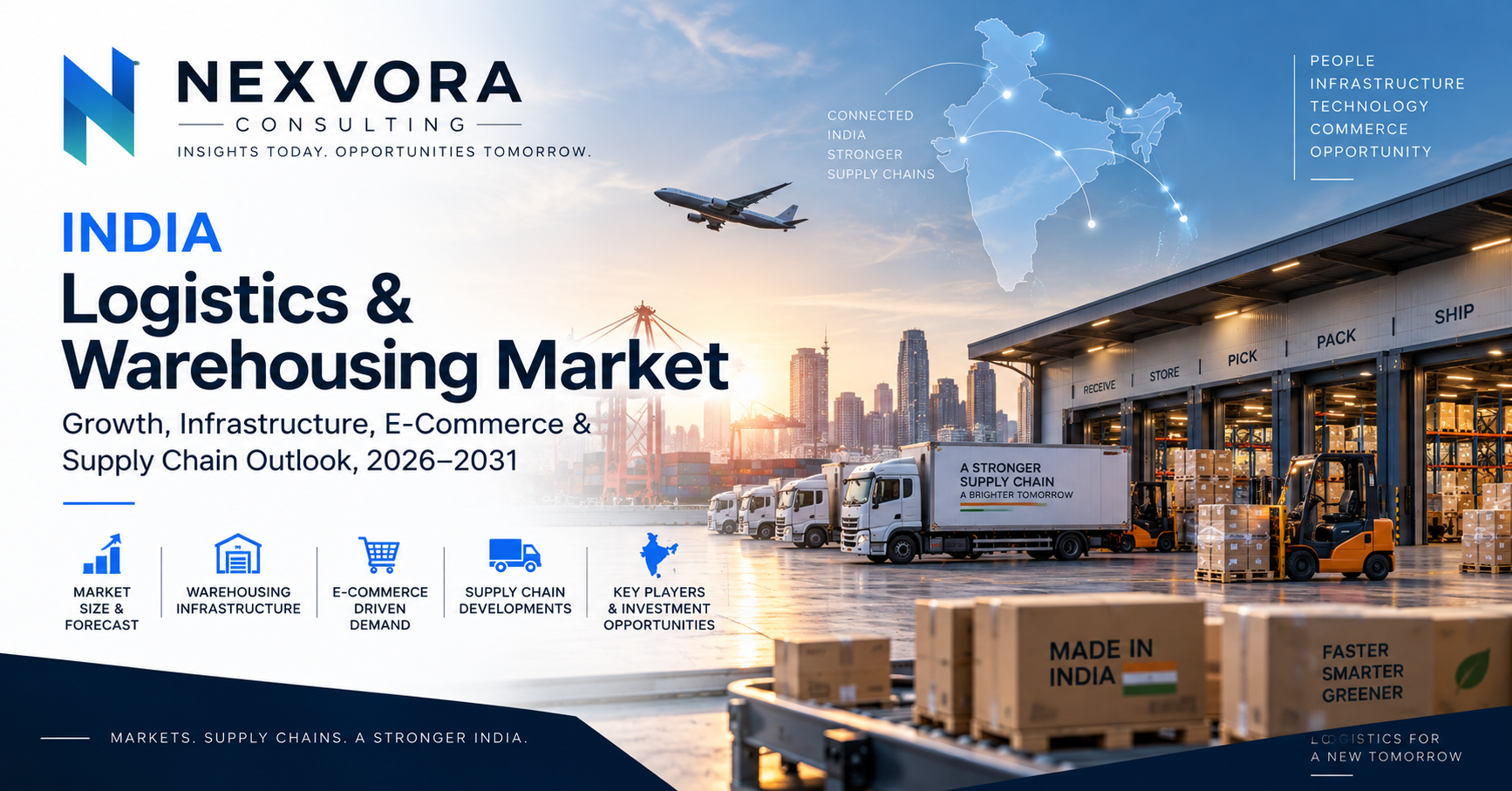
- India's logistics and warehousing market is estimated at US$335–360B in 2026 and projected to reach US$515–570B by 2031, implying an 8.5–10.0% modeled CAGR—one of the fastest growth trajectories among major global logistics markets.
- Organized warehousing is outpacing the broader sector, with Nexvora modeling 10.5–12.5% CAGR as Grade A logistics parks and compliant facilities displace informal storage across major consumption and manufacturing hubs.
- Cold chain logistics is the fastest-growing sub-segment at an estimated 12–15% CAGR, driven by acute underpenetration across food distribution, pharmaceuticals, dairy, seafood, and vaccine supply chains.
- E-commerce, quick commerce, and omnichannel retail are reshaping warehousing geography—placing a premium on urban-adjacent fulfillment infrastructure in the eight major metropolitan markets.
- Manufacturing-linked logistics demand is broadening across automotive, electronics, pharmaceuticals, and food processing, supported by supply chain localization trends and export-oriented production clusters.
- The competitive landscape is bifurcating: scaled integrated logistics providers are gaining ground as institutional customers prioritize national coverage, digital visibility, and compliance—accelerating consolidation across the sector.
A Market at an Inflection Point
India's logistics and warehousing sector has long been characterized by fragmentation, infrastructure deficits, and informality. But Nexvora's assessment points to a decisive turning point: the market, estimated at US$335–360 billion in 2026, is on a trajectory to reach US$515–570 billion by 2031—a modeled CAGR of 8.5–10.0%. This is not incremental expansion. It reflects a fundamental restructuring of how goods move, store, and reach consumers across one of the world's most complex and rapidly urbanizing economies.
Several converging forces explain the acceleration. Government-led infrastructure programs, including dedicated freight corridors, expressway networks, and port modernization initiatives, are compressing transit times and lowering last-mile costs. At the same time, the formalization of trade—driven by GST compliance, regulatory scrutiny, and the demands of institutional customers—is tilting the competitive balance toward organized logistics providers. Nexvora's research suggests that this formalization dynamic alone could shift hundreds of billions of rupees in freight and storage value from informal to organized channels over the forecast period, creating significant opportunity for scaled operators capable of meeting compliance and service-level benchmarks.
What makes the current moment particularly compelling for market participants is that demand is being generated across multiple verticals simultaneously. E-commerce is still in high-growth mode. Manufacturing is resurging. Cold chain infrastructure is being built almost from scratch relative to economic need. And consumer expectations—shaped by urban quick commerce and digital-first retail—are setting new benchmarks for logistics performance that the market must now meet.
Organized Warehousing: The Fastest-Growing Sub-Sector
Within the broader logistics ecosystem, organized warehousing stands out as the segment most likely to deliver outsized returns. Nexvora models organized warehousing growing at 10.5–12.5% CAGR through 2031—meaningfully ahead of the overall market. The shift is being driven by a straightforward but powerful dynamic: as businesses scale, comply with regulations, and serve institutional or export customers, informal storage becomes untenable. Grade A logistics parks—featuring modern racking, fire suppression systems, compliant loading bays, and digital inventory management—are increasingly the baseline expectation rather than a premium option.
Major consumption hubs are seeing the most acute demand pressure. The National Capital Region, Mumbai Metropolitan Region, Bengaluru, Hyderabad, Chennai, Pune, Ahmedabad, and Kolkata are all experiencing elevated demand for high-quality warehousing space, particularly as e-commerce fulfillment networks require proximity to dense urban populations. Nexvora's field intelligence indicates that lease rates in prime logistics corridors around these cities have been rising consistently, and vacancy rates for Grade A assets remain structurally low even as new supply comes online.
The investment landscape is responding. Domestic and international real estate capital is flowing into logistics parks, industrial townships, and multi-user warehousing facilities at a pace that would have seemed implausible a decade ago. Nexvora's assessment is that this supply build-out is necessary but will need to be carefully matched to localized demand patterns—oversupply risks exist in secondary markets where demand catalysts are less established, while core urban corridors are likely to remain supply-constrained well into the forecast period.
Get the full market report — data, forecasts & competitive analysis.
E-Commerce and Quick Commerce: Rewriting Warehousing Geography
No single force has done more to reshape Indian warehousing demand over the past five years than e-commerce, and Nexvora's forward assessment suggests the sector's influence will only intensify through 2031. The growth of online retail—and the newer, more demanding phenomenon of quick commerce, where delivery windows of 10–30 minutes are now consumer expectations in major metros—requires a fundamentally different warehousing footprint than traditional retail distribution. Dark stores, micro-fulfillment centers, and dense urban storage nodes are becoming as strategically important as large regional distribution hubs.
Omnichannel retail is adding another layer of complexity. As traditional retailers integrate their physical and digital channels, their logistics networks must support ship-from-store, buy-online-pick-up-in-store, and centralized return processing simultaneously. This creates demand not just for more space but for smarter space—facilities configured for fast, accurate picking and sorting rather than bulk pallet storage. Nexvora models e-commerce and quick commerce collectively accounting for a disproportionate share of net new warehousing demand through 2031, with demand concentrated in the eight major metropolitan markets mentioned above.
The implication for logistics operators and real estate investors is clear: proximity to urban consumers is now a primary location criterion for warehouse development. The days when logistics facilities were sited purely on land cost and highway access are giving way to a more nuanced calculus that weighs consumer density, delivery time windows, and last-mile network efficiency. Markets that can offer urban-adjacent logistics land with adequate infrastructure connectivity will command increasing premiums over the forecast period.
Manufacturing-Linked Logistics: A Structural Demand Engine
While e-commerce captures the headlines, manufacturing-linked logistics may prove to be the most durable growth driver over Nexvora's five-year forecast horizon. India's manufacturing base is broadening and deepening across automotive, electronics, chemicals, pharmaceuticals, textiles, food processing, and industrial goods. Supply chain localization—the trend toward bringing production closer to end markets—combined with active government incentives for export-oriented manufacturing, is generating sustained demand for inbound raw material logistics, in-plant handling, finished goods distribution, and export freight services.
The automotive sector offers a useful illustration. As electric vehicle production scales alongside traditional internal combustion manufacturing, the supply chain becomes more complex—requiring just-in-time delivery of battery components, temperature-sensitive electronics, and conventional mechanical parts through integrated logistics networks. Similarly, the pharmaceutical sector's growing export orientation demands warehousing that meets international Good Distribution Practice standards, pushing the industry firmly toward organized, compliant logistics providers.
Nexvora's assessment is that manufacturing corridors—particularly those aligned with established industrial clusters in Gujarat, Maharashtra, Tamil Nadu, Karnataka, and Telangana—will see sustained logistics and warehousing investment regardless of short-term demand fluctuations. The long-cycle nature of manufacturing investments means that once production capacity is established, associated logistics infrastructure tends to follow and persist. This makes manufacturing-linked logistics demand more predictable, if less dramatic, than the e-commerce-driven demand surge.
Cold Chain: High Potential, Significant Underpenetration
Cold chain logistics represents arguably the most significant gap between current provision and economic potential in India's logistics sector. Nexvora estimates the cold chain segment could expand at approximately 12–15% CAGR through 2031—the fastest growth of any logistics sub-segment in our coverage. The demand drivers span food distribution (fruits, vegetables, dairy, seafood, meat), pharmaceutical distribution (vaccines, biologics, temperature-sensitive medicines), and specialty retail. India's food system alone generates enormous cold chain demand that current infrastructure is far from meeting.
The underpenetration of cold chain relative to both agricultural output and pharmaceutical production is well-documented. Much of the country's produce spoilage and medicine efficacy risk can be traced to breaks in the cold chain—points where temperature control lapses during transit or storage. Addressing this is not merely a commercial opportunity; it has significant implications for food security, public health, and export competitiveness. As India seeks to expand its agricultural and pharmaceutical exports, meeting international cold chain standards is increasingly a market-access requirement rather than a differentiator.
Nexvora's intelligence suggests that investment is beginning to flow into cold chain infrastructure at a meaningful scale, with integrated logistics providers, specialized cold chain operators, and food processing companies all building or leasing temperature-controlled capacity. However, the geographic distribution of this investment remains uneven—urban markets and coastal hubs are better served, while inland agricultural production zones and Tier 2/3 cities lag significantly. Bridging this gap represents both a challenge and a commercial opportunity for operators willing to invest in underserved markets.
The implication for stakeholders across the value chain is significant. Food retailers, quick commerce platforms, pharmaceutical distributors, and exporters all face increasing pressure to demonstrate cold chain integrity to customers and regulators alike. Those who invest in or partner with compliant cold chain operators now are likely to secure competitive advantages that will be difficult to replicate later as the market matures and prime assets are locked up.
Regional Dynamics: Western and Southern India Lead, Emerging Markets Catch Up
India's logistics geography is not uniform, and Nexvora's regional analysis reveals important distinctions that should inform investment and operational decisions. Western India—anchored by Maharashtra and Gujarat—remains the country's logistics heartland. Mumbai's port infrastructure, JNPT's container throughput, the DMIC industrial corridor, and Gujarat's established export manufacturing base combine to make this region the highest-density logistics market in the country. Maharashtra and Gujarat together account for a disproportionate share of organized warehousing stock and 3PL revenue, and Nexvora expects this leadership to persist through 2031.
Southern India—Karnataka, Tamil Nadu, Telangana, and Andhra Pradesh—is the most dynamic growth region in Nexvora's assessment. Bengaluru's technology-linked consumption economy, Chennai's automotive and electronics manufacturing clusters, Hyderabad's pharmaceutical and technology sectors, and the region's strong port access through Chennai, Krishnapatnam, and Vizag collectively position the South as a logistics growth engine. The concentration of export-oriented industries and the region's relatively advanced infrastructure base make it attractive for both domestic logistics investment and multinational supply chain configuration.
Northern India, led by the National Capital Region, provides unmatched consumption density and proximity to the Indo-Gangetic plain's agricultural and industrial output. The region's logistics infrastructure has historically lagged its economic importance, but dedicated freight corridor investments and expressway development are gradually closing this gap. Eastern India—particularly West Bengal and Odisha—remains underserved relative to its potential, but port development and improving connectivity are creating conditions for logistics investment that Nexvora expects to become more visible toward the latter part of the forecast period.
Competitive Landscape: Consolidation and the Premium on Scale
India's logistics sector has historically been one of the most fragmented in the world, with hundreds of thousands of small trucking operators, regional warehousing providers, and local freight agents competing on price with minimal differentiation. Nexvora's assessment is that this fragmentation is beginning to consolidate in a meaningful way, driven by customer preference for integrated, compliant, digitally visible logistics partners rather than a patchwork of local providers.
Large integrated logistics companies are building national networks that combine freight, warehousing, last-mile delivery, and customs brokerage under single service agreements. This is precisely what institutional customers—large e-commerce platforms, multinational manufacturers, organized retailers, and pharmaceutical companies—increasingly demand. The ability to offer end-to-end visibility across the supply chain, guaranteed service levels, and compliance documentation is becoming a baseline requirement for serving the upper tier of the Indian market. Nexvora's intelligence suggests that customers are demonstrably willing to pay a modest premium for these capabilities over the lowest-cost fragmented alternative.
Consolidation pressures are also being felt at the regional operator level. Smaller logistics companies that have historically served local markets face increasing competition from national players expanding their geographic coverage. Those that can offer genuine local market knowledge, customer relationships, and asset density may find acquisition opportunities or partnership arrangements with larger players. Those that cannot differentiate on either service or cost are likely to face margin compression and eventual market exit. Nexvora expects the number of scaled integrated logistics providers operating nationally to grow, while the long tail of informal operators gradually shrinks as a share of total market value—though not necessarily in absolute number of participants—through 2031.
Get the full market report — data, forecasts & competitive analysis.
Strategic Implications for Market Participants
For logistics operators, the forecast period demands a clear choice between depth and breadth. Operators with the capital and ambition to build national networks should prioritize coverage of the eight major metropolitan markets while establishing footholds in manufacturing corridors before competition intensifies. For those without national scale aspirations, deep specialization—in cold chain, hazardous goods, automotive logistics, or pharmaceutical distribution—offers defensible market positions that larger generalists cannot easily replicate.
For real estate investors and developers, Nexvora's assessment points to sustained demand for Grade A logistics assets in the major metropolitan markets, with particular opportunity in cold storage development where supply gaps are most acute. The risk of oversupply is real in secondary markets, but the structural undersupply of compliant, modern logistics real estate in core urban corridors is likely to persist for several years even under aggressive development scenarios.
For corporate supply chain leaders, the period through 2031 represents an opportunity to lock in competitive logistics infrastructure—through long-term leases, strategic 3PL partnerships, or selective captive investment—before the market tightens further and the best assets and partners are fully committed. Nexvora's broader intelligence work consistently finds that companies that make proactive supply chain infrastructure investments during market expansion phases achieve structural cost and service advantages over those that wait for the market to stabilize. In India's logistics sector, the window for proactive positioning remains open—but it is narrowing.
Frequently asked questions
How large is India's logistics and warehousing market in 2026?
Nexvora estimates India's logistics and warehousing market at US$335–360 billion in 2026, reflecting the sector's scale across road freight, rail, air cargo, coastal shipping, and organized and informal warehousing combined.
What is driving growth in India's warehousing sector?
Growth is being driven by e-commerce and quick commerce fulfillment demand, manufacturing-linked logistics across automotive, electronics, and pharma sectors, cold chain development, and the ongoing shift from informal to organized, Grade A warehousing facilities.
Which regions in India offer the strongest logistics and warehousing investment opportunities?
Western India (Maharashtra and Gujarat) and Southern India (Karnataka, Tamil Nadu, and Telangana) are the leading regions, benefiting from port access, industrial corridors, consumption density, and established third-party logistics ecosystems. The National Capital Region also represents a major demand concentration.
What is the outlook for cold chain logistics in India through 2031?
Nexvora models cold chain logistics expanding at approximately 12–15% CAGR through 2031—the fastest growth of any logistics sub-segment—driven by food distribution, pharmaceutical and vaccine logistics, dairy, and seafood supply chains, all of which face significant infrastructure deficits today.
How is India's logistics competitive landscape changing?
The sector is consolidating as large integrated logistics providers invest in national networks, digital shipment visibility, and compliance capabilities. Institutional customers are prioritizing these attributes over price alone, which is gradually shifting market share from fragmented regional operators toward scaled providers.
India Logistics & Warehousing Market — Intelligence Report
You might also like
Market reports related to this article.