
India's Logistics & Warehousing Sector: The Decade of Structural Transformation
Nexvora Intelligence maps the forces reshaping India's logistics and warehousing market—from cold chain surges to corridor-led demand—through 2031.
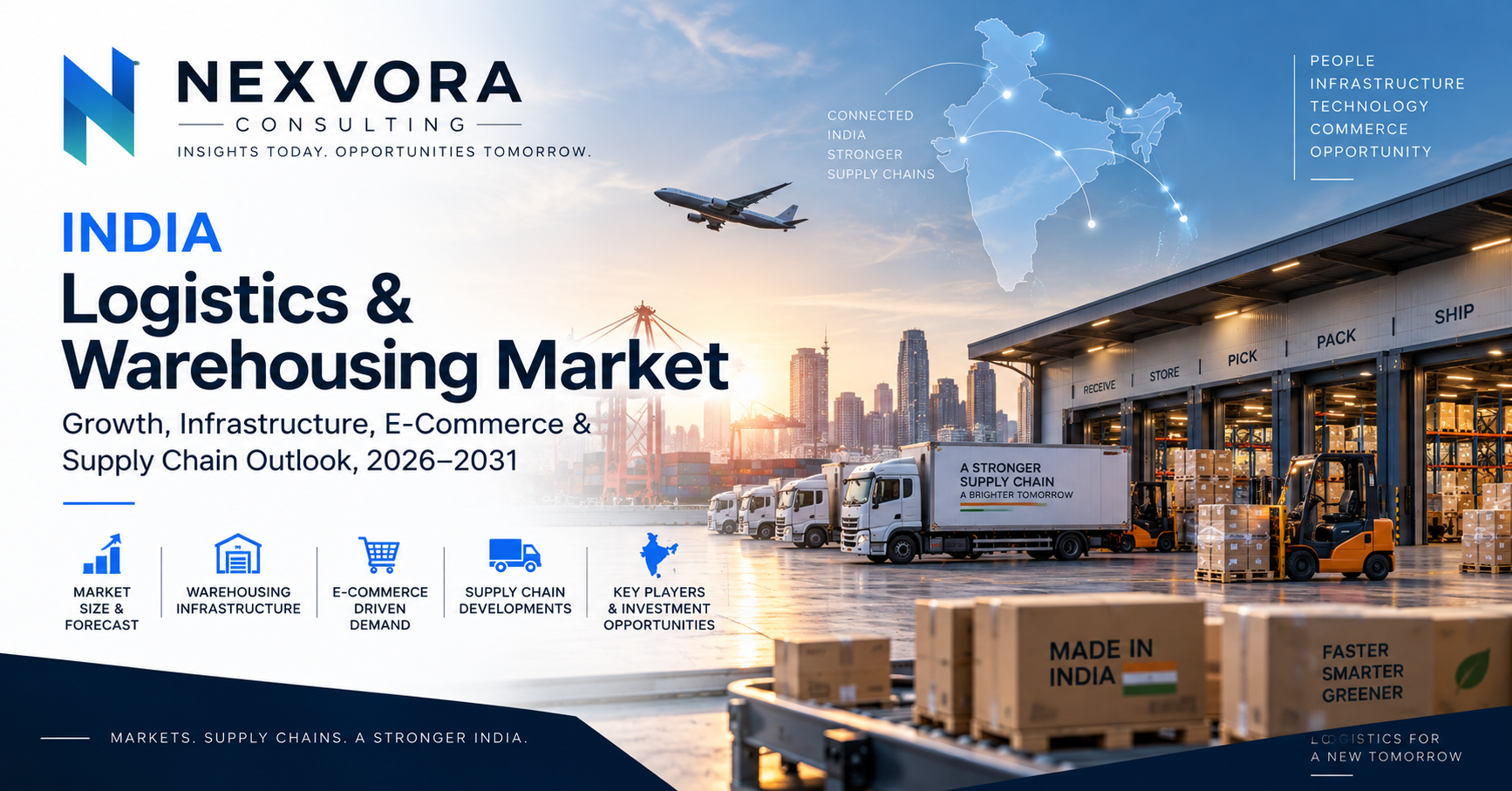
- Nexvora estimates India's logistics and warehousing market at $230–$275 billion in 2026, with a projected CAGR of 10.5%–12.5% pointing to $380–$470 billion by 2031.
- Organized warehousing is the fastest-growing structural segment within the market, modeled at 12%–14% CAGR, as tenants prioritize grade-A compliance and scalability.
- Cold chain and temperature-controlled logistics is the highest-conviction subsegment, with Nexvora modeling 13%–16% CAGR driven by food, pharma, and specialty goods demand.
- Industrial corridor and multimodal node locations will capture a disproportionate share of new capacity absorption—securing corridor-adjacent positions now is a strategic priority.
- Operating cost pressures across land, labor, fuel, and financing act as a structural filter, rewarding operationally disciplined players over volume-only competitors.
- Organized 3PL and integrated supply chain outsourcing will represent a materially larger share of sector value by 2031, creating a consolidation window for well-capitalized operators.
A Market at an Inflection Point
India's logistics and warehousing sector has long been described as a market with enormous latent potential. What makes the current moment different is that the enabling conditions—policy reform, infrastructure investment, and shifting corporate supply chain philosophy—are converging simultaneously. Nexvora Intelligence estimates the market stands at $230–$275 billion in 2026, a figure that reflects both the sheer scale of India's economic throughput and the degree to which organized, productivity-focused logistics remains underpenetrated relative to peer economies. That gap is precisely where the opportunity lives.
The transition is not merely one of volume growth. India's logistics sector is undergoing a structural reorganization—from fragmented, asset-light, and informally operated networks toward consolidated, compliance-oriented, and technologically capable systems. This shift is being driven by a convergence of forces: e-commerce giants demanding fulfillment precision, multinational manufacturers seeking reliable contract supply chains, and institutional capital hunting yield in a sector that is beginning to offer credible risk-adjusted returns. For business leaders evaluating entry, expansion, or partnership decisions in this market, understanding the mechanics of this transformation is as important as sizing the headline opportunity.
What the Growth Numbers Actually Signal
Nexvora's base-to-upside modeling projects a CAGR of 10.5%–12.5% through 2031, implying the market could reach $380–$470 billion by the end of the forecast window. For context, a near-doubling of sector value within six years is not an incremental expansion—it represents a fundamental re-rating of how logistics is priced, procured, and valued in the Indian economy. The midpoint of that range would place India among the most dynamically growing logistics markets globally, measured by absolute value addition.
Importantly, these numbers mask a significant internal divergence. Not all segments of the logistics market will grow at the same pace, and not all operators will capture proportional value. Organized warehousing—purpose-built, grade-A facilities offering modern specifications, fire safety compliance, and scalable configurations—is modeled by Nexvora to grow at 12%–14% CAGR, meaningfully ahead of the overall sector. This premium growth rate reflects a secular migration of tenants away from informal sheds and ungraded storage toward institutionally managed real estate that can support complex fulfillment operations. For investors and developers, the implication is clear: quality assets in the right locations will command sustained leasing demand well beyond the near term.
The sectoral growth story is also inseparable from India's broader macroeconomic trajectory. Rising household incomes, expanding manufacturing capacity under production-linked incentive frameworks, and deepening digital commerce penetration are all feeding incremental freight volumes into a network that is simultaneously being upgraded. Nexvora's assessment is that the growth rate is sustainable rather than cyclical, underpinned by structural demand rather than a single policy tailwind or commodity cycle.
Get the full market report — data, forecasts & competitive analysis.
E-Commerce as the Fulcrum of Warehouse Design Evolution
No single force is reshaping India's warehousing landscape more decisively than the rapid maturation of e-commerce and quick-commerce fulfillment requirements. The expectation of same-day or next-day delivery in Tier-1 cities, and the emerging pressure to replicate those service levels in Tier-2 markets, is fundamentally altering what a warehouse needs to do and where it needs to be located. Traditional godown-model storage, optimized for bulk holding, is giving way to facilities designed around velocity—high-throughput inbound processing, rapid sortation, and outbound dispatch accuracy measured in minutes rather than hours.
This operational shift has profound implications for facility specifications. Nexvora's research identifies a growing tenant preference for higher clear-height buildings that can accommodate multi-level racking, wider column spans to enable flexible floor layouts, dock-door ratios that support simultaneous inbound and outbound flows, and power infrastructure sufficient to run intensive material handling equipment. In practical terms, this means the next generation of Indian warehouse development will look meaningfully different from the stock that dominated the market a decade ago. Developers who recognize this specification shift early and build accordingly will find their assets in structural oversupply relative to tenant demand—while those who continue delivering legacy configurations risk chronic vacancy.
Beyond individual facility design, e-commerce is also driving a rethinking of network topology. Distributed inventory positioning—holding stock closer to the end consumer rather than consolidating at regional hubs—is emerging as a dominant supply chain strategy for high-SKU businesses seeking to compress last-mile delivery windows. This is creating demand for a new layer of smaller, strategically sited fulfillment nodes in urban and peri-urban locations, alongside the large format distribution centers that continue to anchor national networks. The interplay between these two tiers of the logistics network is one of the most complex and consequential dynamics Nexvora is tracking in this market.
Cold Chain: The High-Conviction Subsegment
Among the various specialized subsegments within India's broader logistics landscape, temperature-controlled supply chain infrastructure stands out as the highest-conviction growth opportunity in Nexvora's current assessment. The cold chain segment serves a diverse and expanding set of end markets—processed and fresh food, pharmaceuticals and biologics, dairy, seafood, and increasingly a range of specialty consumer goods with temperature-sensitive packaging requirements. Each of these end markets is growing independently, and their collective demand is creating sustained absorption pressure on a cold chain network that remains severely undersupplied relative to international benchmarks.
Nexvora models the cold chain and temperature-controlled logistics subsegment growing at 13%–16% CAGR through 2031—the fastest of any major subsegment in the broader logistics market. The drivers are partly demand-side: India's organized food retail and quick-service restaurant sectors are expanding rapidly, domestic pharmaceutical manufacturing is scaling up for both domestic consumption and export, and consumer awareness of food safety is gradually shifting procurement toward refrigerated supply chains. But the growth story is equally supply-side: the existing network has significant infrastructure gaps, and new capacity being brought online is consistently absorbed faster than projections suggest, keeping utilization rates elevated and supporting investment economics.
For operators and investors, cold chain logistics in India offers an attractive combination of high growth, relatively disciplined competition, and defensible margins—at least compared to ambient warehousing, where competitive intensity is rising sharply. The technical barriers to entry are real: operating cold storage facilities at scale requires specialized construction, reliable power infrastructure, trained operational staff, and rigorous compliance management. These barriers tend to protect incumbents with genuine operational competence while filtering out undercapitalized entrants. Nexvora's implication for capital allocators is that cold chain assets, particularly in food and pharma corridors, deserve a premium weighting in any Indian logistics portfolio through 2031.
The Geography of New Capacity: Corridors and Multimodal Nodes
Where new logistics capacity is being absorbed is as strategically significant as how much is being added. India's industrial corridor program—linking major manufacturing and consumption centers through planned infrastructure investment—is rapidly becoming the primary geography for large-format warehouse development and leasing activity. Corridor-adjacent locations offer logistics operators a compelling combination: proximity to production facilities, access to national highway infrastructure, connectivity to rail freight terminals, and, in many cases, planned utility and connectivity improvements that reduce operational costs relative to legacy industrial zones.
The West and North India corridor markets are currently leading absorption, with Nexvora identifying these regions as likely to capture a disproportionate share of incremental leasing through the near-to-mid term. The western corridor benefits from proximity to major ports and the manufacturing clusters of Gujarat and Maharashtra, while the northern corridor serves as the supply chain backbone for a consumption belt that spans some of India's most populous states. Southern corridors are also gaining momentum, particularly as electronics and automotive component manufacturing scales up in Tamil Nadu and Karnataka.
Multimodal freight nodes deserve particular attention as a shaping factor in logistics geography. As India's dedicated freight corridor rail infrastructure matures, the economics of rail-road intermodal logistics will improve significantly, making certain inland locations far more competitive for distribution activity than proximity to the nearest highway alone would suggest. Nexvora's assessment is that operators and developers who identify and secure positions at future-oriented multimodal nodes today—before infrastructure completion drives land price appreciation—will enjoy a structural location advantage that compounds over the forecast period.
Operating Cost Pressures: The Constraint That Keeps the Sector Honest
Nexvora's research is deliberate in not presenting India's logistics growth story as frictionless. A set of persistent operating cost pressures—spanning land acquisition, labor markets, fuel pricing, and financing costs—acts as a meaningful brake on margin expansion even as top-line volumes compound. Land values in corridor-adjacent and peri-urban locations are rising as institutional capital and developer interest intensify competition for sites. Labor, while abundant in aggregate, is becoming increasingly scarce in skilled warehousing and logistics operations roles, putting upward pressure on wages in exactly the operational categories that drive service quality.
Fuel costs represent one of the most structurally difficult inputs to manage in a logistics business, given their sensitivity to global commodity markets and domestic tax policy. Indian logistics operators have historically managed this risk through a combination of flexible rate structures and fuel surcharge mechanisms, but customer pressure—particularly from large e-commerce and FMCG accounts with significant negotiating leverage—limits the degree to which cost pass-through is achievable. Financing costs add another layer of constraint, as the capital intensity of grade-A warehousing development requires long-tenor debt that remains comparatively expensive in the Indian market relative to developed economy benchmarks.
The practical implication of these cost pressures is that India's logistics sector rewards operational discipline and scale more heavily than many comparable markets. Companies that can achieve density in specific corridors, manage labor efficiently through strong training and retention programs, and access capital at competitive rates will generate materially superior economics to those that cannot. Nexvora's view is that cost pressure, far from being a deterrent to investment, functions as a structural filter—ensuring that the operators who achieve durable market positions are those with genuine operational competence rather than those simply riding volume growth.
The Organized 3PL and Integrated Supply Chain Opportunity
One of the most consequential medium-term shifts Nexvora's research identifies is the accelerating migration of corporate India toward organized third-party logistics and integrated supply chain management. Historically, many large Indian manufacturers and retailers maintained fragmented, partially in-house logistics operations—a legacy of the era when reliable third-party alternatives were scarce and the informal sector offered cost advantages that offset service quality deficits. That calculus is changing rapidly as the quality and geographic reach of organized 3PL providers improves and as corporate customers recognize that supply chain complexity is a competency drain when managed internally.
By 2031, Nexvora projects that organized 3PL, integrated warehousing, and contract supply chain management will represent a materially larger share of overall sector value than they do today. The drivers of this shift include multinational manufacturers requiring their Indian operations to align with global supply chain governance standards, e-commerce businesses that cannot afford the capital intensity of building proprietary logistics networks, and mid-market companies that increasingly view outsourcing logistics as a strategic rather than merely tactical decision. For 3PL providers with the scale, systems, and network density to absorb this demand, the next five years represent an exceptional window for market share consolidation.
The competitive dynamics within organized 3PL are also evolving. Pan-India scale is increasingly a baseline requirement for winning contracts from large national accounts, as customers demand consistent service levels across geographically dispersed supply chains. This favors well-capitalized, professionally managed operators and creates meaningful headwinds for regional players without the network depth or technology capability to compete at the national level. Nexvora's implication for strategic planners is straightforward: the window for building or acquiring the scale necessary to compete for premium 3PL contracts is finite, and the cost of market entry will rise as consolidation accelerates.
Get the full market report — data, forecasts & competitive analysis.
Strategic Priorities for Market Participants Through 2031
Nexvora's synthesis of the India logistics and warehousing market points toward a set of consistent strategic priorities for different categories of market participant. For real estate developers and institutional investors, the near-term priority is securing corridor-adjacent land positions and delivering grade-A facilities that meet the evolving specification requirements of e-commerce and organized retail tenants. The premium for well-located, high-specification stock will widen relative to second-tier assets as tenant sophistication increases and compliance requirements tighten. Cold chain asset development, particularly in food and pharmaceutical corridors, represents the highest-conviction capital deployment opportunity within the broader sector.
For logistics operators and 3PL providers, the strategic imperative is network densification and service capability investment. Corridor presence, multimodal access, and the ability to offer integrated warehousing and transportation solutions under a single service agreement are increasingly table-stakes for competing in the upper market. Companies that invest in talent development, operational systems, and geographic expansion ahead of demand will find themselves in a structurally advantaged position as the outsourcing wave accelerates. Those that defer investment in favor of protecting short-term margins risk being displaced as the organized segment of the market matures and competitive standards rise.
For corporate supply chain leaders—whether manufacturers, retailers, or e-commerce operators—the central question is how to build logistics networks that are simultaneously cost-efficient, scalable, and resilient. Nexvora's assessment is that the answers to that question in India increasingly point toward fewer, deeper partnerships with organized 3PL providers rather than the fragmented multi-vendor arrangements that characterized previous supply chain strategies. The complexity and velocity of modern Indian consumer markets demand supply chain partners with genuine operational depth, and identifying and committing to those partners early will be a source of competitive advantage through the forecast period.
Frequently asked questions
How large is India's logistics and warehousing market in 2026?
Nexvora Intelligence estimates the India logistics and warehousing market at $230–$275 billion in 2026, reflecting a large but still underpenetrated base with significant room for productivity-driven expansion.
What is driving growth in India's warehousing sector?
Key growth drivers include e-commerce fulfillment demand reshaping facility design, industrial corridor infrastructure development, rising 3PL outsourcing by corporates, and rapid expansion of cold chain requirements across food and pharmaceutical sectors.
Which logistics subsegment in India offers the highest growth potential?
Nexvora's research identifies cold chain and temperature-controlled logistics as the highest-growth subsegment, modeled at 13%–16% CAGR through 2031, driven by food, pharma, and specialty goods supply chain requirements.
Which regions in India are leading logistics and warehousing demand?
West and North India corridor markets are currently leading capacity absorption, with corridor-adjacent and multimodal node locations expected to capture a disproportionate share of new leasing activity through 2031.
What are the biggest risks or constraints in India's logistics market?
Operating cost pressures—including rising land values in corridor locations, skilled labor scarcity, fuel price volatility, and relatively high financing costs—remain the primary constraints on margin expansion even as volumes grow strongly.
India Logistics & Warehousing Market — Intelligence Report
You might also like
Market reports related to this article.