
India's Logistics and Warehousing Sector: The Infrastructure-Led Growth Story Reshaping South Asia's Supply Chains
India's logistics and warehousing market is on a structural growth trajectory, driven by e-commerce demand, cold chain expansion, and organized infrastructure investment through 2031.
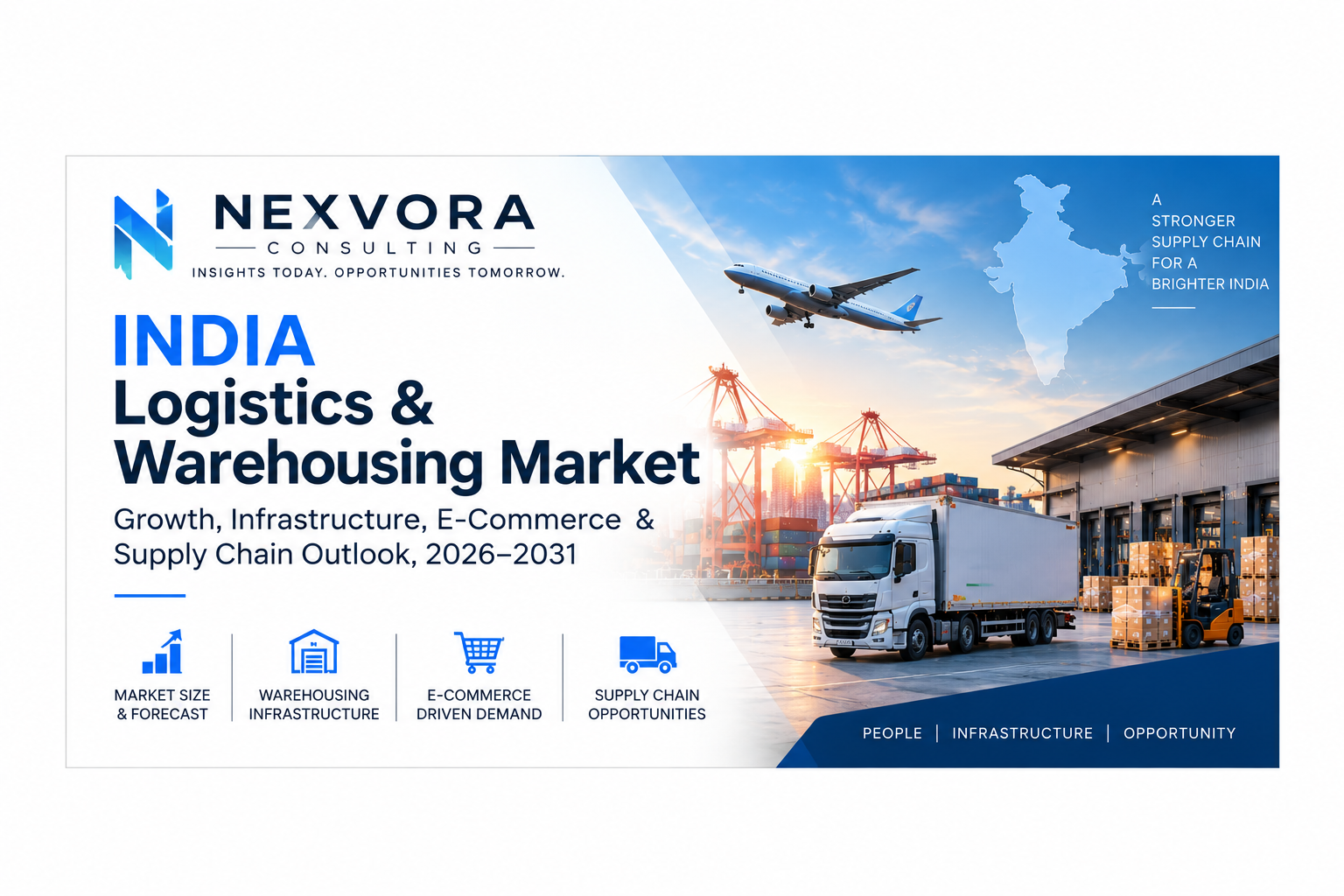
- India's logistics and warehousing market is modeled by Nexvora at US$335–360B in 2026, growing to US$515–570B by 2031 at an estimated 8.5–10.0% CAGR.
- Organized warehousing is the fastest-growing segment, with Nexvora modeling 10.5–12.5% CAGR as Grade A logistics parks displace informal storage infrastructure.
- Cold chain logistics is the highest-growth sub-segment at a modeled 12–15% CAGR, driven by food distribution, pharmaceuticals, vaccines, and specialty retail demand.
- E-commerce, quick commerce, and omnichannel retail will account for a disproportionate share of incremental warehousing demand, reshaping spatial and operational requirements.
- The competitive landscape is consolidating around scaled integrated 3PLs; customers' rising standards for coverage, compliance, and digital visibility are accelerating the bifurcation.
- Western and Southern India — Maharashtra, Gujarat, Karnataka, Tamil Nadu, and Telangana — remain the leading logistics regions, supported by port access, industrial density, and 3PL ecosystems.
A Market at an Inflection Point
India's logistics and warehousing sector is entering a period of structural transformation that goes well beyond cyclical economic expansion. Nexvora's assessment places the market at approximately US$335–360 billion in 2026, with a modeled trajectory toward US$515–570 billion by 2031 — implying a compound annual growth rate of 8.5–10.0% over the forecast period. These are not incremental gains. They reflect a fundamental reordering of how goods are stored, moved, tracked, and delivered across one of the world's most complex geographic and demographic landscapes.
What makes this moment particularly significant is the convergence of several structural forces — all arriving simultaneously. India's manufacturing base is deepening, its consumer economy is expanding into Tier II and Tier III cities, its regulatory environment is increasingly rewarding organized operators, and its physical infrastructure is being upgraded at a pace unseen in prior decades. The Goods and Services Tax regime has already rationalized warehousing geography by reducing the incentive to fragment inventory across state lines for tax purposes. The result is a sector where scale, compliance, and digital visibility are becoming genuine competitive differentiators rather than aspirational qualities.
For business leaders evaluating India as a supply chain hub, a manufacturing location, or a consumption market, understanding the structural mechanics of this logistics evolution is no longer optional. It is foundational to every operational, financial, and strategic decision made in the region over the next five years.
Organized Warehousing: The Fastest-Moving Segment
Among the many segments within India's logistics ecosystem, organized warehousing stands out as the highest-conviction growth story in Nexvora's modeled framework. Nexvora estimates organized warehousing will expand at a 10.5–12.5% CAGR through 2031 — meaningfully ahead of the broader market — as Grade A logistics parks, modern fulfillment centers, and compliant multi-user facilities steadily displace informal and substandard storage infrastructure that has historically dominated the sector.
The drivers of this shift are structural and reinforcing. Large e-commerce operators, third-party logistics providers (3PLs), and multinational manufacturers increasingly require warehousing that meets specific specifications: clear heights above 10 meters, high floor-load ratings, dock-levelers, fire suppression systems, and digital inventory management compatibility. Informal godowns simply cannot meet these requirements, and as customers raise their compliance standards, the market is progressively routing capital and tenancy toward Grade A supply.
Developer appetite is responding in kind. Industrial and logistics real estate developers — both domestic and international — have significantly increased their land acquisition and construction pipelines in the National Capital Region, Mumbai Metropolitan Region, Bengaluru, Hyderabad, Pune, Chennai, Ahmedabad, and Kolkata. Nexvora's analysis identifies these eight metropolitan nodes as the epicenters of warehousing absorption over the forecast period, with secondary demand building in Lucknow, Jaipur, Coimbatore, Nagpur, and Guwahati as logistics networks mature and consumption corridors expand inland.
The implication for investors and occupiers is clear: the premium attached to compliant, well-located Grade A space is likely to widen rather than compress over the next five years, as supply continues to chase structurally accelerating demand across nearly every cargo category.
Get the full market report — data, forecasts & competitive analysis.
E-Commerce, Quick Commerce, and the Omnichannel Demand Engine
No single demand driver has reshaped India's warehousing geography more decisively than the rise of e-commerce — and the segment's evolution toward quick commerce and omnichannel retail is adding further complexity to the spatial and operational requirements placed on logistics networks. Nexvora's assessment indicates that e-commerce, quick commerce, and omnichannel retail will account for a disproportionate share of incremental warehousing demand through 2031, both in terms of gross square footage leased and in terms of the operational sophistication required from facility operators.
Quick commerce — the sub-30-minute or sub-60-minute delivery model pioneered by dark store networks in urban India — is particularly consequential for logistics infrastructure. It requires dense networks of small-format fulfillment nodes embedded within city limits rather than on peripheral logistics parks. This is driving a new category of urban warehousing demand that sits at the intersection of real estate, last-mile logistics, and retail operations. The economics of this model are still being stress-tested at scale, but its trajectory toward mainstream adoption in India's top metropolitan markets is increasingly difficult to dispute.
Omnichannel retail — where established brick-and-mortar retailers integrate online ordering, store-based fulfillment, and regional distribution — is adding a further layer of demand for flexible, multi-purpose warehousing. Retailers that previously managed inventory through a network of regional wholesalers and distributors are now building centralized and regionally distributed warehousing capacity to serve both their physical stores and digital channels from a unified inventory pool. This structural shift in how Indian retail manages its supply chain is a multi-year tailwind for organized warehousing operators, fulfillment service providers, and logistics technology vendors alike.
Road Freight Evolution and the Multimodal Opportunity
Road freight will remain the dominant logistics mode in India through 2031 — this is a reality embedded in the geography, the existing asset base, and the nature of India's consumption distribution. However, Nexvora's assessment identifies a meaningful evolution in the composition and quality of road freight over the forecast period, driven by network effects, regulatory pressure, and the entry of digitally enabled freight platforms that are bringing transparency and efficiency to a historically fragmented market.
The long-haul full-truckload segment is being reshaped by digital freight brokerages that match shipper demand with truck capacity in real time, reducing empty-run rates and improving asset utilization for truck operators. At the same time, express surface networks — operated by integrated logistics providers — are capturing share in time-sensitive, lighter-weight cargo flows, competing with air freight on cost and with traditional surface transport on speed and reliability.
Perhaps the most significant structural shift at the urban delivery layer is the gradual emergence of electric vehicle-enabled last-mile fleets. As Indian cities tighten restrictions on diesel vehicles in urban cores and as the economics of electric two-wheelers and three-wheelers improve, the unit economics of urban delivery are being recalculated. Nexvora's modeled view is that EV-enabled last-mile delivery will move from a niche operational experiment to a mainstream urban logistics model in India's largest cities within the forecast window, with meaningful implications for logistics operators, fleet owners, and fuel infrastructure providers.
Complementing the road network is India's expanding multimodal infrastructure — dedicated freight corridors, inland container depots, and port-hinterland connectivity projects that are progressively reducing transit times and improving reliability on major trade lanes. Western and Southern India are best positioned to benefit from these investments, with Maharashtra, Gujarat, Karnataka, Tamil Nadu, and Telangana anchoring the most mature and well-connected logistics ecosystems in the country.
Cold Chain Logistics: Underpenetrated and Accelerating
Cold chain logistics occupies a unique position in Nexvora's India logistics framework: it is simultaneously one of the most underpenetrated segments relative to its demand potential and one of the fastest-growing. Nexvora models cold chain logistics expanding at approximately 12–15% CAGR through 2031, making it the highest-growth sub-segment within the broader logistics market and a strategic priority for both operators and infrastructure investors.
The demand case for cold chain investment in India is compelling across multiple verticals. In food distribution, the losses attributable to inadequate temperature-controlled storage and transport infrastructure represent both an economic problem and a food security concern that the government and private sector are jointly motivated to address. Dairy, seafood, fresh produce, and processed foods all require cold chain infrastructure that India has historically underbuilt relative to the scale of production and consumption. Nexvora's assessment is that as organized food retail and quick commerce expand their penetration of the fresh and perishables category, the pressure on cold chain capacity will intensify substantially.
Pharmaceutical and healthcare logistics represent a separate but equally urgent demand driver. India's position as a global generics manufacturing hub, combined with expanding domestic healthcare coverage and the logistical lessons drawn from vaccine distribution challenges, has elevated cold chain compliance from a regulatory checkbox to a genuine operational priority for pharmaceutical companies, hospital networks, and public health administrators. Specialized cold chain operators with validated temperature monitoring, GDP-compliant facilities, and nationwide coverage are increasingly positioned as essential infrastructure partners rather than commodity service providers.
The investment gap in cold chain infrastructure also represents an opportunity for domestic and international capital. Land, construction, refrigeration equipment, and technology for cold chain facilities in India remain attractively priced relative to developed markets, while the return profile — anchored by long-term leases from food, pharma, and retail tenants — is structurally de-risked by the demand dynamics described above.
Manufacturing-Linked Logistics: Riding the Localization Wave
Beyond consumer-facing logistics demand, India's manufacturing sector is generating a parallel and significant expansion in industrial logistics requirements. Nexvora's analysis highlights automotive, electronics, chemicals, pharmaceuticals, textiles, food processing, and industrial goods as the primary manufacturing verticals driving logistics demand through 2031, with supply chain localization and export-oriented production clusters emerging as the structural force behind much of this growth.
India's government has pursued a deliberate policy of import substitution and export promotion across several critical manufacturing sectors through Production Linked Incentive schemes and industrial corridor development. The practical logistics implication of these policies is the emergence of new industrial production clusters — in Gujarat, Rajasthan, Andhra Pradesh, Tamil Nadu, and Uttar Pradesh, among others — that require supporting logistics ecosystems: inbound raw material flows, inter-plant transfer networks, finished goods distribution, and export-oriented freight management to major ports.
For logistics service providers, manufacturing-linked demand is qualitatively different from e-commerce demand. It tends to favor predictable, high-volume, long-term contract structures over the more variable and seasonally skewed demand profile of consumer logistics. It also places a premium on sector-specific capabilities — temperature control for pharma, hazardous materials handling for chemicals, just-in-time sequencing for automotive — creating differentiation opportunities for specialized 3PLs with deep vertical expertise. Nexvora's assessment is that the 3PL sector in India will continue to grow its penetration of manufacturing-linked logistics as large industrial customers prioritize outsourcing non-core supply chain functions to focus capital on production.
Competitive Dynamics: Consolidation and the Scale Imperative
India's logistics sector has historically been characterized by extreme fragmentation — tens of thousands of small trucking operators, local warehouse operators, and regional freight forwarders operating with limited technology, narrow geographic reach, and inconsistent service quality. This fragmentation is not disappearing overnight, but Nexvora's competitive landscape assessment identifies a clear bifurcation emerging between scaled integrated logistics providers and the fragmented regional operators that continue to serve lower-complexity cargo flows.
The consolidation thesis is grounded in customer behavior rather than financial engineering. As Indian manufacturers, retailers, and e-commerce operators scale their businesses and deepen their supply chain complexity, their tolerance for fragmented, multi-vendor logistics arrangements diminishes. They increasingly seek providers that can offer national coverage, consistent service levels, digital shipment visibility, compliance documentation, and a single commercial relationship. This demand profile systematically advantages larger, better-capitalized operators with diversified service portfolios over smaller specialists with limited geographic or modal reach.
Private equity capital has recognized this dynamic and has been actively consolidating logistics assets in India through direct investments, platform-building acquisitions, and backing of technology-enabled logistics companies. The result is an accelerating pace of mergers, acquisitions, and organic scale-building among the leading integrated 3PLs, express networks, and warehousing operators. Nexvora's view is that this consolidation trend has meaningful runway remaining — the logistics sector in India remains significantly less concentrated than comparable markets in Southeast Asia, China, or Europe — and that the next five years will substantially reshape the competitive hierarchy.
Get the full market report — data, forecasts & competitive analysis.
Regional Spotlight: Western and Southern India's Logistics Leadership
Geography and industrial history have endowed Western and Southern India with structural logistics advantages that Nexvora expects to persist and deepen through 2031. Maharashtra and Gujarat together anchor India's most mature logistics ecosystem, combining port access through Nhava Sheva, Mundra, and Pipavav; industrial density from automotive, chemicals, pharmaceuticals, and textiles clusters; and a well-developed 3PL ecosystem with national reach. The Dedicated Freight Corridor connecting these Western nodes to Northern industrial heartlands further amplifies their logistics centrality.
Southern India — led by Karnataka, Tamil Nadu, and Telangana — brings a complementary set of logistics advantages: deep manufacturing bases in electronics, automotive components, and aerospace; major export-oriented IT and industrial parks requiring sophisticated inbound and outbound supply chains; and consumption markets in Bengaluru, Chennai, and Hyderabad that rank among India's most active warehousing absorption centers. The port infrastructure at Chennai, Krishnapatnam, and Kochi provides critical export connectivity for Southern manufacturing clusters.
Implication for market participants: capital allocation decisions in India's logistics sector should weight Western and Southern regions heavily in the near term, while maintaining optionality in Northern India's National Capital Region and emerging Eastern India corridors — particularly as Dedicated Freight Corridor connectivity matures and consumption penetration deepens in underserved inland markets. A regionally balanced perspective, grounded in corridor-specific demand analysis, is essential to positioning effectively in what Nexvora assesses as one of Asia's most consequential logistics investment stories of this decade.
Frequently asked questions
How large is India's logistics and warehousing market in 2026?
Based on Nexvora's modeled estimates, India's logistics and warehousing market is valued at approximately US$335–360 billion in 2026, with a projected trajectory to US$515–570 billion by 2031 at an 8.5–10.0% CAGR.
Which segment is growing fastest within India's logistics sector?
Cold chain logistics and organized warehousing are the fastest-growing segments. Nexvora models cold chain at approximately 12–15% CAGR and organized warehousing at 10.5–12.5% CAGR through 2031 — both well ahead of the broader market average.
How is e-commerce affecting warehousing demand in India?
E-commerce, quick commerce, and omnichannel retail are generating disproportionate warehousing demand, particularly in major metro markets including the NCR, Mumbai, Bengaluru, Hyderabad, Chennai, Pune, Ahmedabad, and Kolkata. These channels are also raising the specification and technology requirements for modern fulfillment infrastructure.
Which regions in India have the most developed logistics ecosystems?
Western and Southern India lead in logistics maturity. Maharashtra, Gujarat, Karnataka, Tamil Nadu, and Telangana benefit from port access, industrial corridors, high consumption density, and established 3PL operator networks — making them the primary targets for logistics real estate and service investment.
Is India's logistics market consolidating or remaining fragmented?
The market is bifurcating. While small regional operators persist in lower-complexity segments, customers with national supply chains increasingly require integrated 3PL providers offering full coverage, digital visibility, and compliance capabilities. Nexvora expects meaningful consolidation among mid-to-large operators through 2031.
India Logistics & Warehousing Market — Intelligence Report
You might also like
Market reports related to this article.